Turn translation & captions into revenue with Sponsor Logos → Learn More
Offer floor audio without equipment rental with Silent Theater → Learn More
See how two national organizations in the legal and association sectors use Wordly to deliver live translation and captions, with a custom glossary that keeps even complex legal terms precise
Even fluent bilingual professionals can miss details when they listen in their non-primary language, especially during fast-paced or technical discussions, and in high-stakes settings that gap carries real risk. That is why two national Canadian organizations, the Canadian Superior Courts Judges Association (CSCJA) and the Canadian Society of Association Executives (CSAE), made thorough bilingual and multilingual communication a priority. Both are connected through Stephanie Lockhart, who serves as Executive Director of CSCJA and as Special Events Producer for CSAE, giving her a unique view of the shared communication and inclusion challenges across the legal and association sectors.
CSCJA represents federally appointed judges from every province and territory in Canada's superior courts. With the legal profession at the core of their work, clarity and precision are non-negotiable. While most members are bilingual, relying solely on verbal delivery in English or French risks having important details misunderstood or overlooked when participants are listening in their non-primary language. In these high-stakes environments, interpretation becomes critical to ensuring no nuance is lost and all members stay fully informed.
CSAE represents leaders and staff from hundreds of associations, charities, and nonprofits across sectors such as healthcare, education, professional licensing, and economic development. With such a diverse member base, clear and inclusive communication is essential. Many members are bilingual in English and French, but these may not be their first languages, and the challenge grows when engaging audiences who also speak Mandarin, Punjabi, Arabic, Tagalog, and Spanish, which are common across Canada's multicultural population. Accessibility is another driving force, creating an inclusive space for everyone, including those who are hard of hearing or part of the neurodiverse community.
Both organizations needed a reliable, scalable solution to support their multilingual audiences and eliminate language barriers, without the cost or logistical complexity of traditional interpreters.
Yes. Canada's Superior Court Judges rely on Wordly's real-time AI translation, which speaks to the accuracy and precision the platform delivers even for the country's most discerning legal audiences. A key reason is the built-in custom glossary, which lets CSCJA upload acronyms, speaker names, and key legal terms from past meetings to ensure consistent, accurate interpretation of complex judicial vocabulary, a critical capability where absolute clarity is required.
"What impressed us most was the ability to upload key legal terms to Wordly's glossary," said Stephanie Lockhart, Executive Director of CSCJA. "The live captions and downloadable transcripts and summaries add a layer of value for accessibility and meeting notes/minutes."
For CSCJA, which began using Wordly more than three years ago, the first use case was small: executive meetings with just six judges. The stakes were high in making sure every member fully understood discussions and decisions. The association had previously hired interpreters even for these small gatherings, not out of necessity but as reassurance for bilingual members, which carried a high cost and logistical burden. With Wordly, CSCJA kept that safety net without the expense or scheduling hassle, and has since expanded to board meetings and even an international delegation tour of Toronto courts.
"We started using Wordly for our executive meetings with just six people, not because anyone demanded it, but because the stakes were high and we wanted to ensure every word was heard," said Lockhart. "Even bilingual members can miss something, and all members should be able to engage and understand fully, in their language of choice."
Meanwhile, CSAE used Wordly to support its flagship international conference, drawing 500 to 600 attendees over 2.5 days. While most of the audience was Anglophone, many were bilingual and some sessions included French delivery. Wordly enabled the organization to offer inclusive real-time translation and live captioning that catered to different learning styles and hearing needs in an affordable way, ensuring no participant was left behind.
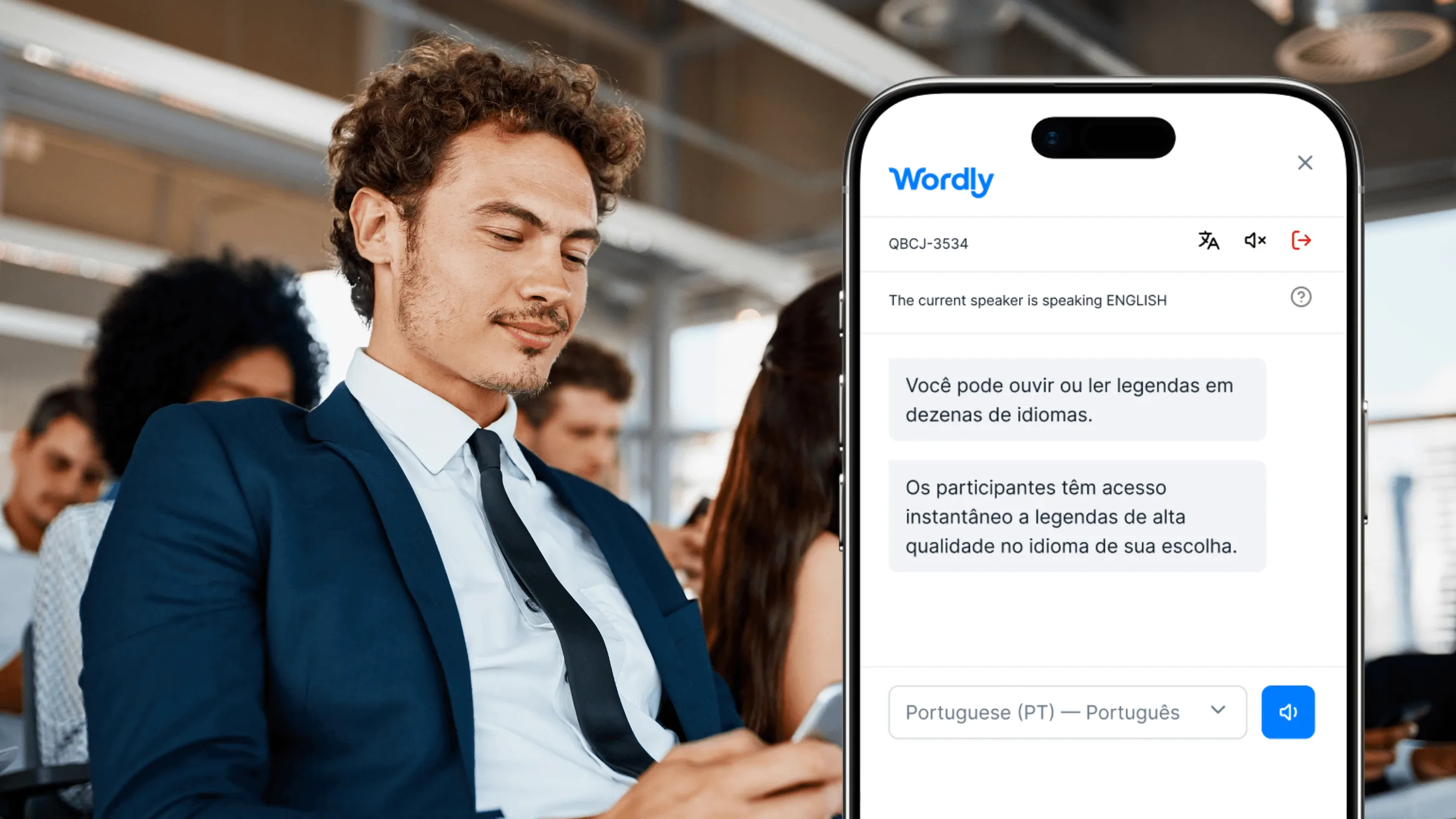
For both organizations, AI translation proved that language inclusion doesn’t have to be expensive or complicated. The fact that Canada’s Superior Judges now rely on live translation from Wordly speaks volumes about its credibility and precision.
CSCJA now relies on the platform as a strategic tool for accessibility, especially in smaller meetings, where traditional interpretation wouldn’t be cost-effective. But even in those settings, clarity remains critical. Board members and judges benefit from uninterrupted discussions, knowing the AI translation is available as a backup when they need it.
CSAE reported strong engagement across both language groups at their conference and highlighted how Wordly helped maintain a welcoming, bilingual experience for all participants. The ease of setup, no equipment or tech headaches, and ability to scale from a handful of attendees to hundreds, made it an ideal fit for both internal meetings and large events.
“With Wordly, we have real-time interpretation that’s always ready, always accurate, and never disruptive.” stated Lockhart.
Looking ahead, both CSCJA and CSAE are in a position to explore expanded use of Wordly to support hybrid meetings, virtual training, and multilingual public outreach. With AI translation now seen as a core communication tool, not just a fallback, these organizations are leading by example in showing how innovative, inclusive, and cost-conscious solutions can enhance professional dialogue and civic engagement.
Their success hasn’t gone unnoticed. Other Canadian organizations, including legal bodies, nonprofits, and professional associations, are now considering Wordly for their own meetings and events, inspired by the seamless integration and impact seen at CSCJA and CSAE.
As Lockhart puts it: "We’re no longer choosing between cost and quality, we’re getting both."
The Canadian Superior Courts Judges Association represents approximately 1,400 sitting and retired judges across Canada’s superior trial and appellate courts, including the Federal Court, Federal Court of Appeal, and Tax Court. Committed to upholding judicial independence and excellence in administration, CSCJA provides professional development, promotes public understanding of the judiciary, and collaborates with leading legal bodies such as the Canadian Judicial Council and the Canadian Bar Association.

CSAE is the national professional body for association executives and staff, serving hundreds of not-for-profit organizations across sectors including healthcare, education, licensing, and economic development. Offering education, peer networking, and industry research, CSAE empowers association professionals to build more effective and inclusive organizations. With members across all provinces and territories, CSAE champions innovation and leadership across Canada’s association landscape.
Wordly is the pioneer and leader in live interpretation, providing a high-quality, secure, easy-to-use, and affordable live AI translation and caption solution for communicating across multiple languages. Wordly translates dozens of languages in real time, making in-person and virtual meetings and events more inclusive, accessible, and engaging.
Its SaaS platform meets enterprise-grade security and privacy standards and eliminates the need for human interpreters or special equipment. Millions of users across thousands of organizations rely on Wordly to make their events and meetings accessible to everyone.
See it in action – book a personalized demo.
The CSCJA and CSAE turned to Wordly to address Canada’s bilingual and multilingual challenges. Both needed a reliable, cost-effective way to provide real-time translation and captions. Learn how Wordly delivered instant translation in dozens of languages, supported legal precision with a custom glossary, and ensured every participant could engage.
Download Case Study.avif)
.png)