Turn translation & captions into revenue with Sponsor Logos → Learn More
Offer floor audio without equipment rental with Silent Theater → Learn More
Published June 2024 | Second Annual Edition | Conducted by Dimensional Research
How event planners are using live AI translation and captions to reach multilingual audiences
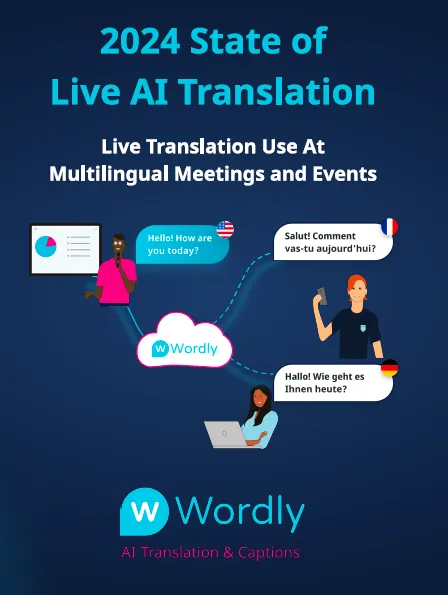
Wordly's 2024 State of AI Translation & Captions report surveyed 205 meeting and event professionals in the US and UK about live translation and captioning. The 2024 study found that 79% see a rising number of attendees whose first language is not English, 97% say increasing inclusivity at their events is a priority, and demand for live translation is climbing across the board. Most planners now have hands-on experience with AI translation, and 85% believe it delivers a higher return on investment than human interpreters. This page summarizes the full findings and what they mean for anyone planning multilingual meetings and events.
Audiences at meetings and events are more global than ever. A product launch, a sales kickoff, an industry conference, or an all-hands meeting can easily draw attendees who speak several different languages, and the language on stage is often not the one each attendee would choose. When people cannot fully follow what is being said, engagement, comprehension, and inclusion all drop. The research behind this report set out to measure how event teams are responding, what is working, and how AI is reshaping the options available to them.
The headline is that demand is rising fast and attitudes have shifted. Event professionals overwhelmingly agree that letting everyone participate in their preferred language produces better outcomes, most are already offering live translation or live captioning, and the majority have moved from curiosity about AI to active use. The sections below walk through the data in detail.
Wordly commissioned Dimensional Research, an independent market research firm, to conduct the study. Stakeholders for meetings and events were invited to complete an online survey. In total, 205 qualified participants completed it.
Every respondent had responsibility for events with more than 100 attendees where at least 10% of participants did not speak English as a first language. The survey was split evenly between the US and UK (103 and 102 respondents) and spanned a wide range of industries, including technology, business services, manufacturing, retail, financial services, and healthcare, as well as companies of every size from under 500 employees to more than 10,000. Most respondents worked in marketing (48%) or sales (37%), and nearly all were managers or executives.
One screening detail is worth highlighting. During recruitment, fewer than 10% of potential respondents were screened out for not meeting the multilingual criteria, which suggests that the majority of events with more than 100 attendees already include at least 10% of people whose first language is not English.
Note that due to rounding, some figures may not total exactly 100%.
Demand is rising on every measure the study tracked. A large majority of event professionals (79%) report that the number of attendees who do not speak English as a first language is increasing, while only about 6% see any decline. The need is not occasional either: 88% say two or more non-English languages are spoken across attendees at a typical event, 40% report six or more, and 20% report eleven or more. More than half (53%) say at least a quarter of their attendees are not first-language English speakers.
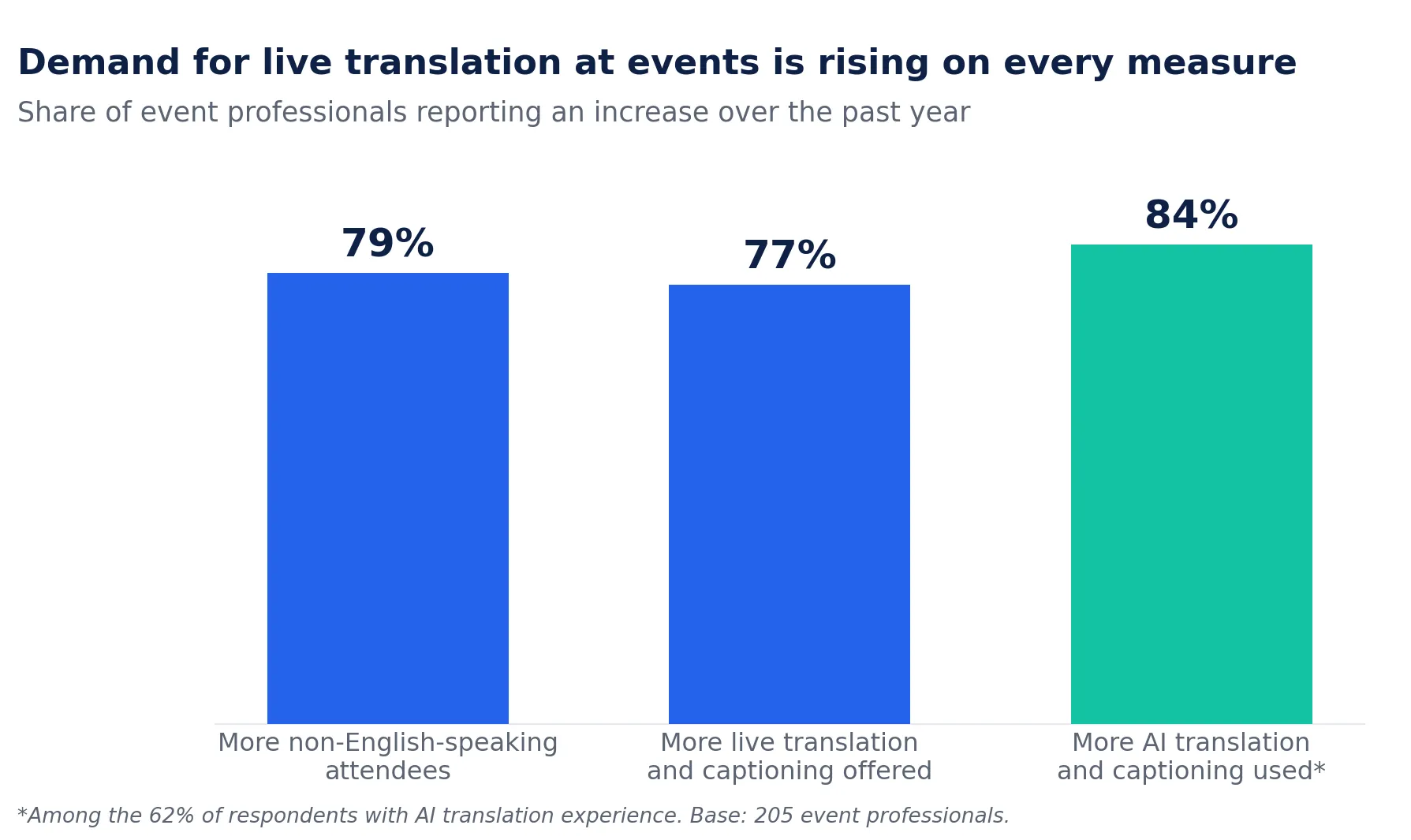
The response is rising in step with the need. More than three-quarters of planners (77%) say they are increasing how often they offer live translation or captioning, and among those who already use AI translation, 84% report increasing their use of it over the past year. Put simply, more multilingual attendees are showing up, and event teams are expanding language support to meet them.
Event professionals are nearly unanimous that language inclusivity is both important and effective. A striking 97% agree that increasing inclusivity and accessibility at their events is a priority, and 94% agree that meetings and events where everyone can participate in their preferred language deliver better outcomes. This is no longer a fringe consideration. It is a mainstream expectation of how good events are run.
At the same time, planners recognize a blind spot. Nearly four in five (79%) agree that first-language English speakers do not adequately think about the language experience of attendees whose first language is not English when planning events. That gap between intention and attention is exactly where deliberate language support, and the right technology, can make the biggest difference.
Live translation is already common practice. A majority of respondents (58%) say they have significant experience offering interpretation or translation services at their events, and 69% offer interpretation or captioning regularly, including 27% who always offer it. Far from being an experimental add-on, language support has become a standard part of how many teams run multilingual meetings and events.
That said, frequency varies, and plenty of planners want to do more than they currently can. The same study that shows widespread adoption also shows widespread friction, which is the subject of the barriers section below. First, it helps to understand why planners invest in translation in the first place.
Event professionals see clear, measurable value in language support. Almost all of them (98%) believe offering live translation and AI captioning increases the return on investment of their events. The benefits they point to are both experiential and commercial.
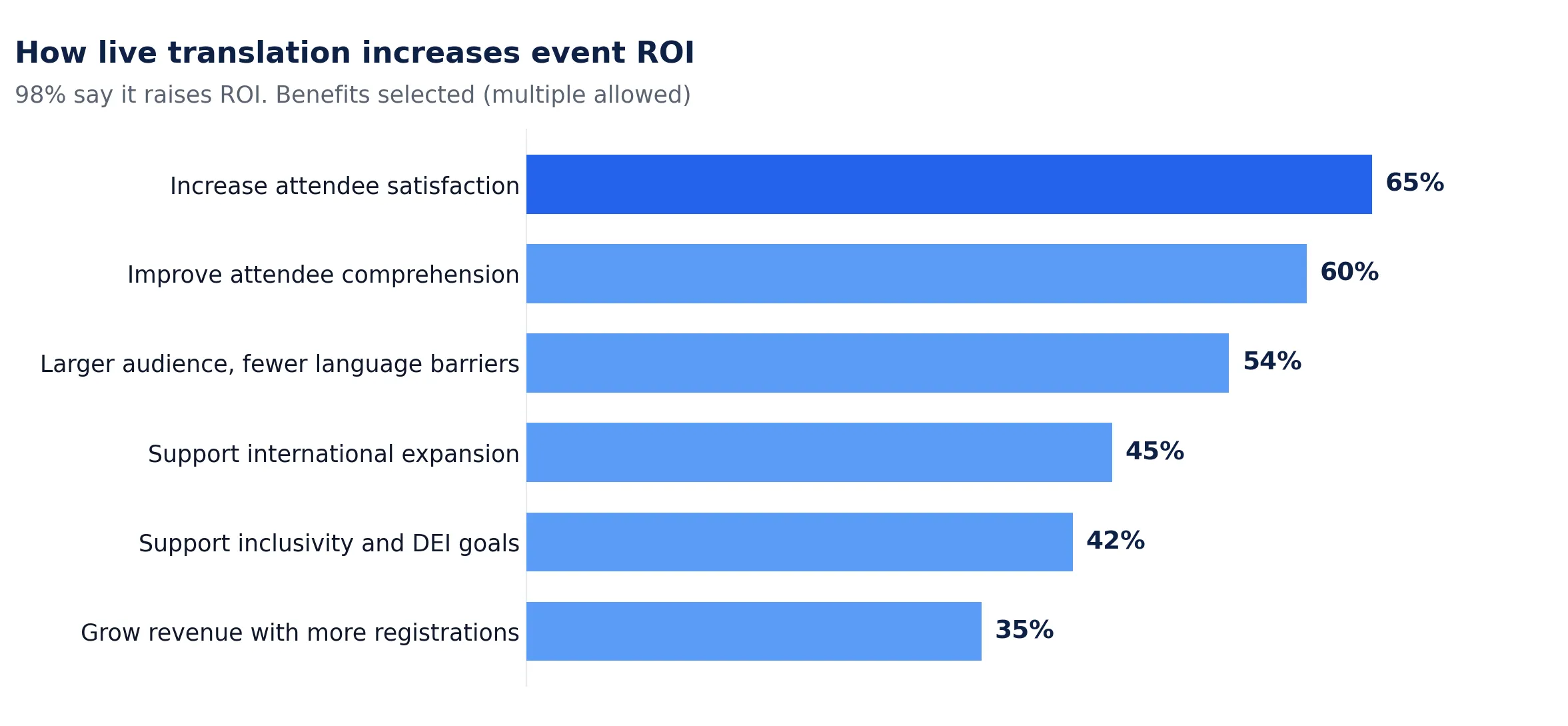
The most cited benefit is higher attendee satisfaction (65%), followed by improved comprehension of the material presented (60%) and a larger audience as language barriers come down (54%). Beyond the room itself, 45% say translation supports international expansion, 42% say it advances inclusivity and DEI goals, and 35% tie it directly to revenue through more registrations. The value compounds for those who use it most: event managers who regularly offer live translation are more likely than occasional users to report that it grows their audience, and executives are more likely than individual contributors to credit it with improving comprehension.
If the value is so clear, why isn't translation universal? Because offering it the traditional way is hard. Nearly three-quarters of planners (74%) say they face barriers to offering interpretation or captioning more often, and the obstacles are mostly logistical rather than philosophical.
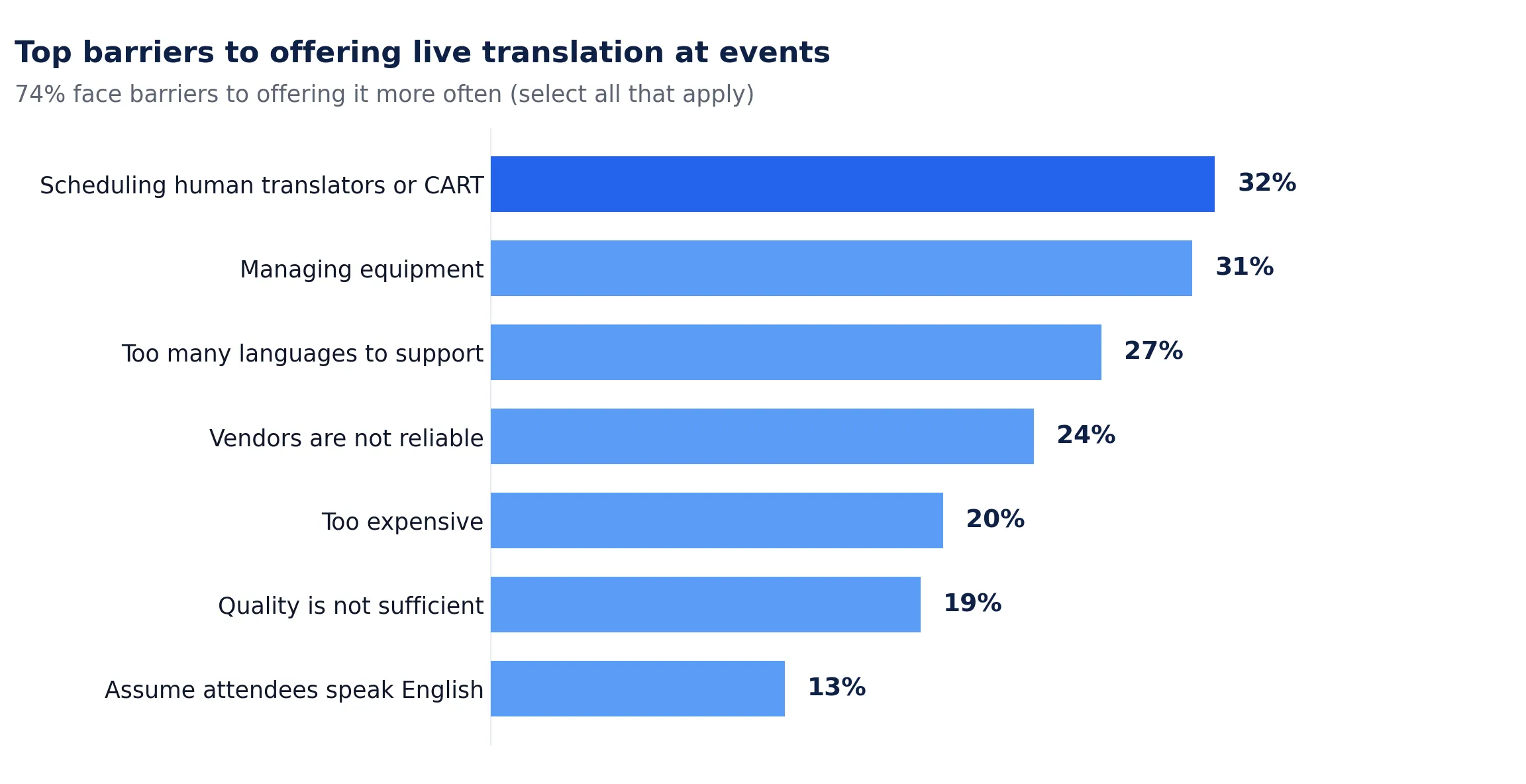
The top barrier is the complexity of finding and scheduling human translators or CART services (32%), followed closely by the logistics of managing equipment (31%) and the difficulty of supporting too many languages to be practical (27%). Cost (20%) and quality concerns (19%) rank lower than the operational headaches.
Notably, about a quarter of respondents (26%) say nothing holds them back at all, which tends to be the group that has already adopted a simpler, more scalable approach. These barriers are precisely the ones that AI-powered translation is designed to remove.
Adoption has moved well past early experimentation, and for most event teams the question is no longer whether to use an AI translator but which one. Most event managers (62%) already have experience with AI translation or captioning, including 48% who have used both human and AI solutions and 14% who have used AI only. Just 38% have used human translation exclusively.
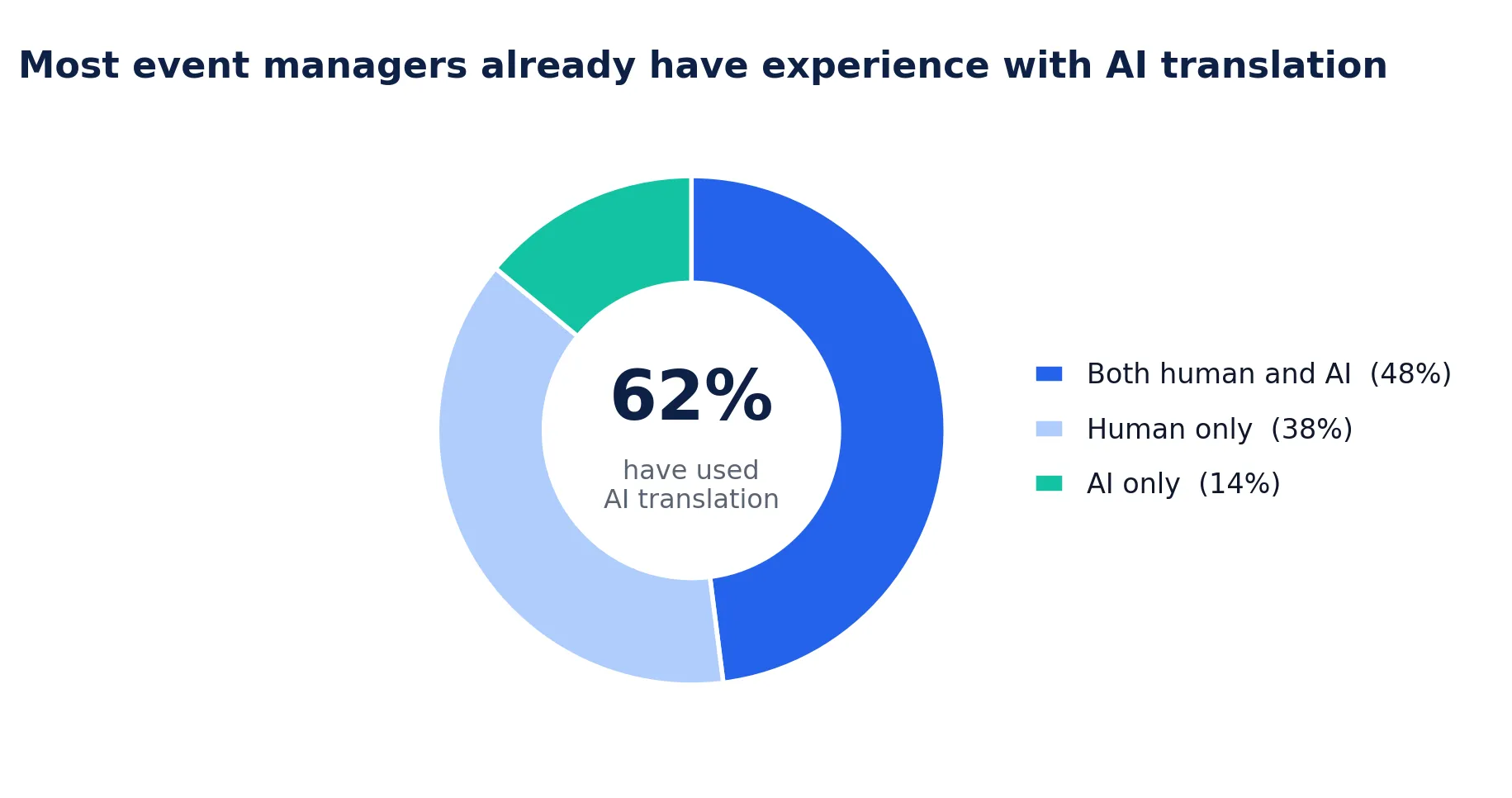
Two findings stand out. First, among planners who have tried AI translation, 99% continue to use it, and 52% use it regularly, with only 1% having stopped. When event teams adopt AI translation, it sticks. Second, among those who have not yet used it, 82% are currently evaluating it or plan to, with only 4% saying they have no plans to evaluate it. Among those with AI experience, usage skews toward employee meetings and training (70%), customer meetings (66%), and conference keynotes (63%), and 71% use AI translation regularly at their events. The direction of travel is unmistakable: a technology most planners have tried, almost none abandon, and the rest are lining up to test.
When event professionals weigh AI against human interpreters, the economics favor AI. A clear majority (85%) believe AI translation delivers a higher return on investment than human-powered solutions, and the reasons are practical.
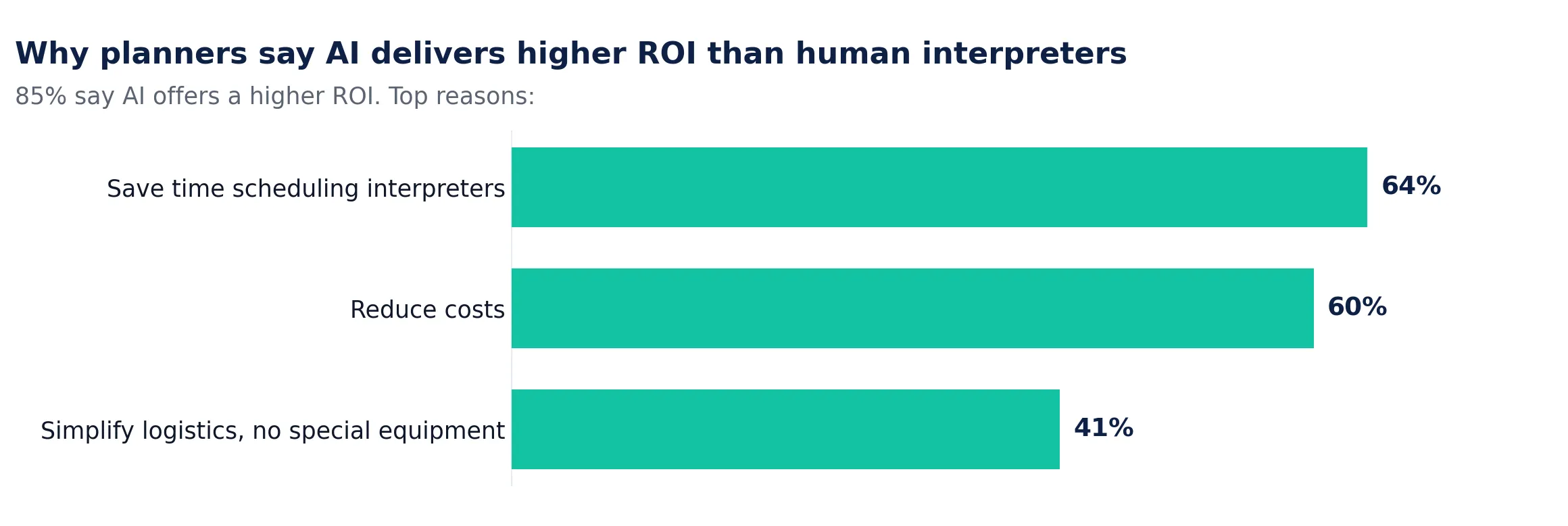
The leading advantages are saving time on scheduling interpreters (64%), reducing cost (60%), and simplifying logistics by removing the need for special equipment (41%). Confidence in the technology is also growing: 95% report that the quality of AI translation has improved over the past year, and 94% agree that AI makes offering translation easier and more affordable
If you want to see what that could mean for your own budget, our cost savings calculator gives you a quick estimate. None of this means human interpreters disappear, but for the majority of multilingual meetings and events, AI has become the more practical and cost-effective default.
Planners are clear about what a strong AI translation solution looks like. When asked which capabilities matter most, they prioritize availability, quality, and how well the tool fits into the systems they already use.
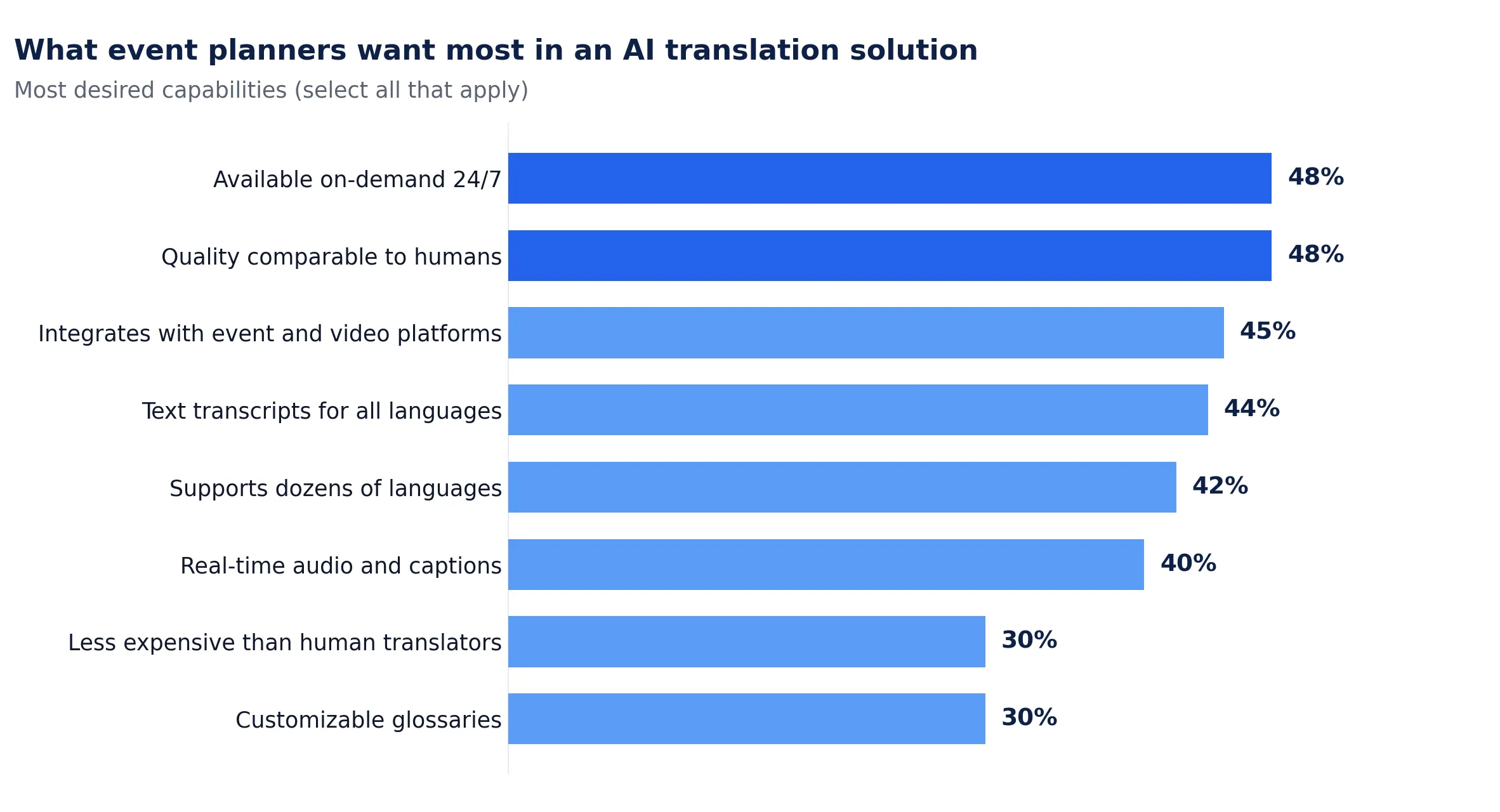
The two most desired features are on-demand 24/7 availability (48%) and quality comparable to human translators (48%), followed by integration with major event and video platforms such as Zoom (45%), text transcripts in all languages (44%), and support for dozens of languages spoken by presenters (42%). When it comes to choosing a solution, ease of use (57%) and the number of languages supported (54%) are the most important purchase criteria, ahead of output quality (40%) and cost (37%). The message to vendors is consistent: make it easy, make it broad, and make it fit the existing event stack.
The research points to a clear, practical path for any team planning multilingual meetings and events.
The data shows that most large events already include a meaningful share of attendees whose first language is not English, and that share is growing. Plan for multiple languages from the start rather than treating language support as an afterthought, and ask early how many languages your audience actually represents.
The biggest barriers planners report are operational: scheduling, equipment, and supporting many languages at once. When you evaluate translation software, weigh how easily a solution scales across languages and integrates with your event and video platforms, since those are the factors most likely to determine whether you can offer translation consistently.
Most planners who try AI translation keep using it. A low-risk way to start is to add AI translation and captioning to a single session, such as an employee town hall, a customer webinar, or a conference keynote, and measure attendee satisfaction and comprehension against your usual baseline.
Wordly launched in 2019 and provides real-time AI translation and captions in dozens of languages, making in-person, virtual, and hybrid events more inclusive, accessible, and engaging. Because the platform delivers translation and captions to each attendee on their own phone or laptop, there is no need for human interpreters or special equipment, which removes most of the logistical and cost barriers this research identified. Wordly is trusted by millions of users across thousands of organizations spanning corporate, nonprofit, government, education, and faith communities.
That maps directly to what planners told this study they want: ease of use, support for dozens of languages, integration with major event and video platforms, real-time audio and captions, and text transcripts in every language.
Planning an event and not sure how much translation you will need? Our hours calculator helps you estimate how many hours of Wordly to purchase for your sessions.
Wordly surveyed 205 event professionals across the US and UK on live translation. Download the full 2024 report for the complete data on rising demand, ROI, top barriers, and the AI translation adoption shaping meetings and events.
Download ReportIt is a research study commissioned by Wordly and conducted by Dimensional Research in 2024. It surveyed 205 meeting and event professionals in the US and UK about how they use live translation and captioning, the return on investment they see, the barriers they face, and how they are adopting AI translation.
The 205 respondents were split evenly between the US and UK and all had responsibility for events with more than 100 attendees where at least 10% of participants did not speak English as a first language. They came from a wide range of industries and company sizes and worked mostly in marketing and sales, primarily as managers or executives.
Yes. A majority (79%) of event professionals report a rising number of attendees whose first language is not English, and 77% say they are increasing how often they offer live translation or captioning. Among planners who use AI translation, 84% have increased their use of it over the past year.
Overwhelmingly. 97% agree that increasing inclusivity and accessibility at their events is a priority, and 94% agree that letting everyone participate in their preferred language delivers better outcomes. At the same time, 79% acknowledge that first-language English speakers often overlook the language experience of other attendees.
98% of event professionals believe offering live translation and captioning increases event ROI. The most cited benefits are higher attendee satisfaction (65%), improved comprehension (60%), and a larger audience as language barriers come down (54%), along with support for international expansion, DEI goals, and revenue growth.
74% of planners face barriers to offering it more often. The biggest are the complexity of scheduling human translators or CART services (32%), managing equipment (31%), and supporting too many languages to be practical (27%). Cost and quality concerns rank lower than these operational challenges.
62% of event managers already have experience with AI translation or captioning. Among those who have tried it, 99% continue to use it and 52% use it regularly. Among those who have not used it yet, 82% are evaluating it or plan to.
Most event professionals believe AI offers better value: 85% say it delivers a higher ROI than human interpreters, mainly through time savings, lower cost, and simpler logistics. In addition, 95% say AI translation quality has improved over the past year, and 94% say AI makes translation easier and more affordable.
The most desired capabilities are 24/7 on-demand availability (48%), quality comparable to human translators (48%), and integration with major event and video platforms like Zoom (45%), followed by text transcripts in all languages and support for dozens of languages. When choosing a solution, ease of use and the number of languages supported are the top purchase criteria.
Wordly provides live AI translation and captions in dozens of languages, delivered to each attendee on their own device with no human interpreters or special equipment required. That directly addresses the scheduling, equipment, language coverage, and cost barriers this research identified, and it offers the platform integrations and transcripts planners say they want.
Dimensional Research provides practical market research for technology companies, partnering with clients to deliver actionable information that reduces risk, increases customer satisfaction, and grows the business. Its researchers specialize in the applications, devices, and infrastructure used by modern businesses and their customers.
Wordly launched in 2019 and provides live AI translation and captions for dozens of languages, making in-person and virtual meetings and events more inclusive, accessible, and engaging. The platform does not require human interpreters or special equipment, making it easier and more affordable to communicate across multiple languages. Wordly is used by millions of users across thousands of organizations worldwide spanning corporate, nonprofit, government, education, and faith communities.
.avif)
.avif)
.png)
%20(1)%201.webp)
.png)
In a 30-minute video call, we will show you how Wordly can work for your use case, and answer questions.
.avif)