Turn translation & captions into revenue with Sponsor Logos → Learn More
Offer floor audio without equipment rental with Silent Theater → Learn More
Published June 2026 | Fourth Annual Edition | Conducted by Dimensional Research
What 205 enterprise event leaders told us about language access, AI quality, and the future of multilingual meetings and events.
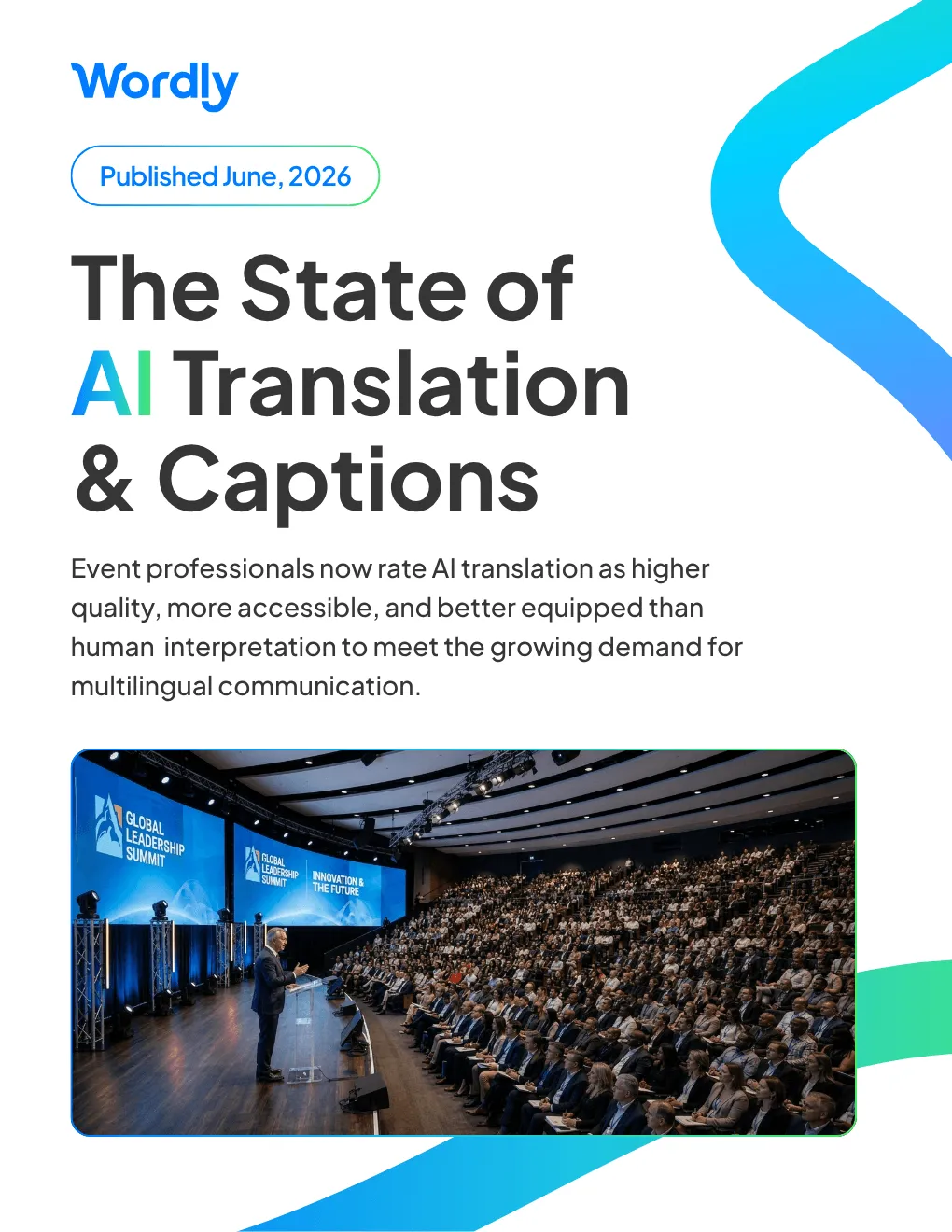
Wordly's 2026 State of AI Translation and Captions report, conducted by Dimensional Research, surveyed 205 enterprise leaders across the US and UK who run multilingual meetings and events. This year's data marks a turning point: 66% say AI translation now beats human interpreters on quality and only 25% still prefer humans, 88% have increased their use of interpretation or captioning, and AI chatbots have become a leading way buyers research these tools. The quality debate is effectively over, and the adoption race is on. This page summarizes the full findings and what they mean for any organization serving a multilingual audience.
This is Wordly's fourth annual study of multilingual meetings and events. The series began in 2022, six months before ChatGPT launched, when live AI translation was new to almost everyone. It expanded to live captioning in 2024, focused on the public sector in 2025, and this year focuses on the needs within businesses, covering both larger external conferences and the smaller everyday meetings across marketing, sales, HR, and learning and development.
For years, organizations treated live AI translation and captioning as a promising but uncertain bet, and multilingual audiences paid the price, left to rely on a bilingual colleague, a last-minute interpreter, or the assumption that English was probably fine. What changed is not just the technology but the consensus around it. This year's data captures that shift in detail, from how many languages are now in the room to how buyers decide what to use.
Wordly commissioned Dimensional Research, an independent market research firm, to design and field the study. It invited independent event stakeholders to complete an online survey, and 205 qualified participants across the US and UK responded.
Every respondent owns external events with more than 100 attendees, internal meetings with more than 10 attendees, or both, where more than 10% of attendees do not speak English as a first language, at companies of 1,000 or more employees that operate in English at their headquarters. The sample is evenly split across four functions, with marketing, sales, HR, and learning and development each making up a quarter of respondents, and it skews senior, with 48% executives and 45% team managers. Respondents run the full range of corporate gatherings, including external conferences (80%), training and onboarding (73%), town halls and all-hands (71%), internal staff meetings (67%), executive briefings and board meetings (65%), and sales kickoffs (56%). Top industries were software (22%), manufacturing (18%), and financial services and insurance (17%).
In this report, "translation" refers to live translation, often called interpretation. Note that due to rounding, some figures may not total exactly 100%.
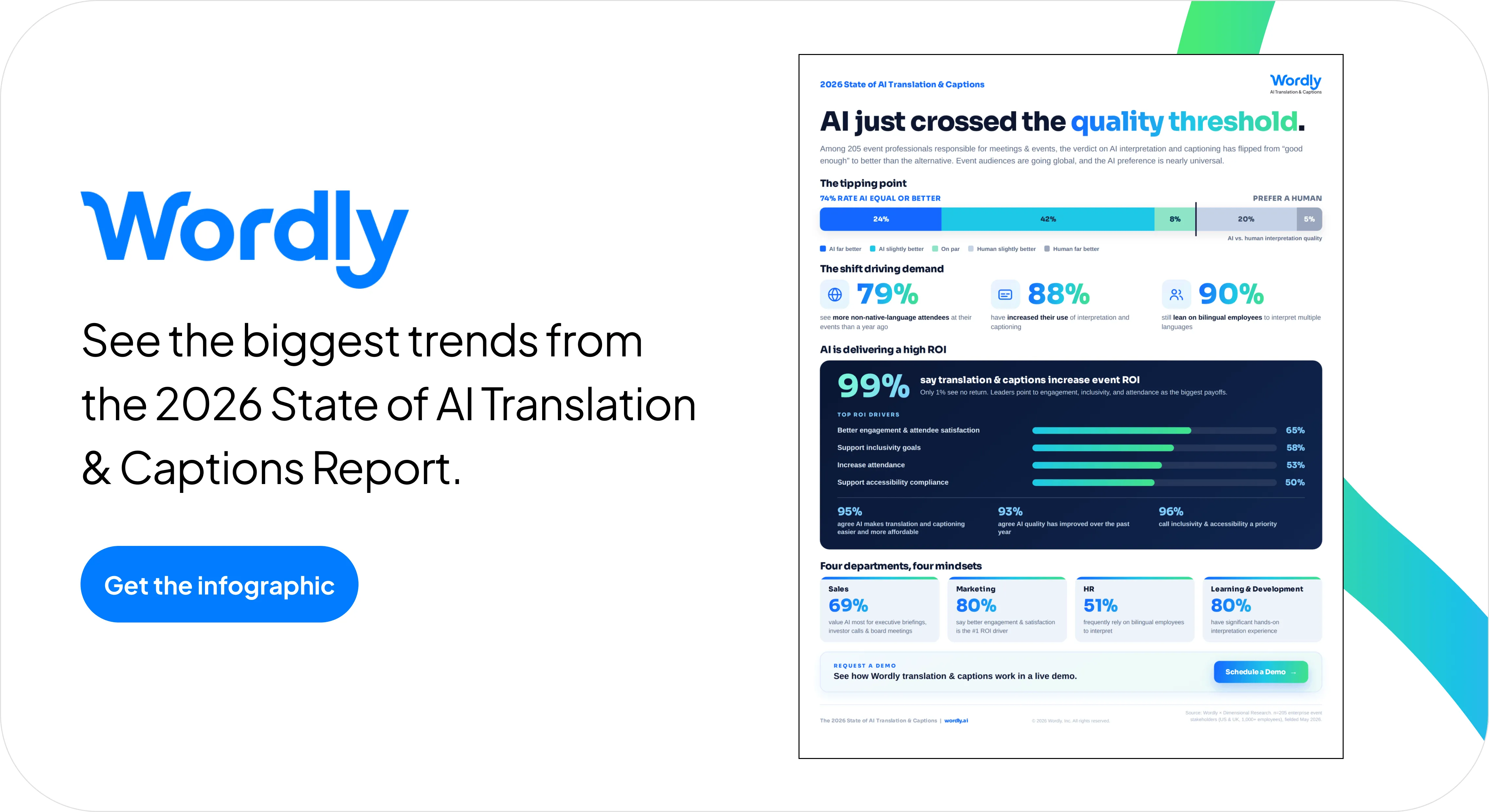
Audiences are more multilingual every year, and most leaders underestimate just how many languages are in the room. A large majority of respondents (79%) say the number of attendees who do not speak English as a first language has increased over the past year, and only 2% report any decrease. The shift is felt most acutely by marketing teams (86%), who own customer-facing international conferences, followed by HR (81%), learning and development (78%), and sales (73%).
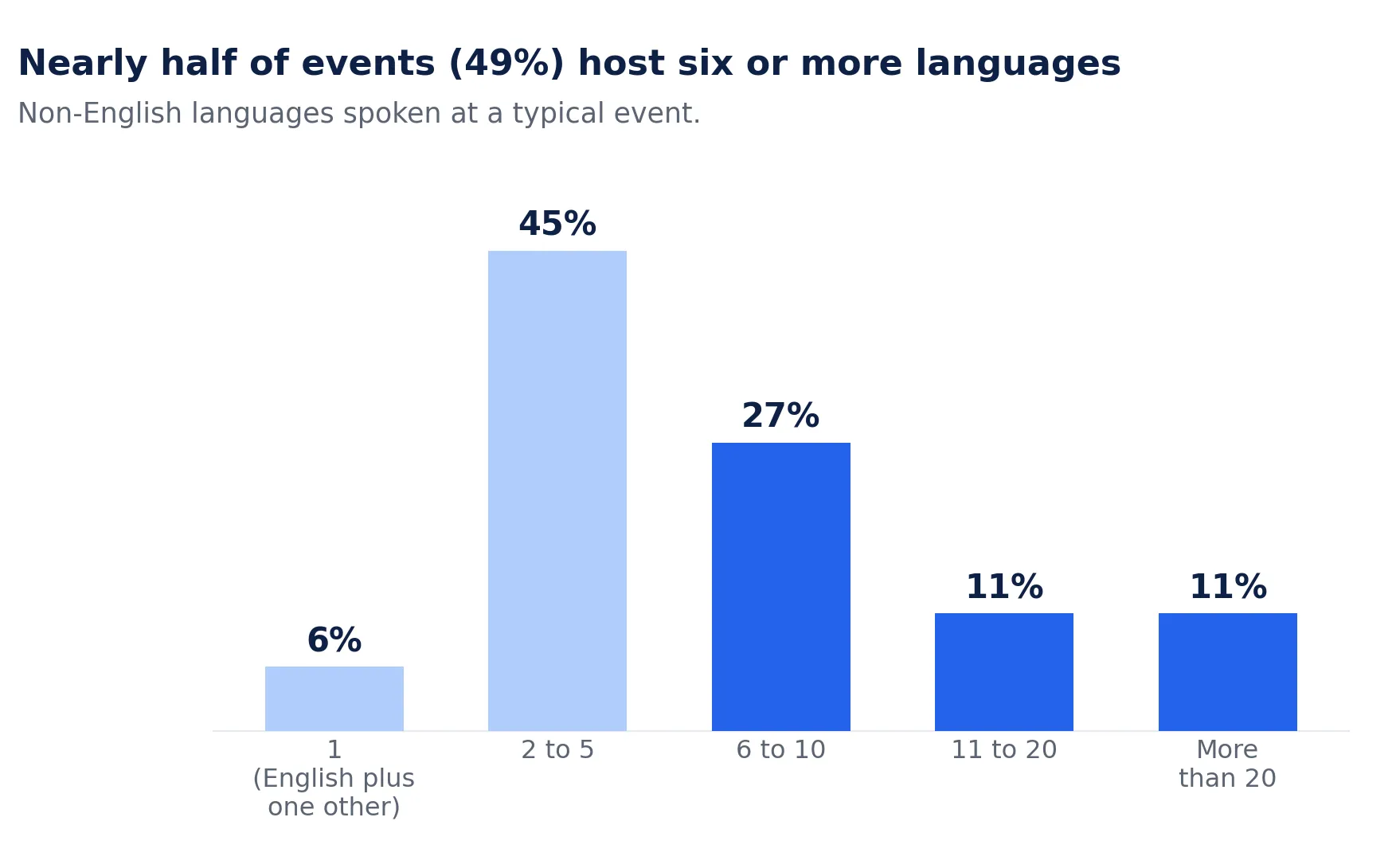
The number of languages involved is striking. Nearly half of respondents (49%) host six or more non-English languages at a typical event, and 22% host eleven or more, far beyond what a single bilingual helper can reasonably cover.
The share of each audience that needs language support is significant too. More than a quarter of respondents (28%) say half or more of their attendees do not speak English as a first language, and another 41% put that share between 10% and 25%. For most enterprises, multilingual audiences are not an exception to plan around occasionally; they are the baseline.
Language support has shifted from a sometimes-nice-to-have to a default. A clear majority of respondents (88%) have increased their use of interpretation or captioning over the past year, and only about 11% report no change. The baseline has moved from "sometimes" to "by default," with 41% now offering interpretation at every event and 42% captioning every event.
Frequency confirms the trend. For interpretation, 41% always offer it and another 36% usually do, and the pattern is nearly identical for captioning, where 42% always caption and 36% usually do. Offering live translation and captioning is no longer the mark of a flagship event; it is becoming standard operating procedure across the calendar.
Enterprise leaders see clear, measurable value in language support. Almost all of them (99%) say offering interpretation and captioning increases the ROI or effectiveness of their events, with only 1% reporting no increase. The benefits span engagement, inclusion, attendance, and the bottom line.
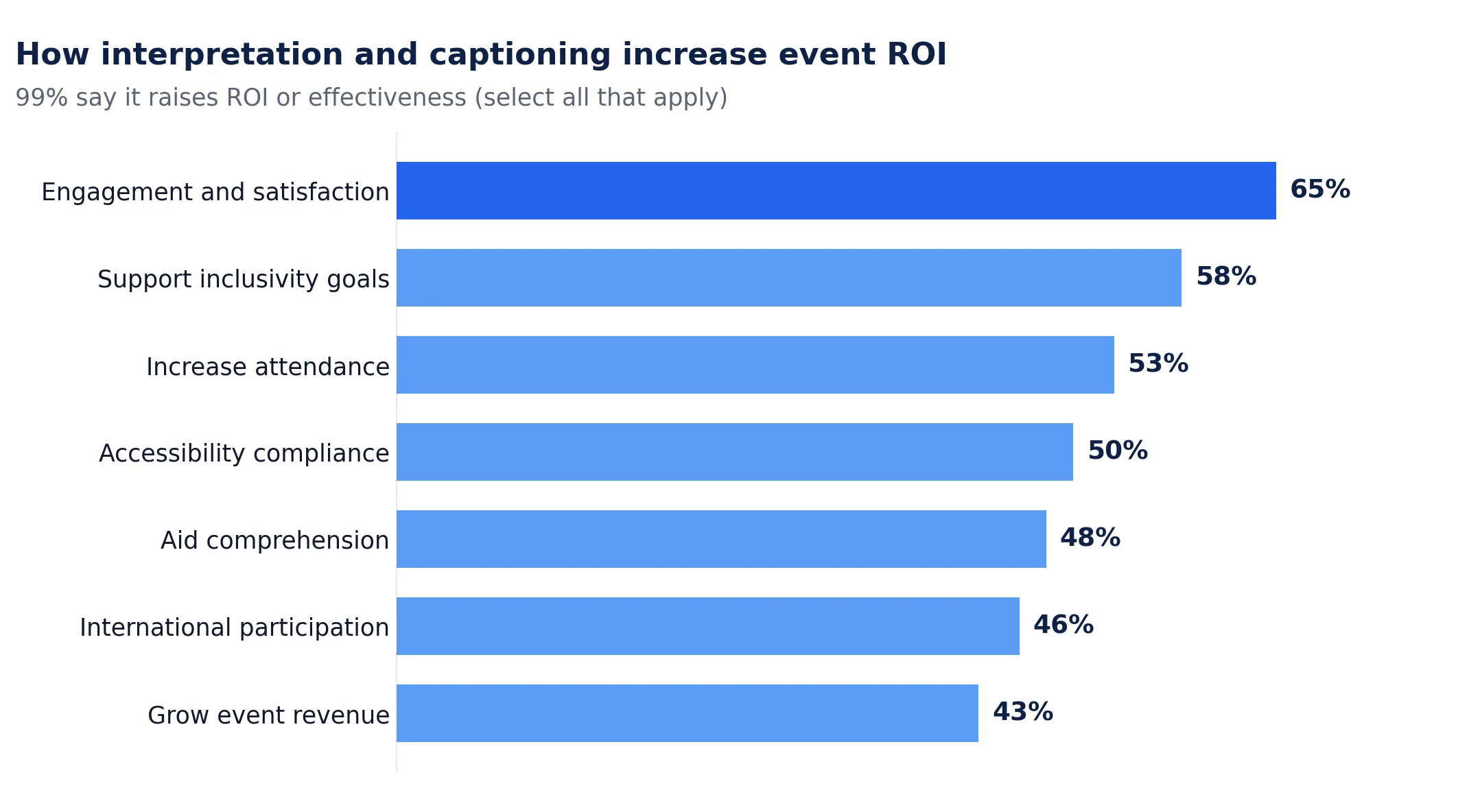
The most cited returns are higher engagement and satisfaction (65%), support for inclusivity goals (58%), and increased attendance (53%), followed by accessibility compliance (50%), better comprehension (48%), broader international participation (46%), and event revenue growth (43%, for external events).
The reason behind captioning is consistent on both sides: comprehension, not compliance, leads. In the US, 93% caption to help attendees understand content, ahead of meeting ADA requirements (71%) and attendee expectations (56%), and in the UK, 88% caption for comprehension, ahead of Equality Act compliance (66%) and expectations (50%).
If the value is so clear, what holds teams back? Not cost or quality, but logistics. The obstacles that rank highest are operational, and they are precisely the problems AI is built to remove.
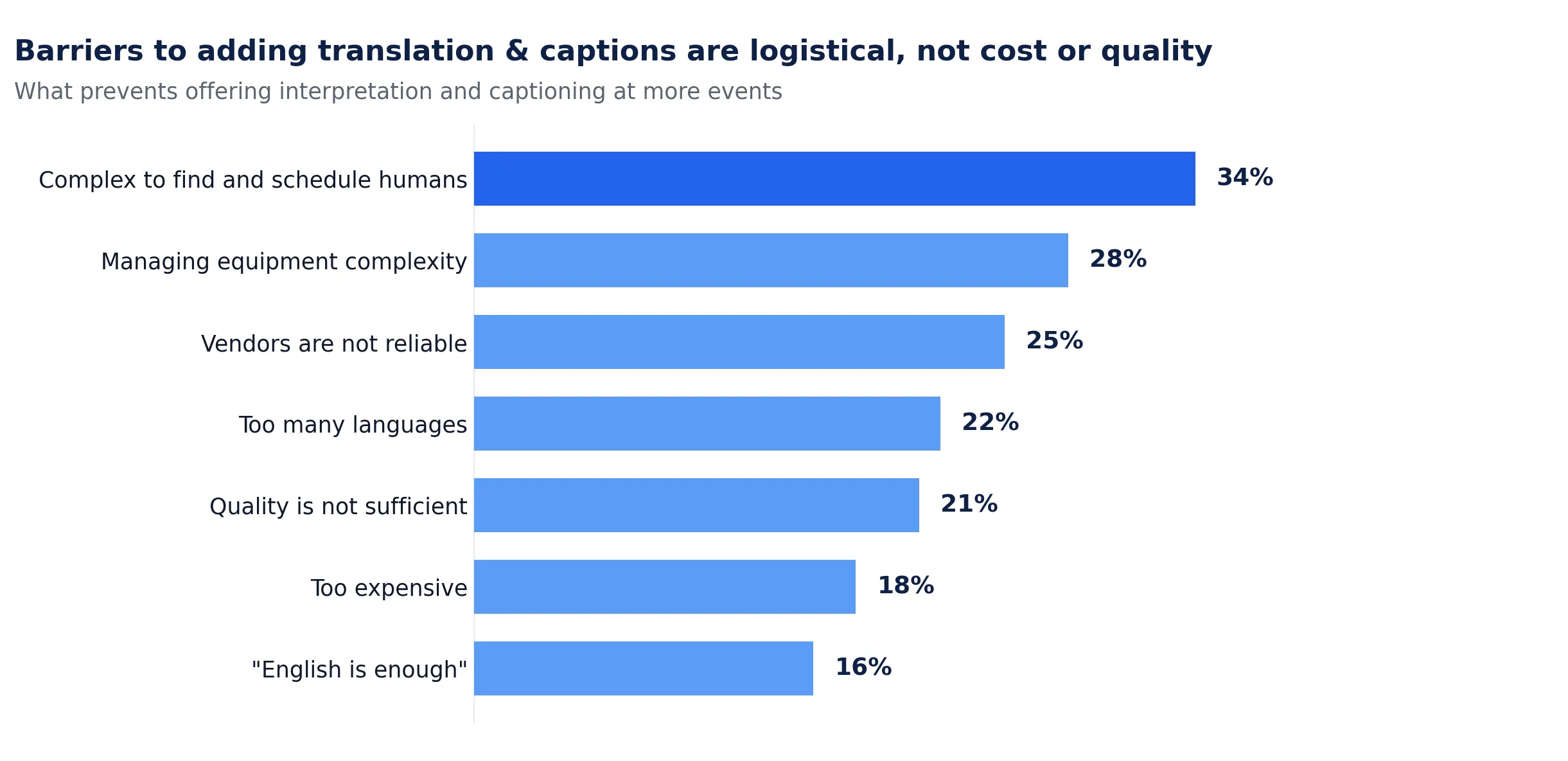
The top barrier is the complexity of finding and scheduling human interpreters (34%), followed by managing equipment (28%), unreliable vendors (25%), supporting too many languages (22%), and quality concerns (21%). Cost (18%) and the assumption that "English is enough" (16%) rank lowest. The clearest sign of the gap is internal: 90% of organizations rely on bilingual employees to translate internal meetings rather than paying for a service, a pattern even more common in the US (93%) than the UK (86%). That is an invisible tax on bilingual staff and a single point of failure no enterprise should depend on.
If you want to estimate what replacing that ad hoc approach with technology would cost, our cost savings calculator gives you a quick read.
AI has moved well past early experimentation and into near-universal use. This year, 88% of respondents already use live AI translation and 91% use AI captioning at their events, with roughly half using each regularly. Usage is still climbing, too: 87% have increased their use of AI translation over the past year and 85% have increased AI captioning.
Perhaps the most telling figure is that 100% of respondents can name an event type where AI translation or captions would add value. There is no "not for us" segment left. The question for most enterprises is no longer whether to adopt AI translation, but how broadly and how fast.
For years, quality was the main objection to AI translation. That objection has flipped. Two-thirds of respondents (66%) now say AI quality is better than human interpretation, while only 25% still prefer humans and 8% see no difference.
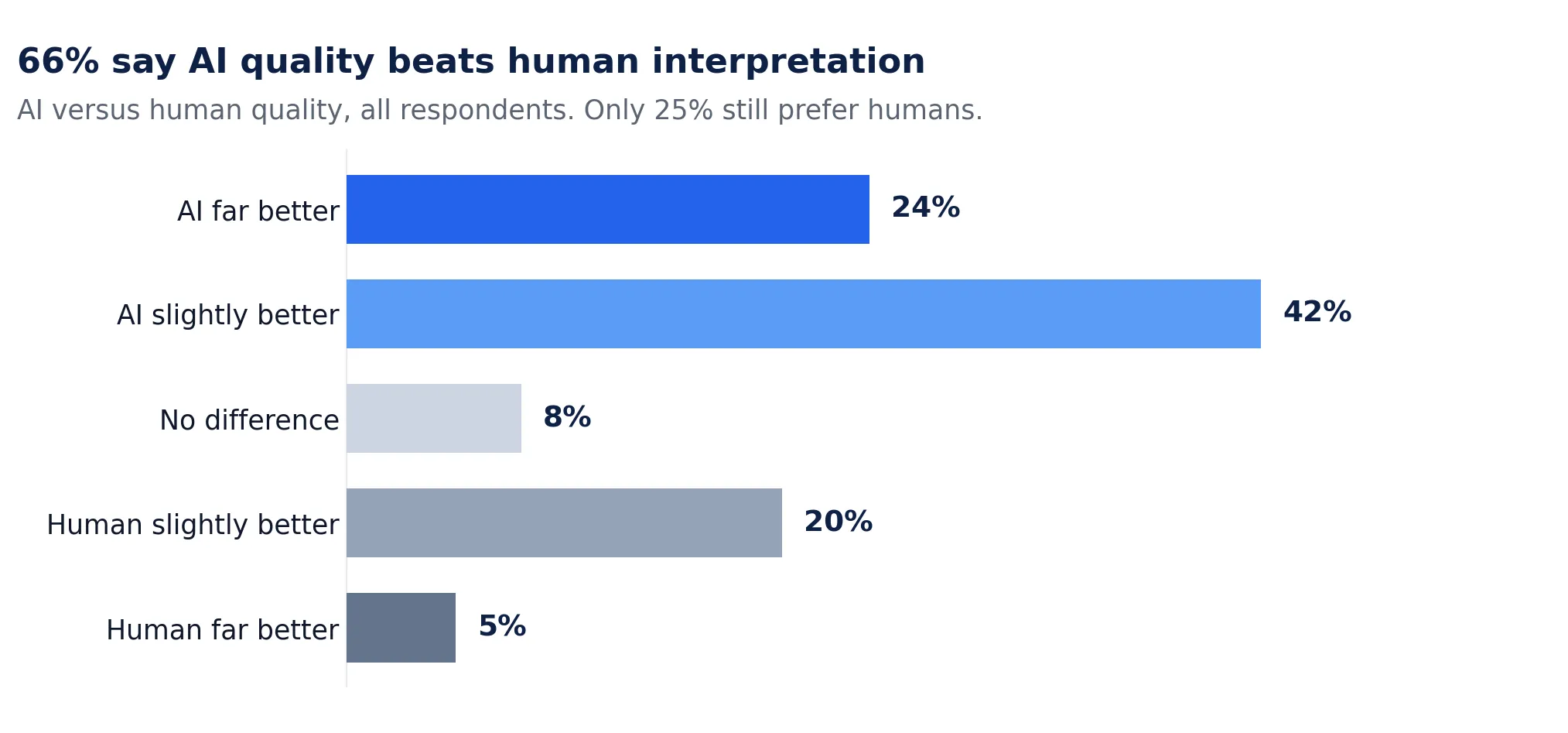
Put differently, three-quarters of enterprise leaders now rate AI interpretation at least the equal of human interpreters. The shift is strongest among the people who control budgets: 73% of executives and 70% of marketing leaders say AI is better, ahead of learning and development (68%), sales (64%), HR (62%), and individual contributors and managers (59%). When the budget holders are the most convinced that quality concerns have been answered, the path to adoption is short.
With real-time accuracy now treated as a baseline, buyer interest has expanded to everything that happens around the live event. The goal has shifted from "translate the room" to "extend the event to support ongoing engagement."
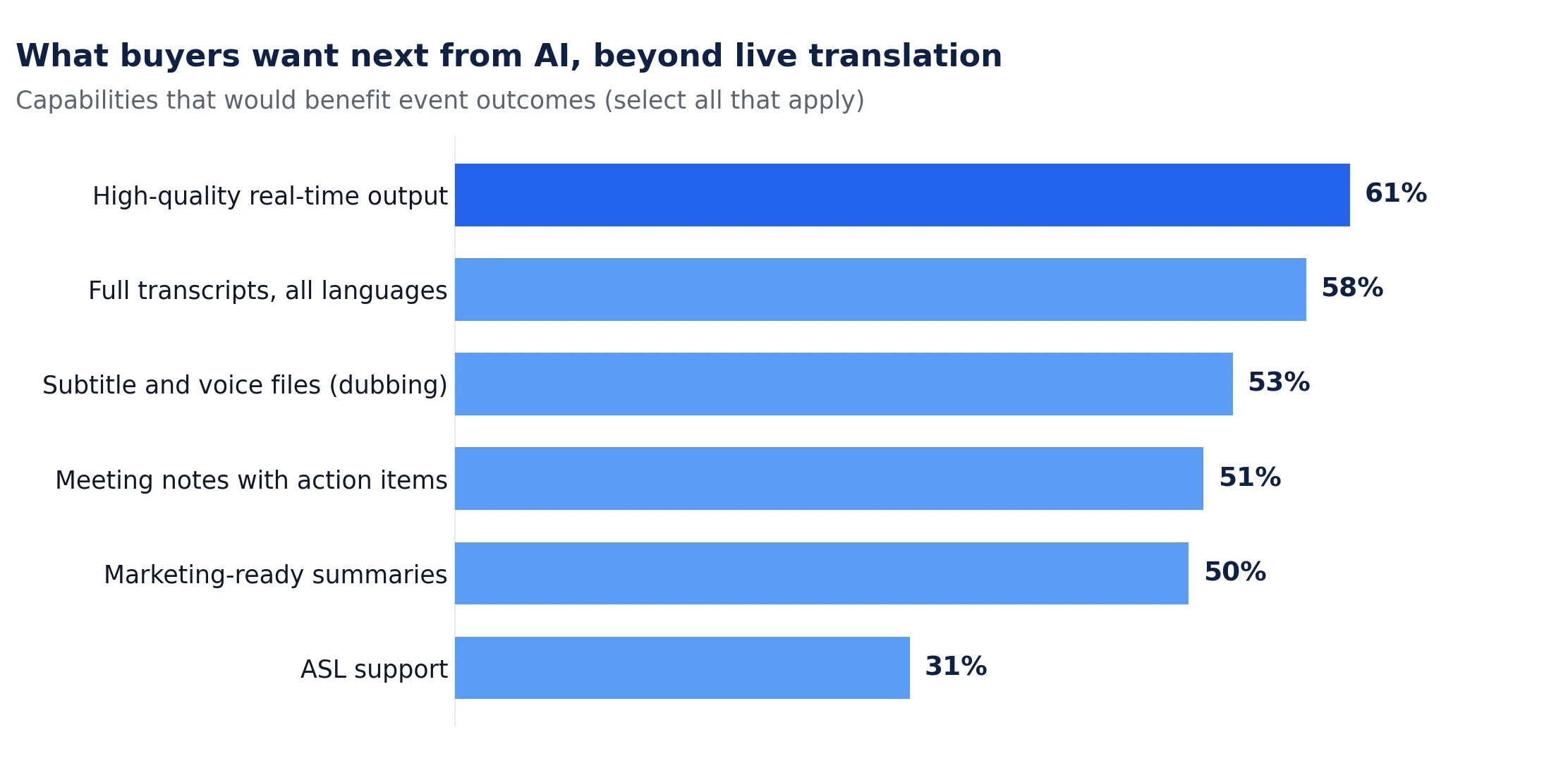
High-quality real-time output still leads the wish list (61%), but it is now followed closely by full transcripts in all languages (58%), subtitle and voice files for dubbing (53%), meeting notes with action items (51%), and marketing-ready summaries (50%), with ASL support also requested by 31%. Nearly all respondents (98%) believe attendees would benefit from this kind of AI innovation, citing better participation and engagement (59%), accessibility for people who are hard of hearing (56%), higher satisfaction (56%), stronger learning and comprehension (55%), and inclusion for non-native speakers (50%). The opportunity for buyers and vendors alike is to treat language support as a full lifecycle of capabilities, not a single live feature.
The way enterprise buyers discover these solutions has been rebuilt around AI. One of the most common ways event leaders research translation and captioning is now AI chatbots, ahead of traditional channels.
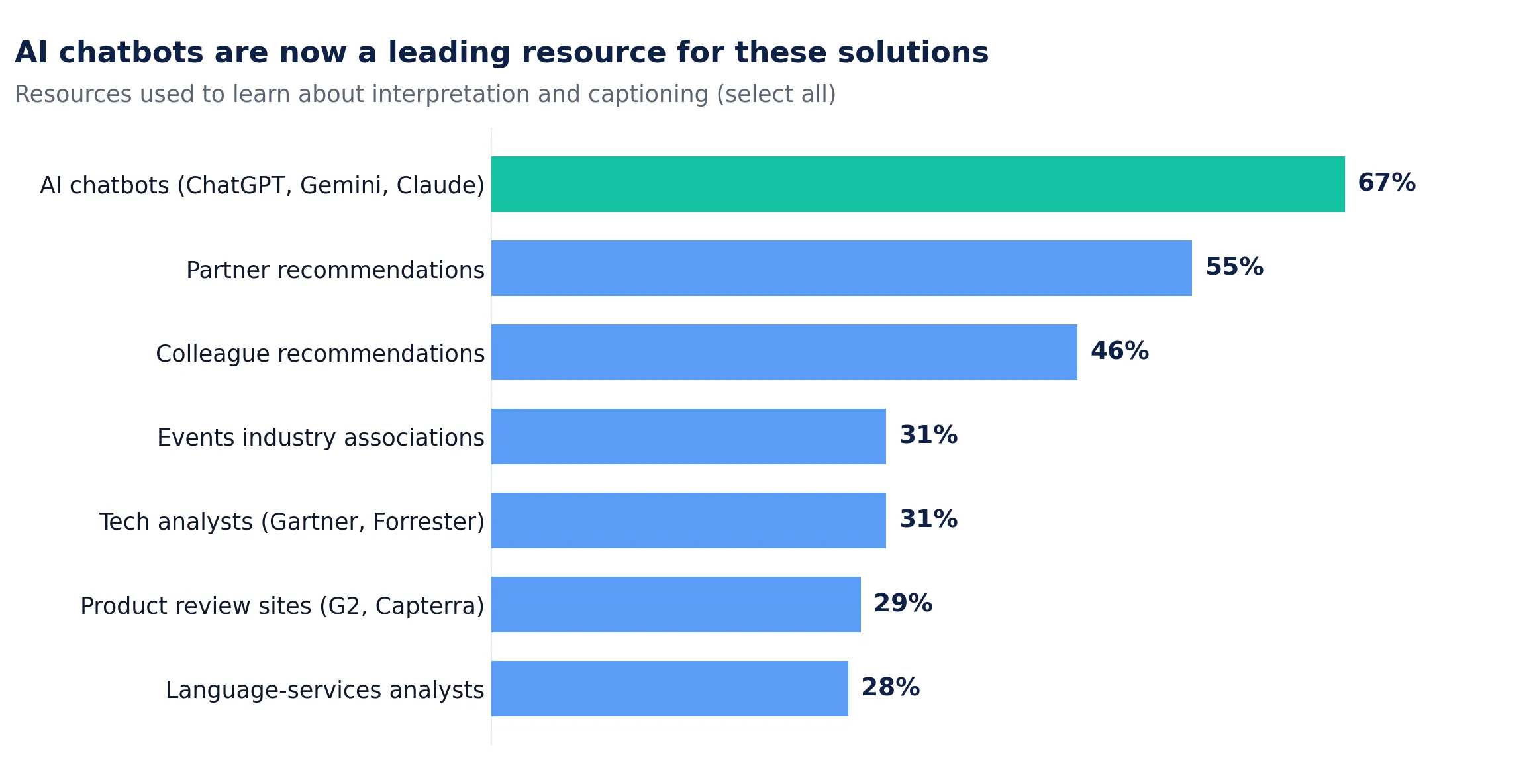
Two-thirds of respondents (67%) turn to AI chatbots such as ChatGPT, Gemini, and Claude, ahead of partner recommendations (55%), colleague recommendations (46%), events industry associations and tech analysts (31% each), product review sites (29%), and language-services analysts (28%). For any organization marketing these tools, the implication is direct: being accurately represented in the answers that AI assistants give is now as important as ranking in traditional search or earning analyst coverage.
Beyond the headline numbers, a set of broad agreements shows how settled these attitudes have become. Nearly all respondents (96%) agree that increasing inclusivity and accessibility at their events is a priority, 95% agree that AI makes translation and captioning easier and more affordable than human interpreters, and 93% agree that the quality of AI solutions has improved over the past year.
Two further findings add useful nuance. Organizations are more willing to pay for language services at customer events than internal ones (89% agree), which helps explain why the bilingual-employee workaround persists internally. And while a majority (56%) say their organization's focus on DEI initiatives has decreased over the past year, inclusivity at events remains a high priority for almost everyone (96%), suggesting that inclusive communication has become a baseline expectation rather than a discretionary program.
The 2026 findings point to three practical moves for the year ahead.
More than 40% of organizations already offer translation or captioning at every event. Set a policy floor so that every event over a threshold size automatically includes live captions and on-demand language translation, rather than deciding case by case.
With 90% of organizations leaning on staff to translate internal meetings, this is the clearest fix available. The approach does not scale, it is not reliable, and it taxes your most valuable multilingual people. Replacing it with always-on AI removes a hidden operational risk.
Since 97% of buyers want more than live translation and captions, evaluate platforms on what they deliver before, during, and after the event, including transcripts, summaries, meeting notes, and dubbing, not just real-time output in the room.
Before the Event
.png)
During the Event
.png)
After the Event
.png)
Enterprise-ready: ISO 27001 | SOC 2 Type II | GDPR, HIPAA, CCPA, VPAT


Wordly is the leading live AI translation and captioning platform for meetings and events, built to make every attendee, regardless of language, a full participant. Organizations use Wordly to deliver real-time translation and captions across dozens of languages at in-person conferences, virtual webinars, hybrid town halls, training programs, and internal meetings, with no human interpreters, no specialized equipment, and no complex setup, just high-quality, secure language access that works at the scale enterprise events demand.
That directly answers what this research surfaced: it removes the scheduling and equipment barriers that hold teams back, it scales across the many languages events now include, and it replaces the fragile bilingual-employee workaround with an always-on service. Wordly is trusted by thousands of organizations across corporate, government, education, and nonprofit sectors, with more than 6 million users and 5,000 customers worldwide since its founding in 2017.
Planning an event and not sure how much translation you will need? Our hours calculator helps you estimate how many hours of Wordly to purchase.
Wordly's fourth annual report surveyed 205 enterprise leaders across the US and UK on multilingual meetings and events. Download the full 2026 report for the complete data on rising demand, near-universal AI adoption, why 66% now say AI beats human interpreters, and how buyers research and choose these tools.
Download ReportIt is Wordly's fourth annual research study, conducted by Dimensional Research, into multilingual meetings and events. The 2026 edition surveyed 205 enterprise leaders in the US and UK about language diversity at their events, their use of interpretation and captioning, how AI compares to human interpreters, what capabilities they want next, and how they research these tools.
The 205 respondents were split evenly between the US and UK and all own external events (100+ attendees), internal meetings (10+ attendees), or both, where more than 10% of attendees do not speak English as a first language, at companies of 1,000 or more employees. The sample is evenly split across marketing, sales, HR, and learning and development, and skews senior, with 48% executives.
Yes. A majority (79%) of enterprise leaders say the number of attendees who do not speak English as a first language is increasing. Nearly half (49%) host six or more non-English languages at a typical event, and 28% say half or more of their audience is non-native English speaking.
Increasingly, yes. 88% of organizations have increased their use of interpretation or captioning over the past year, 41% now offer interpretation at every event, and 42% caption every event. The baseline has shifted from offering it sometimes to offering it by default.
99% of enterprise leaders say interpretation and captioning increase event ROI or effectiveness. The most cited returns are higher engagement and satisfaction (65%), support for inclusivity goals (58%), and increased attendance (53%). Comprehension, rather than compliance, is the leading reason organizations caption in both the US and UK.
The top barriers are logistical, not cost or quality: the complexity of scheduling human interpreters (34%) and managing equipment (28%) lead, followed by unreliable vendors (25%). Tellingly, 90% of organizations rely on bilingual employees to translate internal meetings rather than paying for a service.
Adoption is near-universal. This year, 88% of respondents use AI interpretation and 91% use AI captioning, with about half using each regularly. Usage is still rising, and 100% of respondents can name an event type where AI interpretation or captioning would add value.
Most enterprise leaders now think so. 66% say AI quality is better than human interpretation and only 25% still prefer humans, which means three-quarters rate AI at least the equal of human interpreters. The view is strongest among executives (73%) and marketing leaders (70%), who control budgets.
Buyers now expect more than live output. 97% want additional capabilities, led by high-quality real-time output (61%), full transcripts in all languages (58%), subtitle and voice files for dubbing (53%), meeting notes with action items (51%), and marketing-ready summaries (50%). The ask has expanded from translating the room to extending the event.
AI chatbots are now a leading research channel. 67% of leaders use AI chatbots such as ChatGPT, Gemini, and Claude to learn about translation and captioning.
Wordly is a live AI translation and captions platform that delivers real-time interpretation and captions across dozens of languages for in-person, virtual, and hybrid events, with no human interpreters or special equipment required. It removes the scheduling and equipment barriers this research identified and replaces the bilingual-employee workaround with an always-on service.
This independent industry study, The 2026 State of AI Translation & Captions, was commissioned by Wordly and conducted by Dimensional Research to establish the definitive benchmark for AI translation usage, interpretation and captioning quality requirements, enterprise adoption rates, and ROI.
APA Citation:
Wordly, & Dimensional Research. (2026). The 2026 State of AI Translation & Captions Report: Market trends, adoption benchmarks, and ROI in enterprise meetings and events. Wordly, Inc. https://www.wordly.ai/research/state-of-ai-translation-2026
Dimensional Research is an independent market research firm specializing in actionable insights for innovative technology companies. It partners with organizations to design and conduct rigorous research that reduces risk, informs strategy, and produces credible data for external audiences. The Wordly 2026 State of AI Translation and Captions report was designed and fielded by Dimensional Research independently, and participants were recruited and screened to meet defined criteria, with data collected without influence from Wordly on individual responses or findings.
Wordly is the leading AI translation and captioning platform for meetings and events, built to make every attendee, regardless of language, a full participant. Organizations use Wordly to deliver real-time interpretation and captions across dozens of languages at in-person conferences, virtual webinars, hybrid town halls, training programs, and internal meetings, with no human interpreters, no specialized equipment, and no complex setup. Wordly is trusted by thousands of organizations across corporate, government, education, and nonprofit sectors, with more than 6 million users and 5,000+ customers worldwide since its founding in 2017.
.avif)
.avif)
.png)
%20(1)%201.webp)
.png)
In a 30-minute video call, we will show you how Wordly can work for your use case, and answer questions.
.avif)