Turn translation & captions into revenue with Sponsor Logos → Learn More
Offer floor audio without equipment rental with Silent Theater → Learn More
Published May 2025 | Third Annual Edition | Conducted by SmartBrief
Emerging strategies and challenges shaping language access in local government
Wordly's 2025 State of Language Access report surveyed 117 local government professionals across more than 30 U.S. states. It found that 61% of municipalities serve a growing number of non-native English speakers, and 65% call language access "very important," yet only 11% rate their live public meetings as "very" inclusive. Budget limitations (50%) and logistical complexity (39%) are the top barriers to doing more, while interest in AI-powered translation and captioning is rising fast, with 57% of agencies already evaluating it or planning to. This page summarizes the full findings and what they mean for cities, counties, and boroughs.
American communities are becoming more linguistically diverse, and local governments are on the front line of that change. Permit offices, public hearings, emergency alerts, and community meetings all depend on clear communication, and a resident who cannot follow the conversation cannot fully participate, comply, or stay safe. The research behind this report set out to measure how prepared local governments actually are, where they are falling short, and how new technology is changing what is possible.
The short version: intent is high, but delivery lags. Most municipalities recognize that inclusive communication matters, and most expect real benefits from getting it right. What holds them back is rarely a lack of will. It is cost, complexity, and a continued reliance on informal fixes that do not scale. Below is the full picture.
Wordly partnered with SmartBrief, a close collaborator with government associations, to study language access and multilingual communication in U.S. municipalities. SmartBrief syndicated the survey to subscribers of the ICMA (International City/County Management Association) newsletters. The survey was administered online in February and March 2025 and published in May 2025, with 117 qualified respondents from local government completing it.
Respondents work for or with city, county, and borough governments across a wide range of community sizes, from small towns under 10,000 residents to large urban centers serving more than 500,000. Their roles include city clerks and public information officers responsible for transparency and accessibility, IT and innovation leaders evaluating technology to improve service delivery, and emergency management officials making sure public safety messaging reaches everyone. The survey was conducted in English and asked about the prevalence of non-native English speakers and the tools used to support them.
Because respondents span more than 30 states and every population tier, the results reflect the shared challenges of local government as a whole, the real differences between small and large communities and between regions, and the growing role of government translation tools in closing the gap.
Language diversity is widespread and growing. More than 94% of respondents report that two or more non-English languages are spoken in their community, and nearly a quarter (22%) report more than 10 languages locally. Just over half (52%) serve communities where five or more languages are spoken.
The trend line points up. A clear majority (61%) of municipalities say the number of non-native English speakers in their community is rising, while only 16% report no change and the rest are unsure. Around 30% of respondents say more than a quarter of their constituents are not native English speakers. For most local governments, this is not a niche concern affecting a handful of residents. It is a steadily expanding share of the people they serve.
Most governments call language access a priority, yet far fewer feel their public meetings actually deliver it.
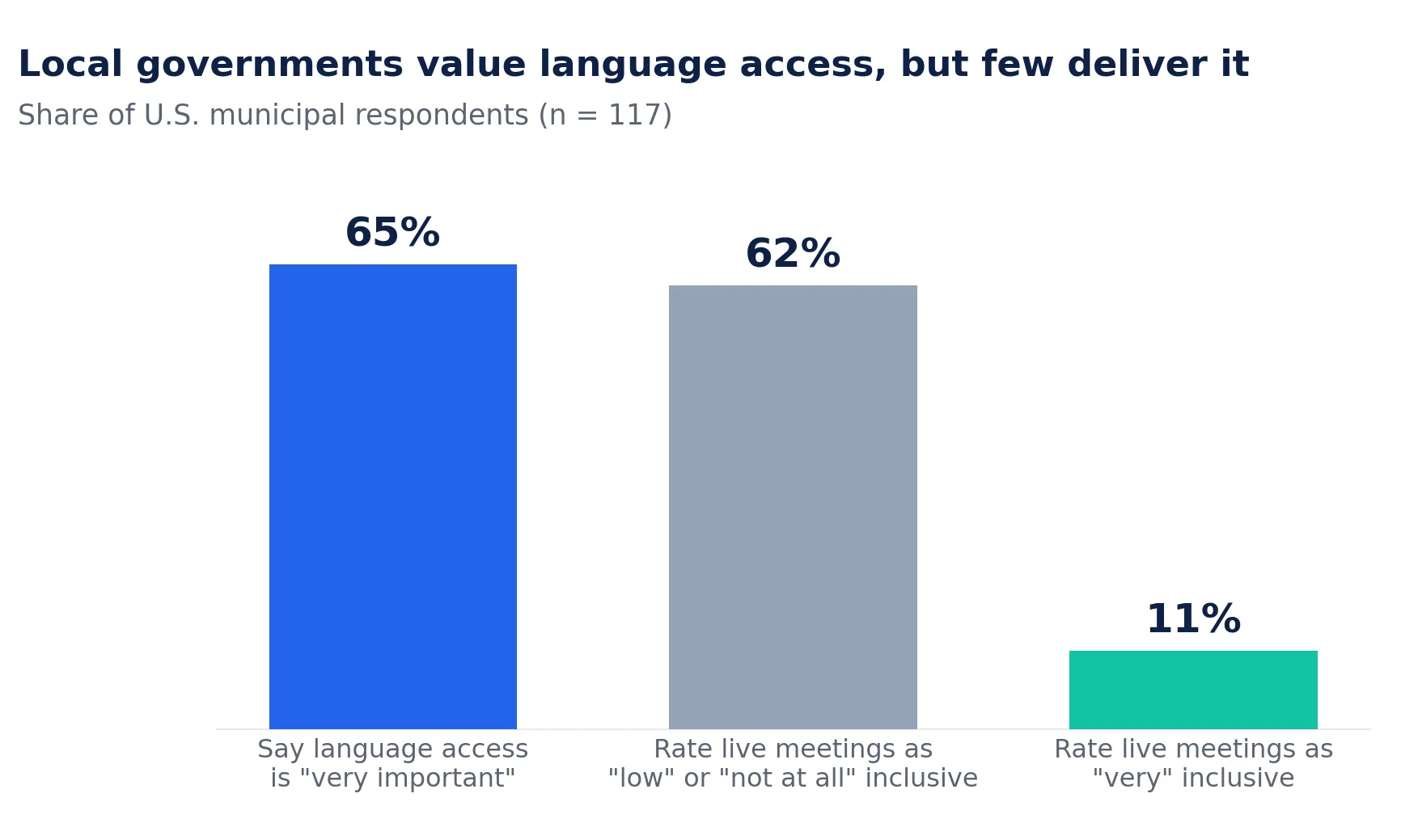
Awareness is high. Nearly two-thirds of respondents (65%) say providing language access and inclusivity is "very important" for their community, and only 11% consider it a low priority or not important at all. Local governments increasingly view language access not only as a matter of equity, but as a driver of civic engagement, economic development, and institutional effectiveness.
The problem is the gap between belief and practice. Whether the setting is a city council translation for a public comment period or a routine community meeting, agencies want to be inclusive but struggle to deliver. When asked how inclusive their live meetings and interactions actually are for non-native English speakers and people who are hard of hearing, 62% described them as "low" or "not at all" inclusive.
Just 11% called their interactions "very" inclusive. These gaps are not only operational. Without inclusive communication, public trust, participation, and compliance all suffer.
The data points to a few clear pain points that limit access, participation, and equity. Cost and complexity dominate, and many agencies still lean on informal solutions that are hard to scale.
When asked what holds them back, agencies point to a familiar mix of cost, complexity, and uncertainty.
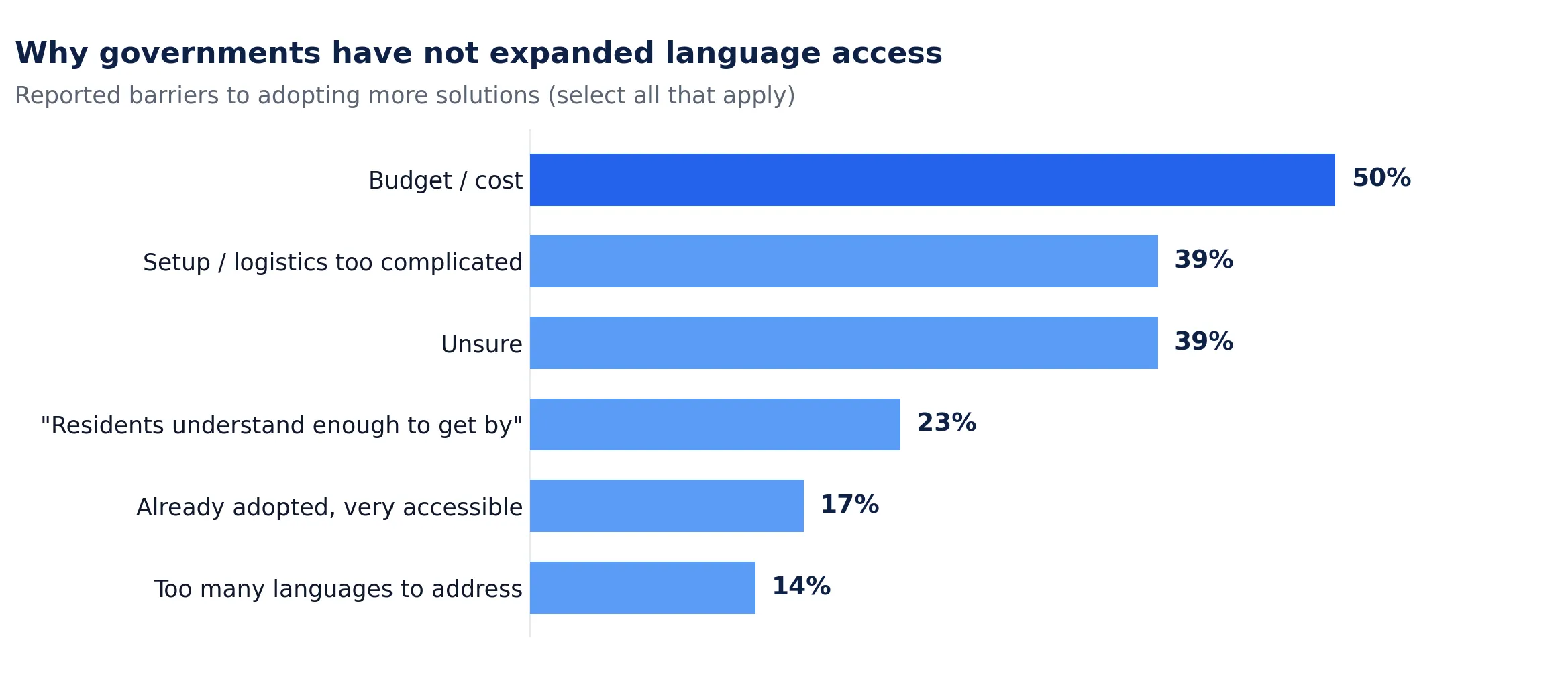
Half of respondents (50%) say budget limitations are the main reason they have not implemented more robust language access solutions. With many agencies under pressure to do more with less, cost is the first hurdle any new program has to clear.
See what modern AI translation could mean for your budget with our cost savings calculator.
Language access is not only about money. It is about management. Over a third of respondents (39%) struggle with the operational challenge of coordinating multilingual support, especially when several languages are involved and staff capacity is limited. Setup, scheduling, and equipment all add friction.
The most commonly used tools are the least scalable. Two-thirds of agencies (66%) rely on employees who happen to be bilingual, and half (50%) use written materials translated into other languages. More consistent, scalable options like AI translation software (31%) and professional interpreters (used by 28% for a single language and 19% for all languages spoken) remain underused. That gap is the clearest signal of an opportunity to modernize.
Only about 1 in 5 municipalities (21%) named staff training as a key objective for improving engagement with non-native English speakers and people who are hard of hearing. Workforce readiness appears to be overlooked in a lot of language access planning, which can undermine even well-funded programs.
When asked which tools they use to engage non-native English speakers during live meetings and communications, respondents pointed mostly to people and paper rather than technology. Bilingual employees (66%) and translated written materials (50%) lead by a wide margin. Captions follow at 37%, then AI translation software at 31%, professional interpreters for a single language at 28%, professional interpreters for all languages spoken at 19%, and sign language interpretation at 18%.
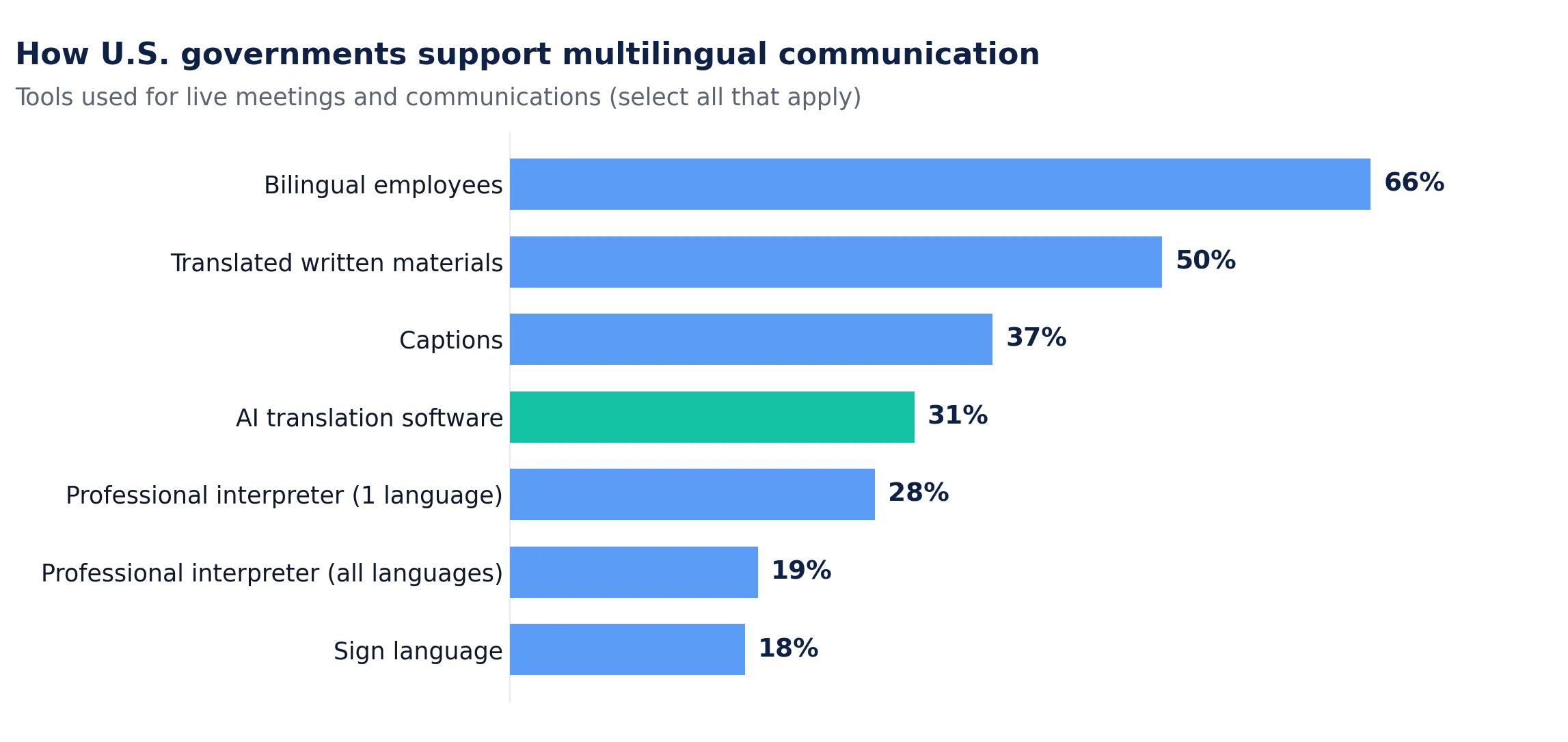
Relying on bilingual employees can work for a single common language, but it is hard to scale across many languages, hard to guarantee for every meeting, and it pulls staff away from their actual jobs. Written translations help with documents but do nothing for live conversation. The relatively low use of captions, real-time meeting translation, captions, and professional interpreters across multiple languages is exactly where most agencies have room to improve..
Language access needs vary significantly by community size. Smaller municipalities tend to face resource and awareness challenges, while larger cities manage greater linguistic diversity but also invest more in tools. Urgency rises steadily as population grows. The sharpest contrast is in how urgent each group considers language access to be.
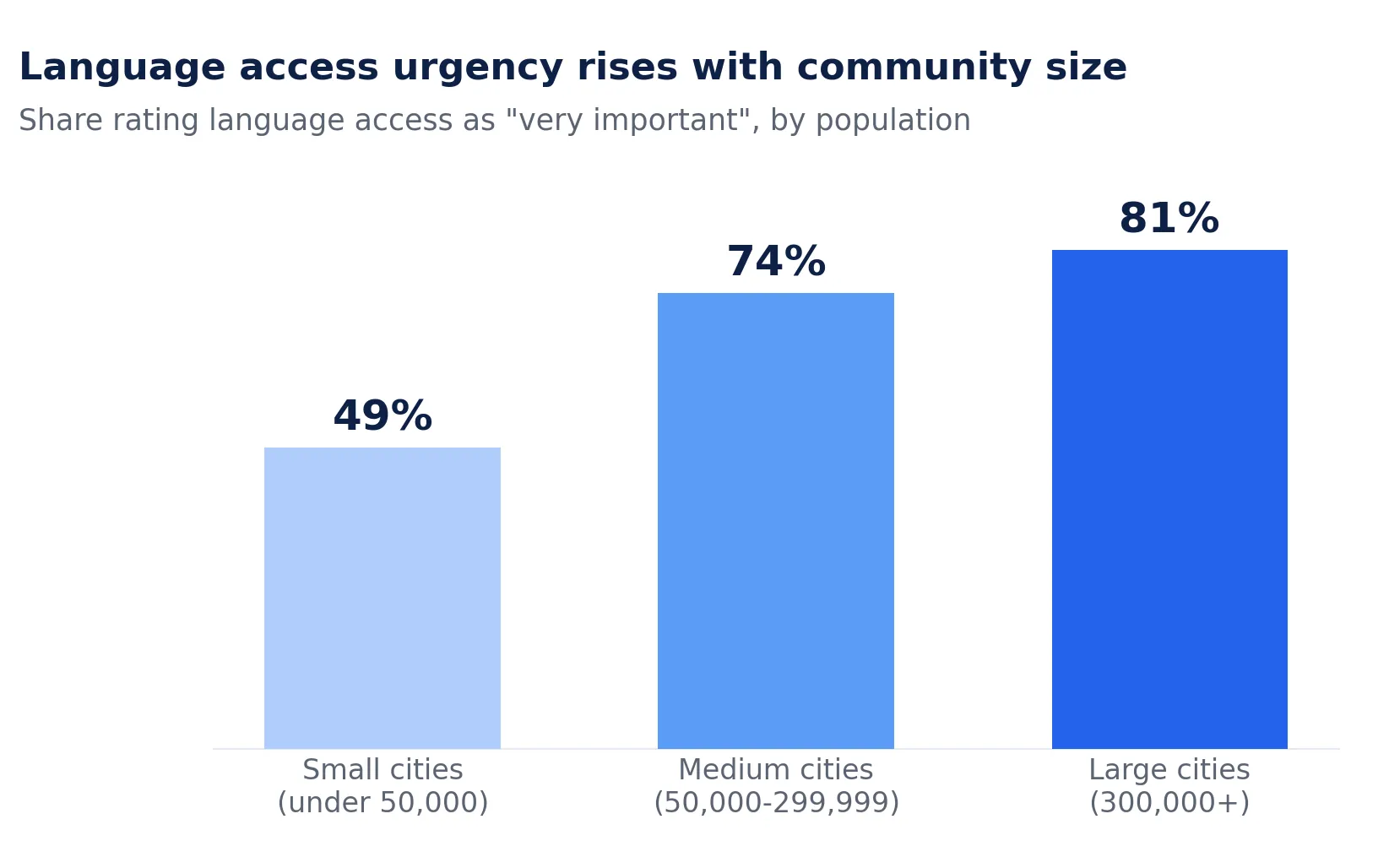
Small cities are still early in recognizing and addressing multilingual needs. Fewer than half (49%) rate language access as "very important," and a combined 76% describe their live meetings as "low" or "not at all" inclusive. Budget is the dominant barrier, cited by 54%. They lean on bilingual employees (53%) over scalable tools like AI translation (42%), and awareness is a real issue: 43% have no plans to evaluate AI-powered translation and 6% had never heard of it.
Medium cities show a stronger commitment, with 74% calling language access "very important," but inclusivity still lags, as only 5% rate their meetings as "very" inclusive. Here complexity is as much of a challenge as cost: setup and logistics barriers (48%) rival budget concerns (45%). The upside is openness to change, with 66% either currently evaluating or interested in evaluating AI-powered translation.
Large cities lead in prioritizing, resourcing, and modernizing language access. A strong majority (81%) rate it as "very important," and 31% report more than 20 non-English languages spoken locally. They also do better in practice, with 25% describing their meetings as "very" inclusive, well above smaller communities. Large cities invest more heavily in tools, including professional translators, captions (56%), and translated written materials (81%), and 56% are evaluating or interested in evaluating AI translation. Even so, gaps in full inclusion remain.
The common thread across every tier is that as community diversity increases, scalable solutions like AI translation become the most practical path to inclusive communication, regardless of city size.
To see how geography and governance styles may influence strategy, the research compared responses from municipalities in traditionally Democratic-leaning ("Blue") and Republican-leaning ("Red") states, based on 2024 presidential election results. This comparison is intended to identify trends, not to make political judgments. It includes 58 municipal employees in Blue states and 54 in Red states.
Both groups recognize the importance of inclusive communication, though urgency varies. In Blue states, 75% say language access is "very important," compared with 52% in Red states. Implementation lags in both: half (50%) of Blue state respondents rate their meetings as very or moderately inclusive, versus 29% in Red states. These differences may reflect how inclusivity is defined or experienced from place to place as much as the tools in use.
The most common tool in both regions is relying on bilingual employees, though it is more prevalent in Blue states (78% versus 54%). Adoption of AI-powered translation is relatively even but still low, at 33% in Blue states and 29% in Red states. Budget is the top barrier everywhere, cited slightly more often in Red states (53% versus 47%), where respondents were also more likely to feel that "most residents understand enough to get by."
Demographics differ in revealing ways. More municipalities in Red states report rising numbers of non-native English speakers (67% versus 55%), while Blue states report more linguistically diverse communities, with nearly a quarter (24%) serving areas where 10 or more languages are spoken, compared with 16% in Red states. Priorities split too: Blue states lean toward civic engagement (81% versus 54%) and compliance (64% versus 32%), while Red states lead on public safety (70% versus 55%). Interest in evaluating AI translation runs higher in Blue states (64%) than Red states (46%), signaling curiosity in both but a wide opening for awareness and education.
Agencies overwhelmingly see language access as an investment with broad payoff, not just a box to check. The most anticipated outcomes are stronger collaboration and better compliance, followed by workforce and economic gains.
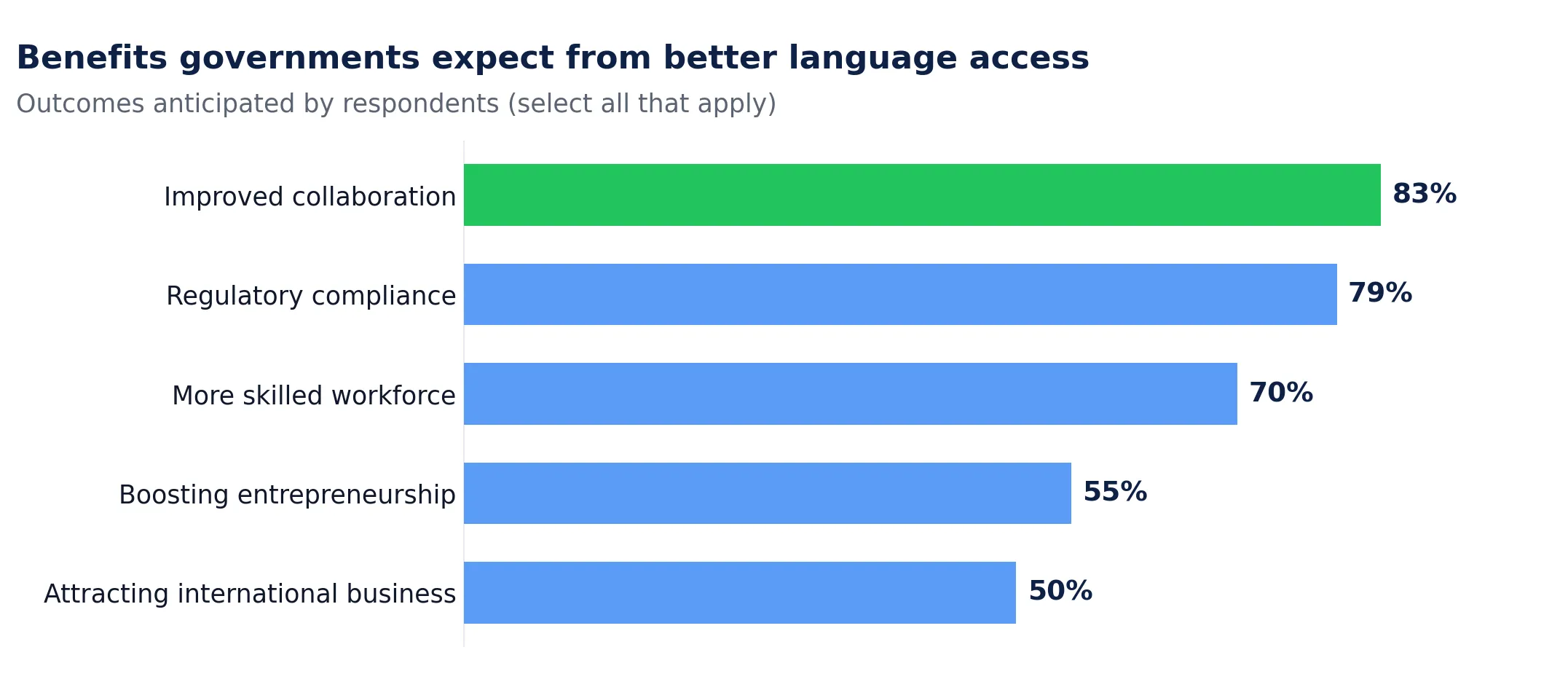
A large majority (83%) believe better language access will strengthen collaboration between local government and residents, and 79% expect it to help meet legal and regulatory obligations more effectively. Seven in 10 (70%) see language inclusivity as a way to attract and retain a more diverse, skilled workforce, while 55% expect it to boost local entrepreneurship and 50% think it can help attract international business. Taken together, these responses frame language access as a lever for civic engagement, economic development, and institutional effectiveness all at once.
When agencies are asked what better engagement is mostly about, public-facing priorities rise to the top: 81% point to access to public services such as permit or passport applications, 67% to civic engagement and participation in community meetings, and 61% to public safety and making sure critical information is communicated. Fewer cite legal compliance (49%) or law enforcement (40%) as the primary driver, which suggests most agencies see language access first as a service and engagement issue, with compliance as a benefit that follows.
Interest in AI-powered translation is high, even though adoption is still emerging. More than half of respondents (57%) are either currently evaluating the technology or plan to, broken down as 24% actively evaluating and 33% interested in doing so. About 28% have no plans to evaluate it, 12% have never heard of it, and only 4% tried AI tools and found they did not meet their needs.
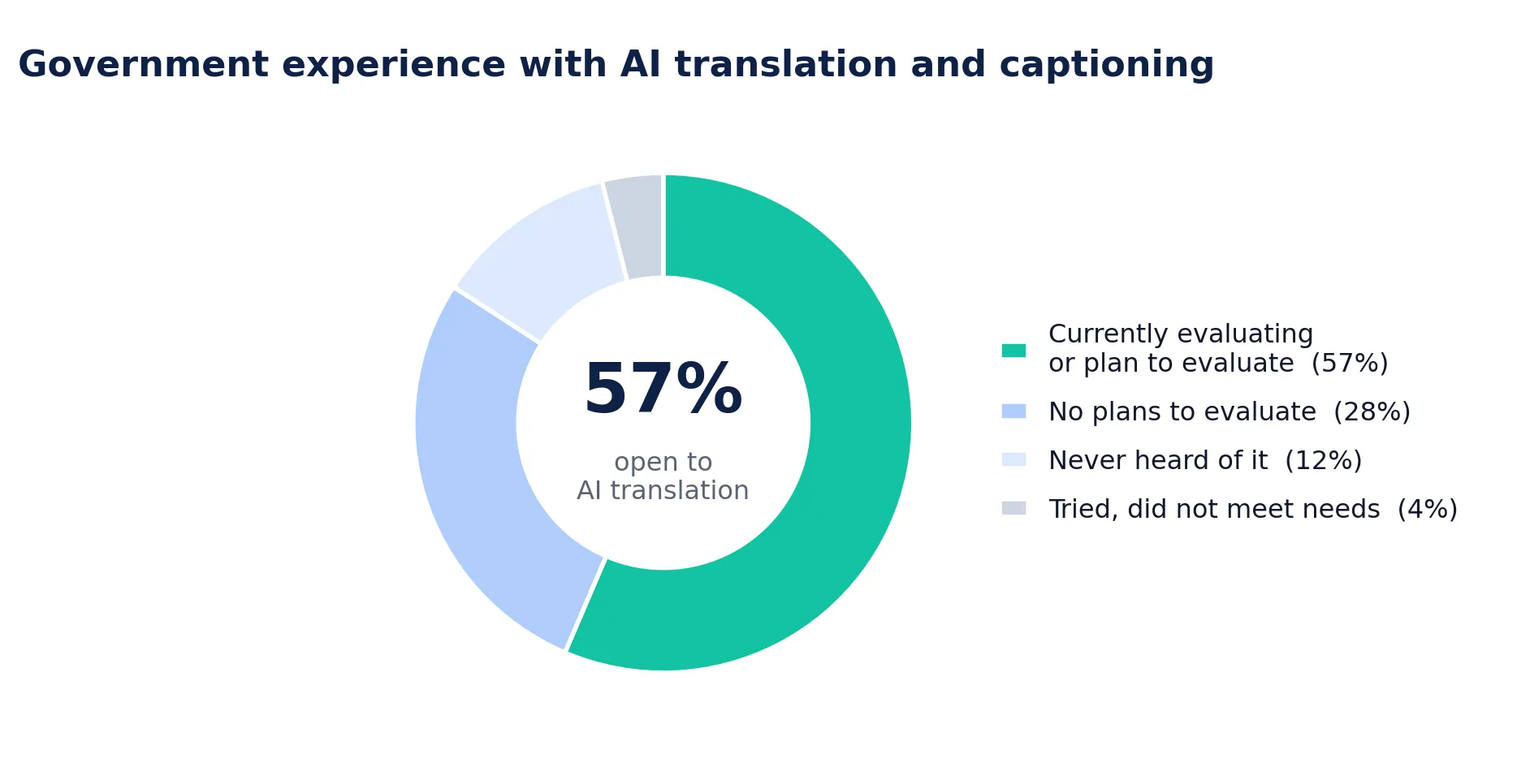
That 4% figure is telling. When agencies do try modern AI translation, almost all of them find it meets the need. The larger barriers are awareness and budget, not the technology itself. Combined with the fact that today's most common tools are the least scalable, this points to a clear opportunity: AI-powered translation and captioning can deliver consistent, real-time language access across many languages without the staffing and equipment overhead that has held agencies back.
If your agency is ready to make communication more inclusive, the research points to a practical, three-step path.
Start by documenting how your agency supports multilingual communities today. Many still depend on informal solutions like bilingual employees or static translations, which are difficult to scale. An internal audit helps you find coverage gaps, inefficiencies, and the highest-value places to introduce more consistent, scalable practices.
Focus first on the programs and services where language barriers cause the most friction. Civic meetings, public hearings, and community outreach often lack inclusive communication support, and emergency alerts, safety notices, and essential services must reach every resident. These high-stakes areas were named as top priorities by more than 80% of the municipalities surveyed.
Finally, explore automated solutions that support multilingual communication in real time. Technology now makes it possible to deliver language access without heavy infrastructure or extra staffing. AI-powered platforms offer secure, scalable options for live translation and captioning, making it easier for agencies to expand access, reduce costs, and serve their communities more effectively.
Done well, modern government interpretation does more than satisfy compliance requirements. It builds trust across diverse communities, strengthens civic engagement, and makes sure essential information reaches everyone, regardless of the language they speak.
Wordly provides high-quality, secure, easy-to-use, and affordable live AI translation and live captioning for communicating across dozens of languages. With years of innovation and thousands of customers worldwide, hundreds of government agencies of all sizes rely on Wordly to increase civic engagement, improve access to services, enhance employee training, meet compliance requirements, and reduce interpreter costs.
Because Wordly is a SaaS platform that meets enterprise-grade security and privacy standards, agencies can add real-time translation and captions to in-person and virtual meetings without special equipment or human interpreters. That makes it a practical answer to the exact barriers this research surfaced: it scales across many languages, removes most of the logistical overhead, and costs far less than staffing interpreters for every meeting.
Planning a meeting or event? Use our hours calculator to estimate how many hours of Wordly you will need.
Wordly surveyed 117 U.S. local governments on language access. Download the full 2025 report for the complete data on rising demand, top barriers, AI translation adoption, and the steps agencies are taking next.
Download ReportIt is a 2025 research report from Wordly, produced with SmartBrief, that surveyed 117 local government professionals across more than 30 U.S. states about multilingual communication. It measures how cities, counties, and boroughs approach language access, the barriers they face, and how they are adopting AI translation and captioning.
Wordly partnered with SmartBrief, which syndicated the survey to subscribers of the ICMA (International City/County Management Association) newsletters. It ran online in February and March 2025 and was published in May 2025. The 117 respondents included city clerks, public information officers, IT and innovation leaders, and emergency management officials from communities ranging from under 10,000 to more than 500,000 residents.
A majority (61%) of municipalities report that the number of non-native English speakers in their community is rising. More than 94% serve communities where two or more non-English languages are spoken, and 52% have five or more languages spoken locally.
Budget is the single greatest barrier, cited by 50% of respondents as the main reason they have not implemented more robust solutions. Logistical complexity is second, named by 39% who struggle to coordinate multilingual support across several languages with limited staff.
The most common tools are bilingual employees (66%) and translated written materials (50%), followed by captions (37%), AI translation software (31%), professional interpreters for a single language (28%), professional interpreters for all languages (19%), and sign language interpretation (18%). The leading tools are the least scalable, which is where most agencies have room to improve.
Urgency rises with size. Among small cities (under 50,000 residents) 49% call language access "very important," compared with 74% of medium cities (50,000 to 299,999) and 81% of large cities (300,000 or more). Large cities also invest more in captions and professional translators and are more likely to rate their meetings as "very" inclusive.
Adoption is emerging but interest is high. About 57% of agencies are currently evaluating AI-powered translation or plan to, while only 4% tried it and felt it did not meet their needs. The main obstacles are awareness and budget rather than the technology itself.
Most respondents (79%) expect that clearer, more accessible communication will help them meet legal and regulatory obligations more effectively, and 49% cite compliance as a direct reason to invest. Accessible communication supports obligations such as the Americans with Disabilities Act and language access requirements for residents with limited English proficiency.
The research recommends three steps: audit your current efforts to find gaps, prioritize high-impact areas like civic engagement and public safety, and evaluate modern AI-powered interpretation solutions that deliver real-time translation and captioning at scale without heavy infrastructure.
Wordly is a secure, affordable live AI translation and captioning platform used by hundreds of government agencies. It delivers real-time translation across dozens of languages for in-person and virtual meetings without special equipment or human interpreters, directly addressing the cost, scale, and logistics barriers the research identified.
A subsidiary of Future Plc, SmartBrief is a leading digital media publisher of targeted business news, delivering curated industry news in partnership with leading trade associations, professional societies, and nonprofits to nearly seven million professionals. ICMA SmartBrief is a daily newsletter covering local-government news. ICMA is the leading organization of local government professionals, working with more than 13,000 members to identify and speed the adoption of leading practices that improve residents' lives.
Wordly provides high-quality, secure, easy-to-use, and affordable live AI translation and captions for communicating across multiple languages in real time. Its platform meets enterprise-grade security and privacy standards and eliminates the need for human interpreters or special equipment. Millions of users across thousands of organizations in the corporate, nonprofit, government, education, and faith sectors trust Wordly for their language access needs.
.avif)
.avif)
.png)
%20(1)%201.webp)
.png)
In a 30-minute video call, we will show you how Wordly can work for your use case, and answer questions.
.avif)