Turn translation & captions into revenue with Sponsor Logos → Learn More
Offer floor audio without equipment rental with Silent Theater → Learn More
Published June 2022 | First Annual Edition | Conducted by Dimensional Research
The definitive guide to interpretation and translation usage for multilingual meetings and events
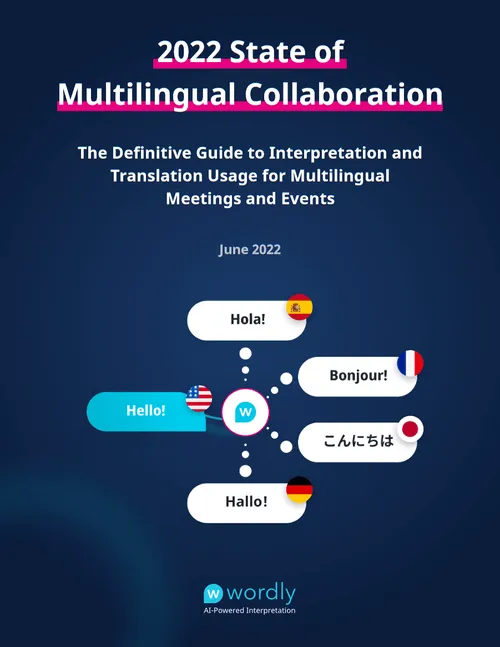
Wordly's 2022 State of Multilingual Collaboration report surveyed 203 corporate meeting and event professionals in the US and UK about how they handle multilingual audiences. The 2022 study found that 77% saw a rising number of attendees who do not speak English as a first language, 60% typically supported six or more languages at an event, and 95% had some experience offering interpretation or translation. Yet only 33% offered it regularly, held back by complexity and cost, and 99% said they would adopt a technology solution that solved those problems. This page summarizes the full findings and what they mean for anyone planning multilingual meetings and events.
Most organizations today are global, with employees, customers, partners, and members who speak many different languages. That creates a real communication challenge, because the language spoken from the stage is often not the language each attendee would choose, which lowers engagement, inclusion, and productivity. This study set out to understand how event teams were handling that challenge in 2022, how often they used interpretation, what stopped them from doing more, and what they wanted from the technology emerging to help.
This was Wordly's first in-depth research into live translation for meetings and events, and it established a baseline that later studies built on. The picture it paints is of an industry that already understood the value of language inclusion and used interpretation widely, but was constrained by the logistics and cost of traditional, human-powered solutions, and was eager for something easier. The sections below walk through the data in detail.
Wordly commissioned Dimensional Research, an independent market research firm, to conduct the study. Meeting and event managers were invited to complete an online survey, and responses were collected between April 15 and 29, 2022. In total, 203 qualified participants completed it.
Every respondent worked in a sales or marketing role at a company with more than 500 employees, and all had direct responsibility for events with more than 100 attendees where at least 10% of participants did not speak English as a first language. The survey was split evenly between the US and UK and spanned a wide range of industries, including financial services, business services, retail, technology, and manufacturing, and company sizes from 500 to more than 10,000 employees. Respondents managed a broad mix of event types, including employee events (83%), customer events (76%), industry and association conferences (75%), and sales training (70%), across in-person, virtual, and hybrid formats.
Note that due to rounding, some figures may not total exactly 100%.
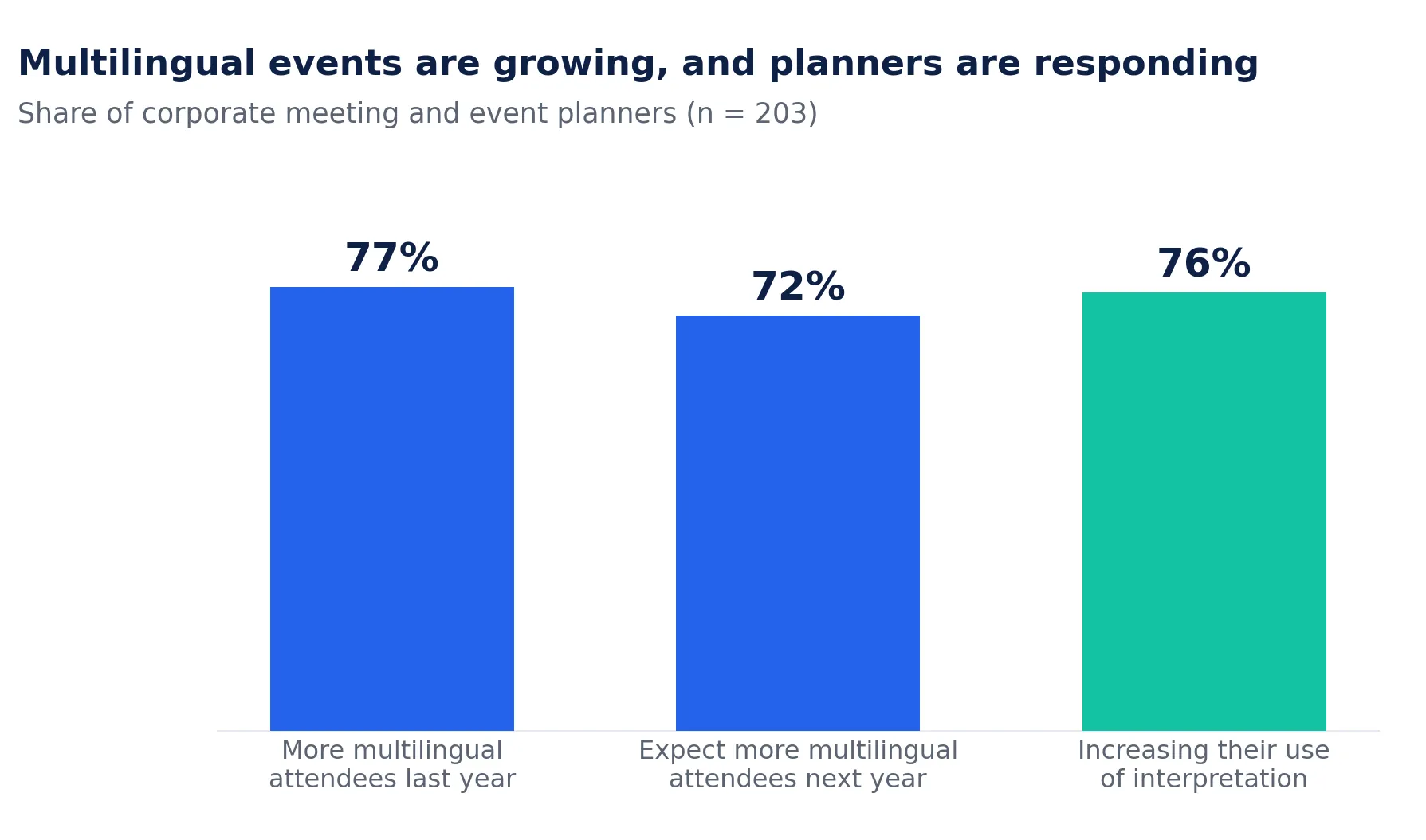
Yes, clearly, and planners expected the trend to continue. More than three-quarters of respondents (77%) reported that the number of attendees who do not speak English as a first language had increased over the past year, and 72% expected it to increase again in the year ahead. The shift to virtual events during the pandemic was a primary driver, with 76% saying that move increased the number of multilingual attendees at their events.
The scale of the audience reinforced the point. More than half of planners (58%) said over a quarter of their event audience typically spoke a different language than the presenter. Multilingual events were not an edge case in 2022; they were the norm for most large corporate gatherings.
Multilingual events often mean many languages at once, not just two. A clear majority of planners (60%) said six or more non-English languages were typically spoken across attendees at their events, and 23% said eleven or more. Only about 1% dealt with a single additional language.
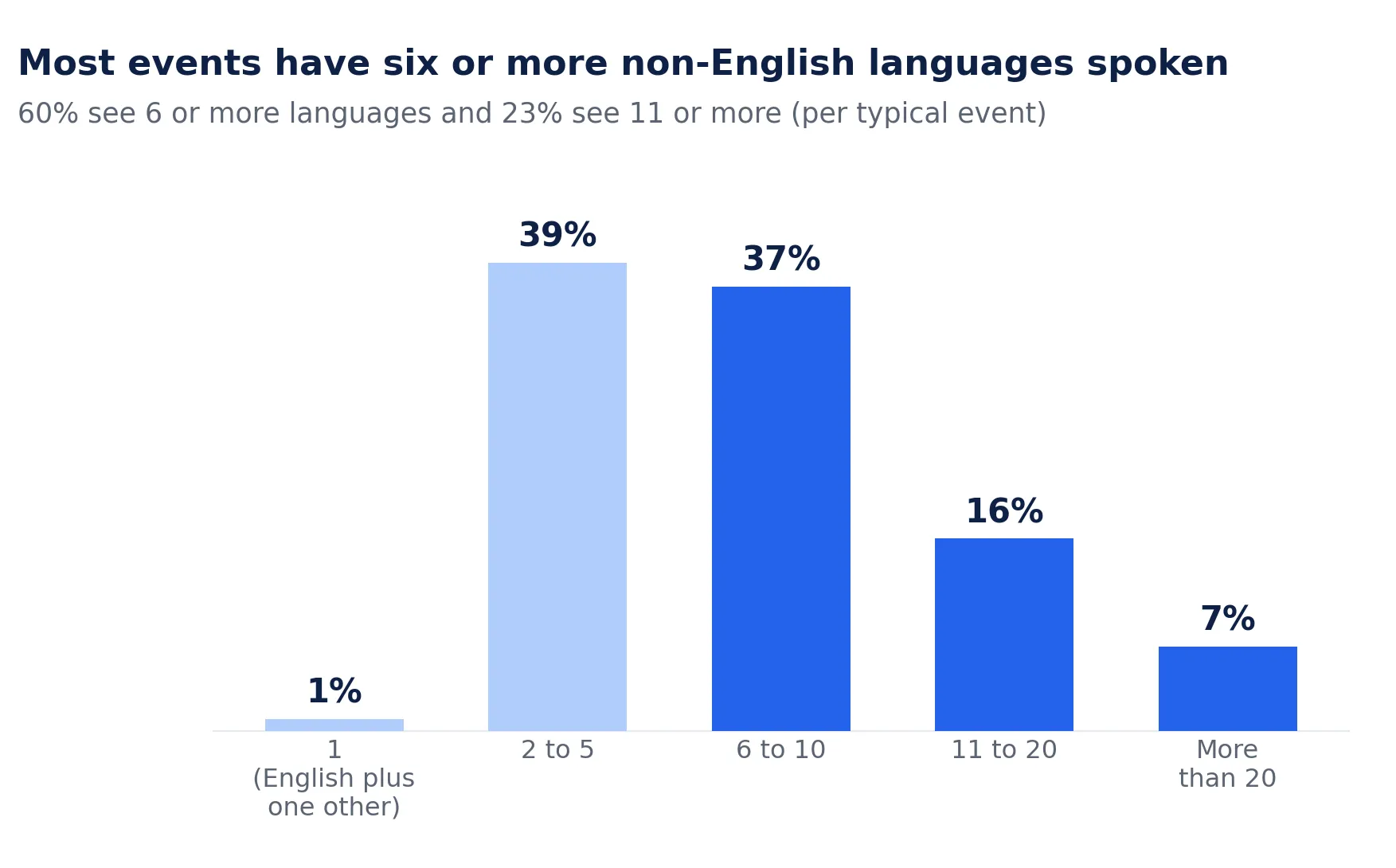
This matters because the traditional solution does not scale neatly. With human interpreters, each additional language generally requires another interpreter, so an event with six, ten, or twenty languages quickly becomes complex and expensive to support. The language counts here help explain why so many planners wanted a more scalable approach.
Interpretation was already in wide use. Almost all respondents (95%) had some experience offering spoken translation or interpretation at their events, and over half (58%) described their experience as significant. Usage was also growing, with 76% saying they had increased how much interpretation they offered over the past year. Marketing teams were more experienced than sales teams (64% versus 48% with significant experience).
Planners used interpretation and translation software across the full range of sessions and formats. More than 60% had used it for every session type, including panel sessions (77%), keynotes (68%), and breakout discussions (61%). By event format, interpretation was most common for in-person events (79%), followed by virtual (61%) and hybrid (47%). In other words, this was not a one-off accommodation for a single keynote; it was woven through many kinds of multilingual meetings and events.
Despite all that experience, consistent delivery was rare. Only 33% of planners said they offered interpretation regularly, meaning always or usually. The reasons were a mix of operational complexity and, notably, a degree of apathy toward attendee needs.
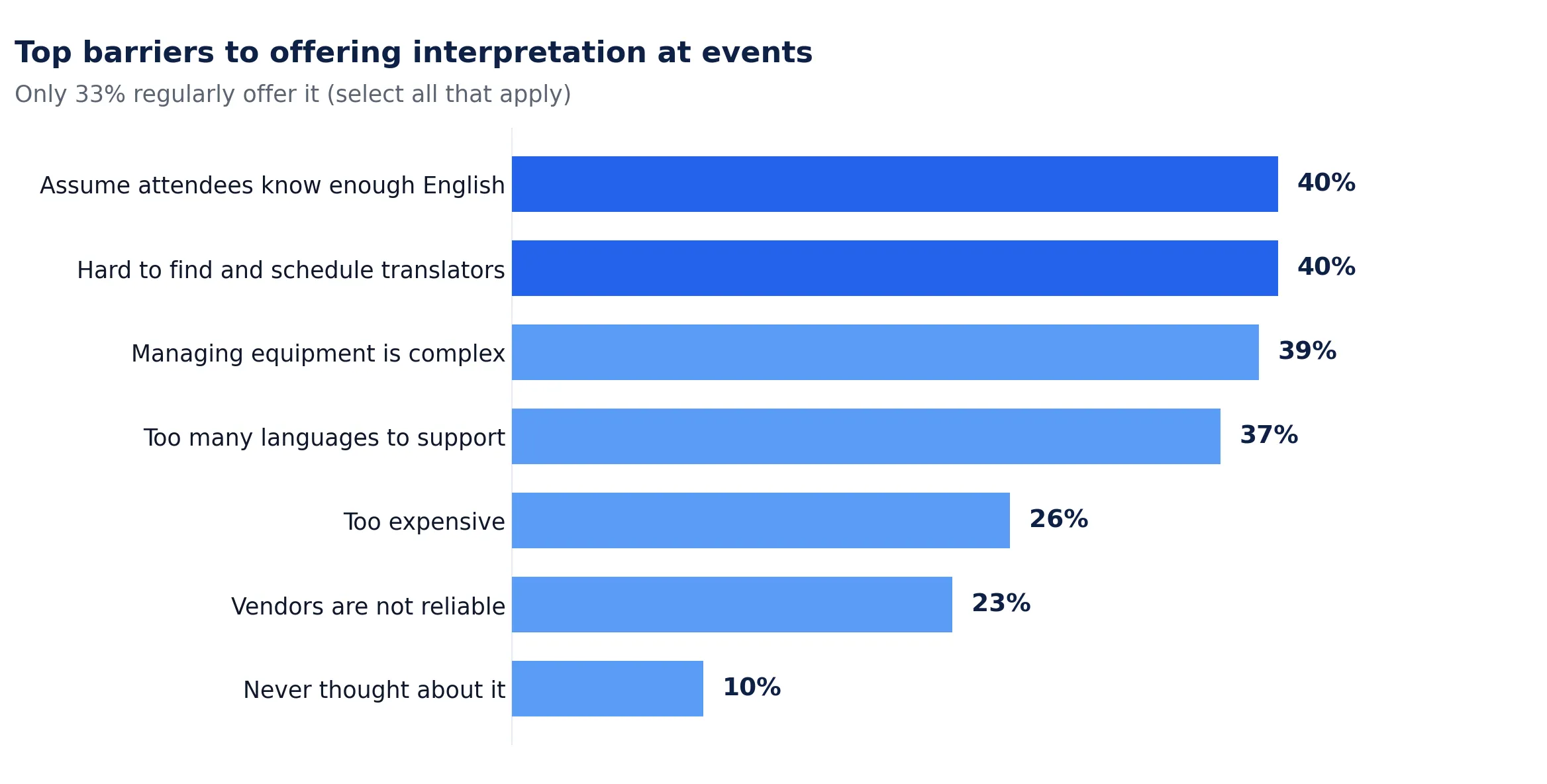
The leading barriers were the complexity of finding and scheduling translators (40%) and managing equipment (39%), along with the difficulty of supporting too many languages to be practical (37%). Tied at the top was a different kind of obstacle: 40% assumed that participants spoke English well enough or would simply choose not to attend. Cost (26%) and unreliable vendors (23%) ranked lower than the logistical and attitudinal barriers.
The study also found that multilingual professionals saw this differently from their monolingual peers, being far less likely to assume attendees would adapt on their own (37% versus 53%).
When asked to imagine a technology solution that could deliver translation to every attendee on their own phone or laptop in any language, without human interpreters, planners were nearly unanimous in their interest and specific about what they wanted. The priorities centered on attendees: making it easy to use and broad enough to cover everyone in the room.
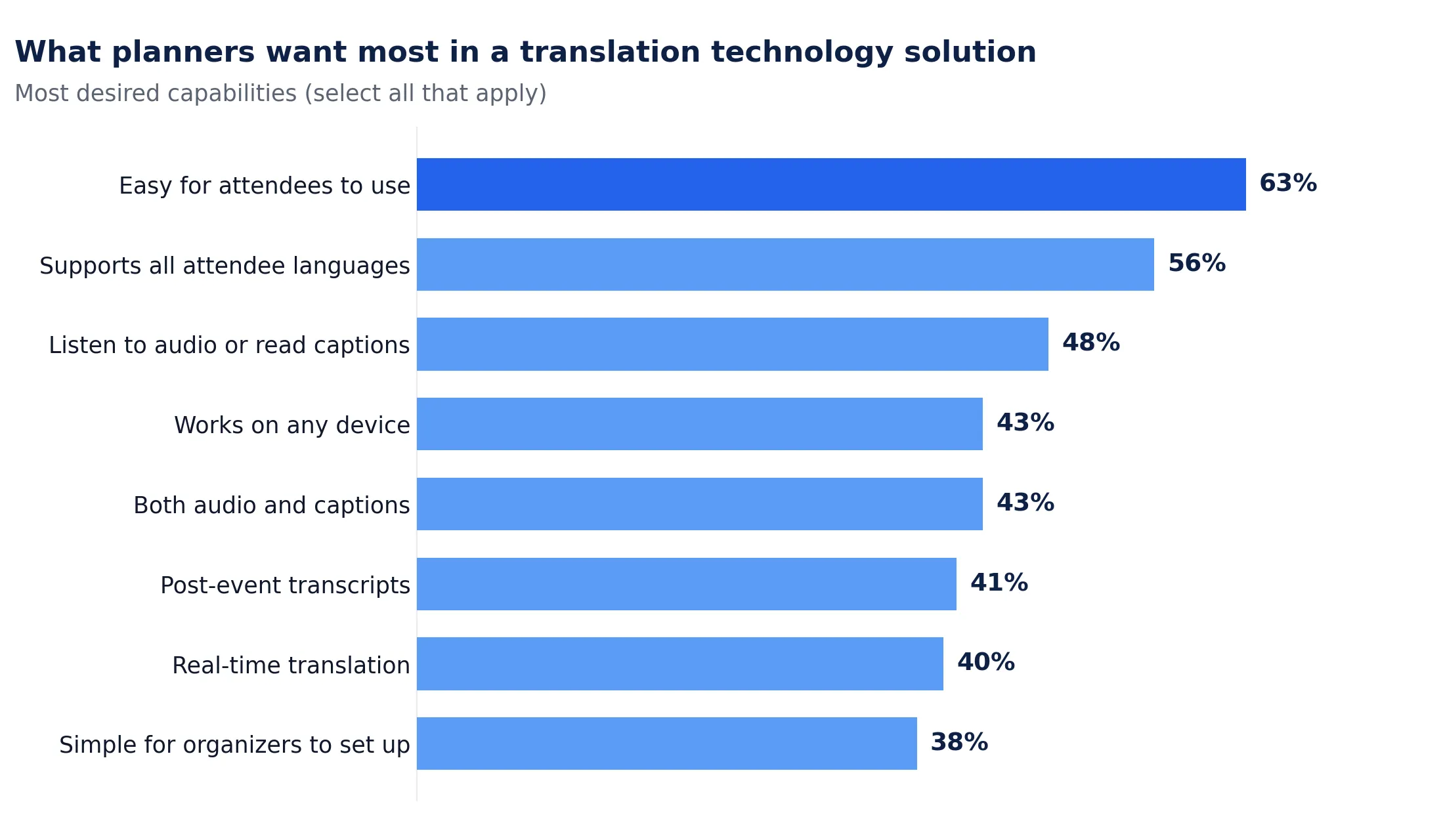
The top three capabilities were ease of use for attendees (63%), support for all languages spoken by attendees (56%), and the ability to listen to audio or read captions (48%), which is exactly what live AI captioning provides, followed by working on any device and offering both audio and text. Cost ranked well below these attendee-facing features, a clear signal that planners were optimizing for attendee experience and language coverage first.
Planners saw strong benefits, both for attendees and for the business. For attendees, the value was about inclusion and comprehension.
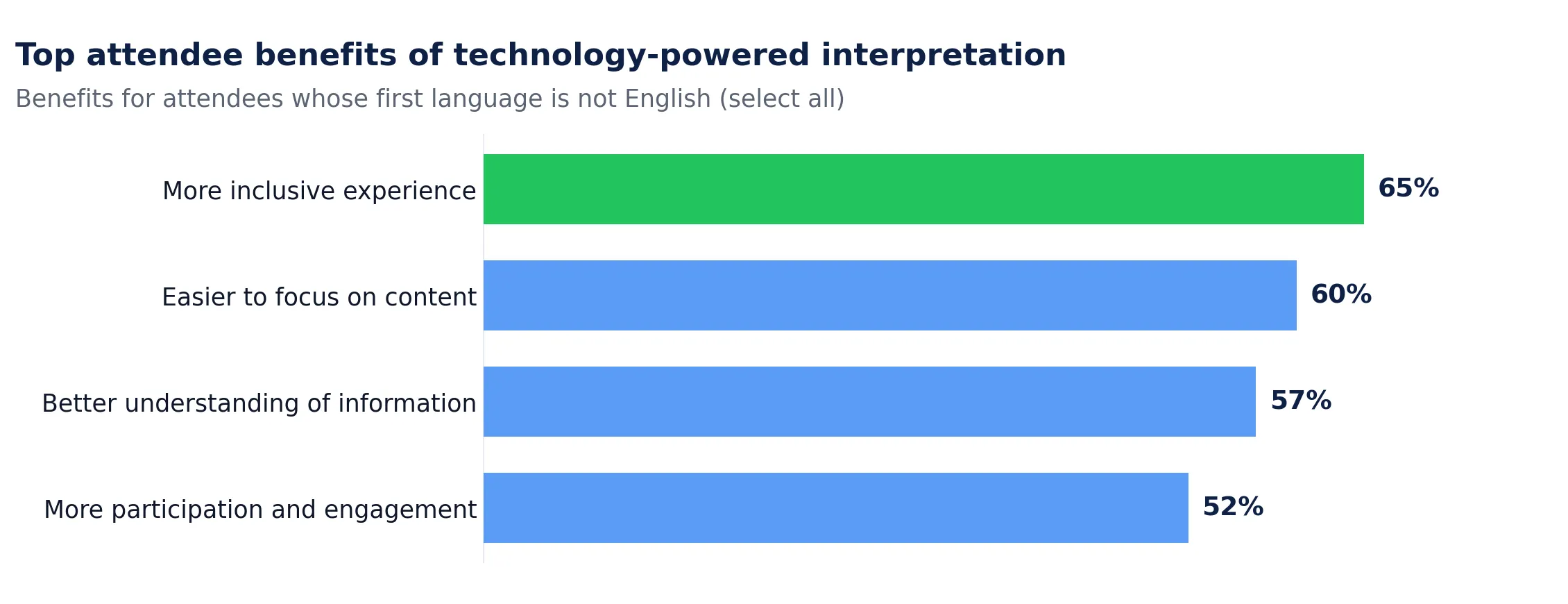
The top attendee benefits were a more inclusive experience (65%), the ability to fully focus on content rather than language (60%), better understanding of the information presented (57%), and more participation and engagement (52%).
For the business, the leading benefits were higher attendee satisfaction (49%) and larger event audiences as language barriers came down (49%), followed by improved comprehension (40%) and reduced complexity compared with human interpretation (38%). The broader sentiment was just as telling: over 90% of planners agreed that increasing inclusivity at their events was a priority and that multilingual events offering interpretation produce better outcomes than English-only ones.
The appetite for a better approach was overwhelming. When asked how likely they would be to use a technology translation solution that included all the capabilities they cared about, 99% said they would, including 56% who said they definitely would.
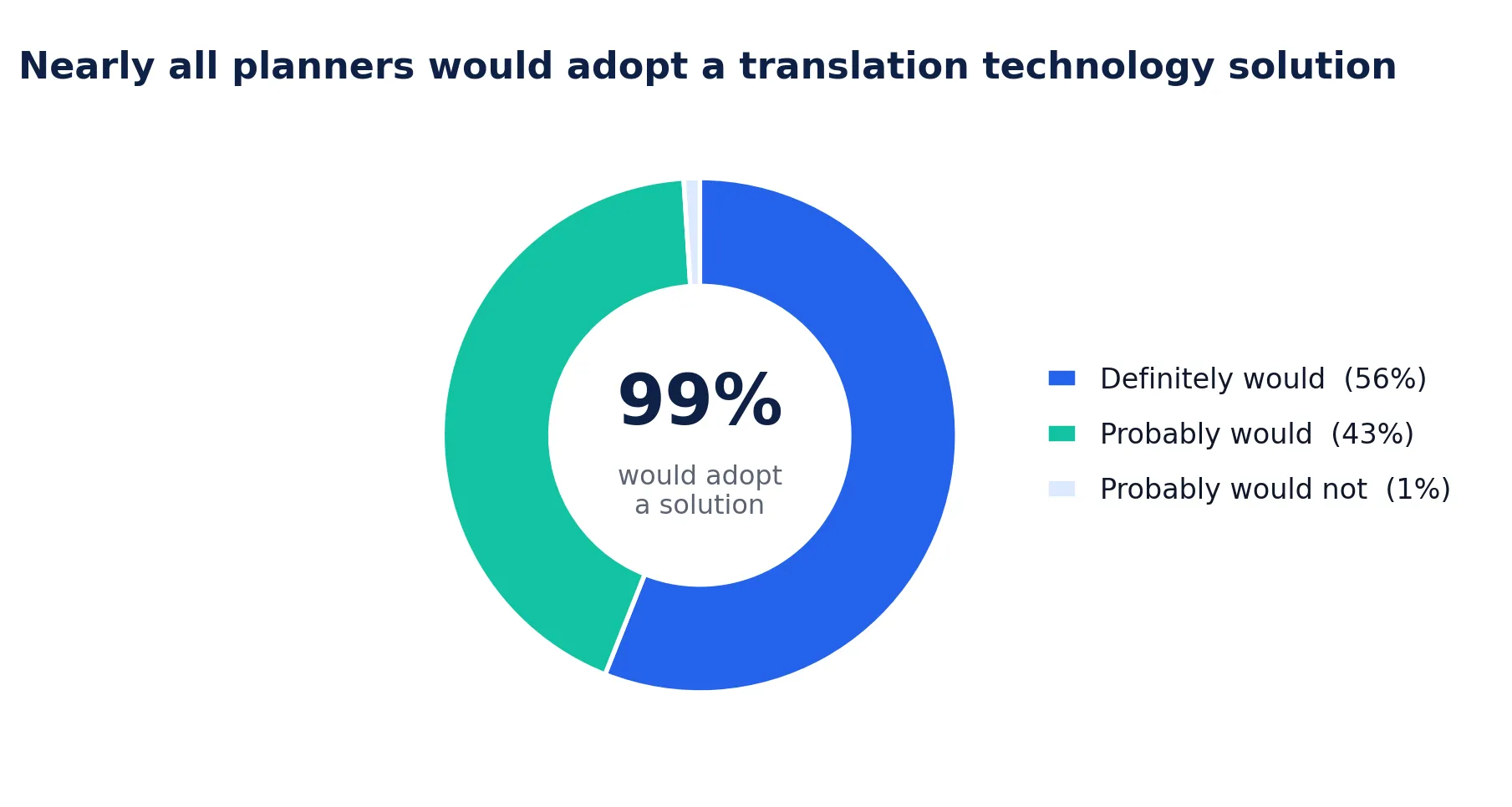
Interest ran even higher in some segments. Planners in the US were more likely than those in the UK to say they definitely would adopt such a solution (70% versus 42%), executives were more eager than managers and individual contributors (63% versus 49%), and software companies topped the list at 85%.
The message from this 2022 baseline was clear: event teams already valued language inclusion and used interpretation widely, but the traditional model was too complex and costly to use consistently, and they were ready for an AI translator to close the gap.
The 2022 findings point to a clear, practical direction for any team planning multilingual meetings and events.
Most large events already included a significant share of attendees who do not speak English as a first language, and that share was growing. Plan for several languages from the outset, and resist the assumption that attendees will simply adapt, since that assumption was one of the biggest reasons interpretation went unoffered.
The barriers planners reported were mostly operational: scheduling translators, managing equipment, and supporting many languages at once. When evaluating options, prioritize how easily a solution scales across languages and how simple it is for both attendees and organizers, because those factors determine whether you can offer language support consistently rather than occasionally.
To see what a scalable solution could mean for your budget, try our cost savings calculator.
Nearly every planner wanted a technology solution that delivered translation to each attendee's own device in any language, without human interpreters. AI-powered translation makes that possible, turning interpretation from a complex, event-by-event project into a repeatable capability you can offer at every meeting and event.
Wordly’s live translation and live captioning platform for meetings and events provides a fast, easy, and affordable way to communicate across many languages. The platform captures the speaker's audio, processes it through a secure cloud infrastructure, and translates it in real time, so presenters speak in their preferred language and attendees read or listen in theirs, on their own computer, tablet, or phone, at in-person, virtual, and hybrid events. Because it removes the need for human interpreters and special equipment, it directly addresses the scheduling, equipment, language coverage, and cost barriers this research identified.
That maps closely to what planners said they wanted back in 2022: a solution that is easy for attendees to use, supports all the languages in the room, and offers both audio and captions on any device. Wordly is trusted by millions of users across thousands of organizations worldwide, spanning corporate, nonprofit, government, education, and faith communities.
Planning an event and not sure how much translation you will need? Our hours calculator helps you estimate how many hours of Wordly to purchase for your sessions.
Wordly surveyed 203 event professionals across the US and UK on multilingual meetings and events. Download the full 2022 report for the complete data on rising multilingual attendance, interpretation use, top barriers, and the demand for technology to solve them.
Download ReportIt is a research study commissioned by Wordly and conducted by Dimensional Research in 2022. It surveyed 203 corporate meeting and event professionals in the US and UK about multilingual audiences, their use of interpretation and translation, the barriers they faced, and their interest in technology solutions. It was Wordly's first in-depth study of live translation for meetings and events.
The 203 respondents all worked in sales or marketing roles at companies with more than 500 employees and had direct responsibility for events with more than 100 attendees where at least 10% of participants did not speak English as a first language. They were split evenly between the US and UK and came from a wide range of industries and company sizes.
Yes. In 2022, 77% of planners reported a rising number of attendees who do not speak English as a first language, and 72% expected the number to grow again the following year. The shift to virtual events during the pandemic was a primary driver of the increase.
A majority of planners (60%) said six or more non-English languages were typically spoken across attendees, and 23% said eleven or more. Only about 1% dealt with a single additional language, which is why interpretation is hard to scale with human interpreters alone.
Yes, widely. 95% of respondents had some experience offering interpretation or translation, and 58% had significant experience. Usage was rising, with 76% offering more than the year before, and interpretation was used across panels (77%), keynotes (68%), and breakouts (61%), most often at in-person events (79%).
Only 33% of planners offered interpretation regularly. The top barriers were the complexity of scheduling translators (40%), assuming attendees know enough English or would not attend (40%), managing equipment (39%), and supporting too many languages (37%). Cost (26%) ranked lower than these operational and attitudinal obstacles.
The most desired capabilities were ease of use for attendees (63%), support for all languages spoken by attendees (56%), and the ability to listen to audio or read captions (48%), followed by working on any device and offering both audio and text. Cost ranked below these attendee-facing features.
For attendees, the top benefits were a more inclusive experience (65%), the ability to focus on content (60%), and better understanding of the information (57%). For the business, the leading benefits were higher attendee satisfaction and larger audiences (both 49%), plus improved comprehension and reduced complexity compared with human interpreters.
Very ready. 99% said they would use a technology translation solution that included the capabilities they cared about, including 56% who definitely would. Interest was highest in the US, among executives, and at software companies (85%).
Wordly provides AI-powered live translation and captions in dozens of languages, delivered to each attendee on their own device with no human interpreters or special equipment required. That directly addresses the scheduling, equipment, language coverage, and cost barriers this research identified, while offering the ease of use and broad language support planners said they wanted.
Dimensional Research provides practical market research for technology companies, partnering with clients to deliver actionable information that reduces risk, increases customer satisfaction, and grows the business. Its researchers specialize in the applications, devices, and infrastructure used by modern businesses and their customers.
Wordly provides live AI translation and captions for dozens of languages, making in-person, virtual, and hybrid meetings and events more inclusive, accessible, and engaging. The platform captures a speaker's audio, processes it through a secure cloud infrastructure, and translates it in real time, with no human interpreters or special equipment required. Wordly is used by millions of users across thousands of organizations worldwide, spanning corporate, nonprofit, government, education, and faith communities.
.avif)
.avif)
.png)
%20(1)%201.webp)
.png)
In a 30-minute video call, we will show you how Wordly can work for your use case, and answer questions.
.avif)