SB 707 & The Brown Act: A Compliance Checklist for California Public Agencies
.avif)
.avif)
Public meetings were never designed to operate like complex digital infrastructure, yet that is exactly the reality California’s Senate Bill 707 (SB707) is forcing government agencies to confront.
Starting July 1, 2026, public meetings will no longer be evaluated solely on whether they happen, but on whether they work reliably for everyone. This includes residents attending remotely and diverse communities that rely on language access to participate meaningfully in the democratic process.
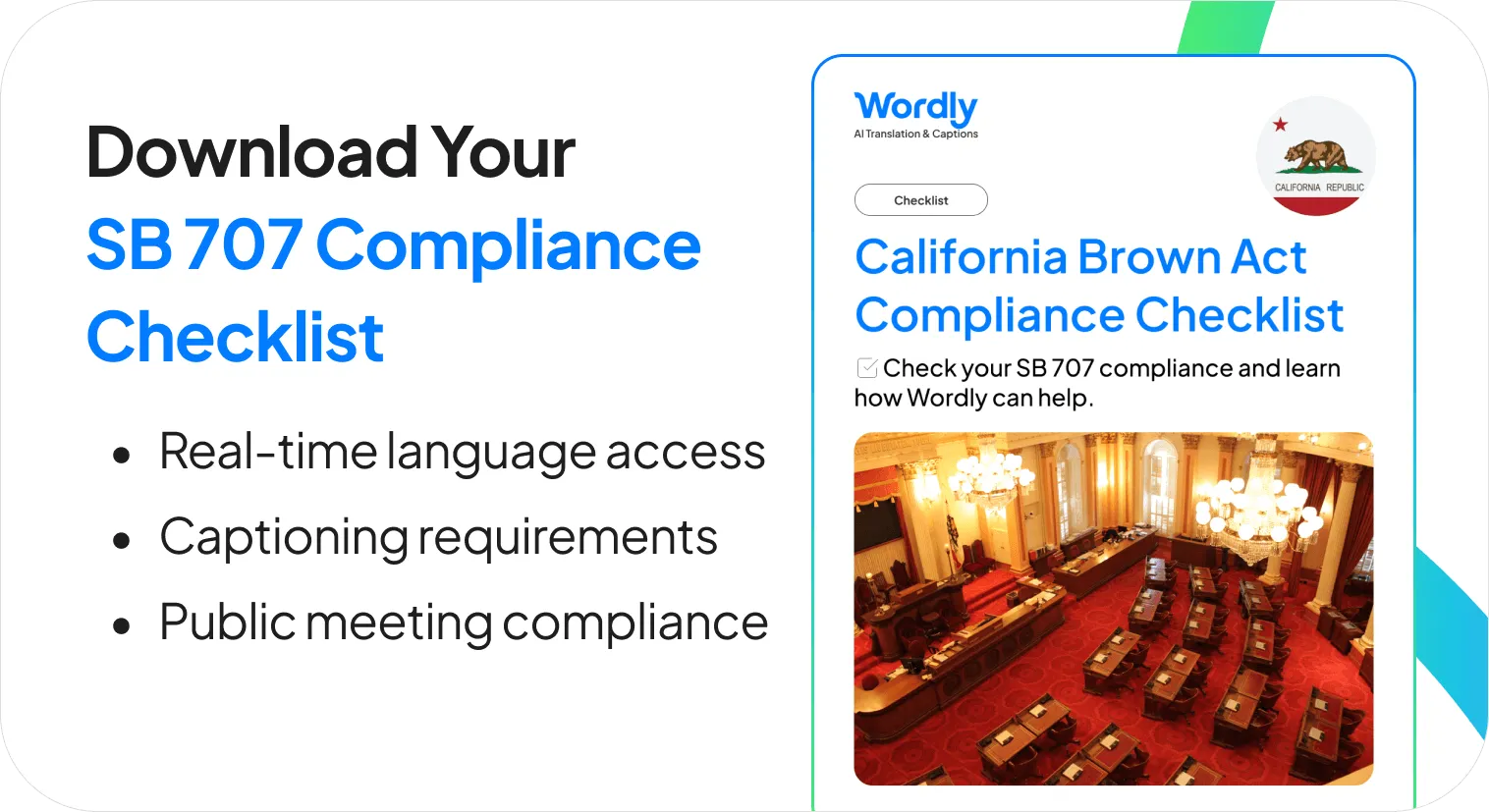
To help agencies pressure-test their readiness, Wordly has created a comprehensive SB707 Compliance Checklist that maps these new legal requirements to operational realities, ensuring your agency is prepared well before the deadline.
Why SB707 Is a Systems Test, Not Just a Policy Update
SB707 is often described as a routine update to the Brown Act, but in practice, it behaves more like a rigorous systems test for your entire organization. It requires a holistic approach that intersects with multiple departments and technologies, including:
- Meeting Technology and AV Reliability: Ensuring seamless audio and video feeds for remote and in-person participants.
- Language Access Planning: Implementing timelines for translation and interpretation services.
- Public Communications: Updating website architecture to ensure participation instructions are clear and accessible.
- Staff Roles and Crisis Management: Defining clear responsibilities during technical disruptions.
Historically, most compliance efforts lived in a single department, like the Clerk’s office or IT. SB707 changes that dynamic. Because no single department typically owns the entire meeting experience end-to-end, many agencies feel stuck. This legislation demands cross-functional collaboration to ensure fiscal responsibility and public trust.
When Compliance Breaks Down
The biggest risk regarding SB707 is partial compliance in practice. We are seeing a quiet failure where meetings technically occur, but functionally fail to provide meaningful access.
Common examples that agencies are already flagging internally include:
- Inconsistent Captioning: Captions are enabled on screens in the room but are missing on the public livestream.
- Delayed Translations: Participation instructions are translated, but posted too late to meet strict notice timelines.
- Unrehearsed Protocols: Disruption policies are written in a handbook but have never been rehearsed by staff, leading to chaos when technology fails.
SB707 significantly raises the standard for what counts as “meaningful access,” especially for eligible legislative bodies beginning July 1, 2026. When something goes wrong, agencies are expected to show good-faith efforts to restore access immediately, rather than improvising solutions in real time.
How are prepared agencies approaching SB 707 readiness?
Agencies that feel most confident about SB707 share one thing in common: they started treating it like an operational refresh rather than a burden. Most are organizing their readiness work around three core areas to ensure operational efficiency and compliance.
1. Meeting Reliability and Disruption Response
Instead of assuming technology will work perfectly, forward-thinking agencies assume it won't and plan accordingly. They are establishing backup audio paths, defining clear staff roles for troubleshooting, and documenting disruption procedures as standard operating protocol.
2. Captions and Accessibility Delivery
Agencies are validating exactly where captions appear, whether on in-room displays, livestreams, or recordings, and ensuring they function consistently across all meeting formats. Accessibility is being rigorously tested, not just "enabled" in settings.
3. Language Access Workflows
SB707’s “applicable language” thresholds introduce real planning work. This involves running demographic analyses, setting realistic translation timelines, and ensuring participation instructions stay synchronized across all required languages to foster collaboration with diverse constituents.
Why Staffing Alone Won’t Solve the Problem
Many agencies’ first instinct is to request budget approval for more staff. In reality, the bigger gains often come from standardization and scalable technology.
To achieve true efficiency, agencies should focus on:
- Reducing Complexity: Minimizing one-off meeting setups that are prone to error.
- Establishing Ownership: Assigning clear ownership of the meeting experience.
- Scalable Technology: Implementing technology like Wordly that scales across meetings instead of being rebuilt each time.
SB707 rewards agencies that reduce complexity, not those that pile more processes on top of fragile systems.
Frequently Asked Questions (FAQ) About SB707
When does SB707 go into effect?
The primary requirements for SB707 regarding improved remote access and visibility for legislative bodies begin on July 1, 2026. However, agencies are encouraged to begin pressure-testing their systems now to ensure full compliance by the deadline.
Does SB707 require us to hire human interpreters for every meeting?
Not necessarily. SB707 focuses on meaningful access. While human interpretation is one method, scalable AI-powered solutions like Wordly can provide real-time translation and captioning that supports aspects of SB707 without the high cost and logistical complexity of scheduling multiple human interpreters for every session.
What happens if our livestream fails during a meeting?
Under the new standards, if a disruption prevents remote public participation or observation, the legislative body may need to take specific actions, potentially including pausing the meeting until access is restored. Having a documented "disruption response" plan is critical to maintaining compliance and public trust.
How does Wordly help with SB707 compliance?
Wordly helps agencies support accessibility and language access requirements by providing real-time AI translation and captioning for in-person, virtual, and hybrid meetings. It automatically detects speaker languages, offers text and audio output for attendees, and integrates seamlessly with existing AV setups, ensuring reliable access for all constituents.
Identify Your Baseline Before You Invest
With the 2026 deadline approaching, the smartest move agencies can make right now is to establish a readiness baseline. Ask yourself: What already works? What only works sometimes? And what hasn’t been tested at all?
That is the purpose of the Wordly SB707 Compliance Checklist. It is a short, cross-functional tool designed to be used by clerks, IT, communications, and accessibility teams together. Don’t let SB707 get in the way of compliant meetings.
Looking for broader SB 707 compliance guidance? See the SB 707 Compliance Guide for California Public Agencies for a comprehensive overview of the law, deadlines, and what agencies need to do.
Recent Wordly Updates
Wordly Enhances Live Subtitles and Captions for Better Conference Accessibility
Wordly recently expanded its live subtitle and caption capabilities to help organizations meet ADA, WCAG 2.1, and language access requirements like California SB 707, with improvements that work consistently across in-room displays, livestreams, and recorded sessions. Read the announcement.
Wordly Launches Voice Transcripts to Help Local Governments Expand Language Access
Wordly's Voice Transcripts feature lets local governments turn live AI-translated public meetings into downloadable audio files in dozens of languages, extending language access beyond live participation into post-meeting communication, archived records, and constituent outreach. Read the launch announcement.
Disclaimer: Content provided is for informational purposes and does not constitute legal advice. Agencies should consult their legal advisors regarding compliance obligations.


.png)
