Conference & Event Language Access Compliance Guide: ADA & Title III Requirements
.avif)
.avif)
Table of Contents:
- Why Language Access Matters for Events
- How do you ensure ADA Title III compliance at conferences and events?
- What are Title VI requirements for federally funded events?
- Applying Accessibility to Digital Event Platforms
- Using Translation Technology to Scale Accessibility
- Balancing Event Security with AI Tools
- Supporting a Diverse Attendee Base
- The Case for Captioning in Noisy Venues
- What are common event accessibility mistakes?
- Frequently Asked Questions on Conference Language Access Compliance
- Next Steps for Event Organizers
This information is not meant to be legal guidance. You should consult with your legal team to understand the specific requirements for your organization.
Conferences and events in the US must comply with ADA Title III, which requires public accommodations to provide auxiliary aids and services like real-time captioning and interpretation to ensure effective communication for attendees with disabilities. Federally funded events must also comply with Title VI of the Civil Rights Act, which requires meaningful access for individuals with Limited English Proficiency through translation services. AI-powered platforms like Wordly help event organizers meet both standards by delivering live captions and translation in dozens of languages across keynotes, breakout sessions, and digital event platforms, at a fraction of the cost of traditional human interpretation.
Why Language Access Matters for Events
Organizing a conference or major event involves countless moving parts from securing the venue to finalizing keynote speakers. But in an increasingly globalized world, one critical element often gets overlooked until the last minute: language access.
Events are designed to share knowledge and foster networking. If a segment of your audience cannot understand the content due to a language barrier or hearing disability, the event fails its primary purpose for those individuals.
Beyond the logistical success of the event, compliance is a major factor. Federal laws prohibit discrimination on the basis of disability and national origin. For event planners, this means planning for accommodations, such as real-time captioning and translation, well before the doors open.
How do you ensure ADA Title III compliance at conferences and events?
Most conferences and trade shows fall under Title III of the ADA, which covers "public accommodations." This includes privately operated entities that are open to the public, such as hotels, convention centers, and auditoriums.
Under the ADA, event organizers must provide "auxiliary aids and services" to ensure effective communication with individuals who are deaf or hard of hearing.
To ensure compliance:
- Assess Needs Early: Include a section in your registration form asking attendees if they require accommodations like sign language interpreters or CART (Communication Access Realtime Translation) services.
- Provide Real-Time Solutions: For keynote sessions and panels, live captioning is often considered an effective aid.
- Train Your Staff: Ensure venue staff and volunteers know how to assist attendees requesting accessibility devices or services.
Language interpretation services should be built into accessibility plans to ensure stakeholders can request support when needed
What are Title VI requirements for federally funded events?
If your event receives federal financial assistance—common for academic conferences, research summits, and non-profit gatherings—you must comply with language access requirements from Title VI of the Civil Rights Act of 1964.
Title VI prohibits discrimination on the basis of race, color, and national origin. The Supreme Court has interpreted "national origin" discrimination to include discrimination against individuals with Limited English Proficiency (LEP).
This means recipients of federal funds must take reasonable steps to ensure "meaningful access" for LEP persons. Factors determining "reasonable steps" include:
- The number or proportion of LEP persons served or encountered in the eligible service population.
- The frequency with which LEP individuals come in contact with the program.
- The nature and importance of the program, activity, or service provided.
- The resources available to the recipient and costs.
For a large conference with international attendees or diverse local populations, providing interpretation services is often necessary to meet this standard.
Applying Accessibility to Digital Event Platforms
Your compliance strategy must extend beyond the physical venue to your digital footprint. Conference apps, registration websites, and virtual event platforms must be accessible.
- WCAG 2.1 Alignment: Ensure your event website meets Web Content Accessibility Guidelines (WCAG) 2.1 Level AA. This includes ensuring screen readers can navigate registration forms and that videos (like promotional trailers) have accurate captions.
- Multilingual Navigation: If you expect a significant number of non-English speakers, your digital assets should offer translation options to ensure they can navigate the schedule and venue maps independently.
Using Translation Technology to Scale Accessibility
Historically, providing interpretation for every session at a conference was cost-prohibitive, requiring soundproof booths and teams of human interpreters for each language.
AI-powered translation technology has revolutionized this space. Solutions like Wordly allow event planners to offer real-time audio translation and captioning for dozens of breakout sessions simultaneously without the logistical nightmare of hardware distribution.
This technology supports compliance by:
- Reducing Cost Barriers: Making it affordable to offer "meaningful access" across all sessions, not just the main stage.
- Increasing Availability: Offering on-demand support for languages that might be rare or difficult to source human interpreters for locally.
Balancing Event Security with AI Tools
For conferences discussing sensitive intellectual property, medical research, or government policy, data security is paramount. When selecting an AI translation provider for your sessions, verify their security protocols.
Look for providers that:
- Do not store voice data longer than necessary for processing.
- Adhere to enterprise-grade security standards like SOC 2.
- Provide clear data privacy agreements.
Wordly security and privacy protection ensures that your event's sensitive discussions remain confidential while still being accessible. You get full control on how you share translation, transcription, summaries, and more.
Supporting a Diverse Attendee Base
Inclusivity drives attendance. When potential attendees know that language barriers won't prevent them from networking or learning, they are more likely to register.
By advertising that your event offers live translation and captioning in dozens of languages, you send a powerful message of welcome. This is particularly effective for international trade shows looking to attract a global audience.
The Case for Captioning Events & Webinars
AI captioning isn't just for the deaf or hard of hearing, it is a massive benefit in the dynamic chaotic environment of a conference.
- Expo Halls: Audio is often drowned out by crowd noise. Captions on screens or on personal devices allow attendees to follow presentations at booth stages.
- Keynotes: For non-native English speakers, reading captions while listening can significantly improve comprehension and retention of complex industry topics.
- Mobile Access: Attendees who may be watching a simulcast from a noisy hallway or lobby can follow along via text on their mobile devices.
Captions also demonstrate inclusivity, removing the burden from individuals who might otherwise have to request accommodations.
What are common event accessibility mistakes?
You see it in the headlines every year: conferences and events that completely ignore accessibility and face lawsuits or reputational damage. The most common mistakes include:
- Reactive Planning: Waiting for an attendee to complain before securing interpretation services. Compliance should be proactive.
- Ignoring Breakout Sessions: Providing access only for the "main stage" while leaving smaller, highly technical sessions inaccessible.
- Assuming English is Enough: In a global market, assuming all professional discourse happens fluently in English excludes valuable perspectives and participants.
Avoiding these mistakes will help you strengthen compliance and attendee engagement.
Frequently Asked Questions on Conference Language Access Compliance
What is the difference between ADA and Title VI for events?
The ADA focuses on disability access (including hearing impairments), requiring effective communication aids like captions. Title VI focuses on national origin, requiring meaningful access for those with Limited English Proficiency (LEP) at federally funded events.
Does my private conference need to provide interpreters?
Under ADA Title III, private entities operating public accommodations must provide auxiliary aids (like interpreters or captions) where necessary to ensure effective communication, unless doing so would be an undue burden.
Can AI translation satisfy Title VI requirements?
Title VI requires "meaningful access." High-quality AI translation can be an effective part of a compliance strategy by providing broad access to multiple languages instantly, especially where hiring human interpreters for every language is not feasible.
How do I handle last-minute requests for translation?
This is where AI solutions shine. Wordly works great for instant deployment. You can set up a session in minutes and provide immediate translation and captioning without needing to book human staff weeks in advance.
Next Steps for Event Organizers
Don't let language barriers limit the impact of your event or expose you to compliance risks. By integrating scalable, AI-driven accessibility tools, you can ensure every voice is heard and every presentation is understood.
Ready to make your next conference fully accessible? Book a demo today to see how Wordly can power your event.
Disclaimer: Content provided is for informational purposes and does not constitute legal advice. Agencies should consult their legal advisors regarding compliance obligations.
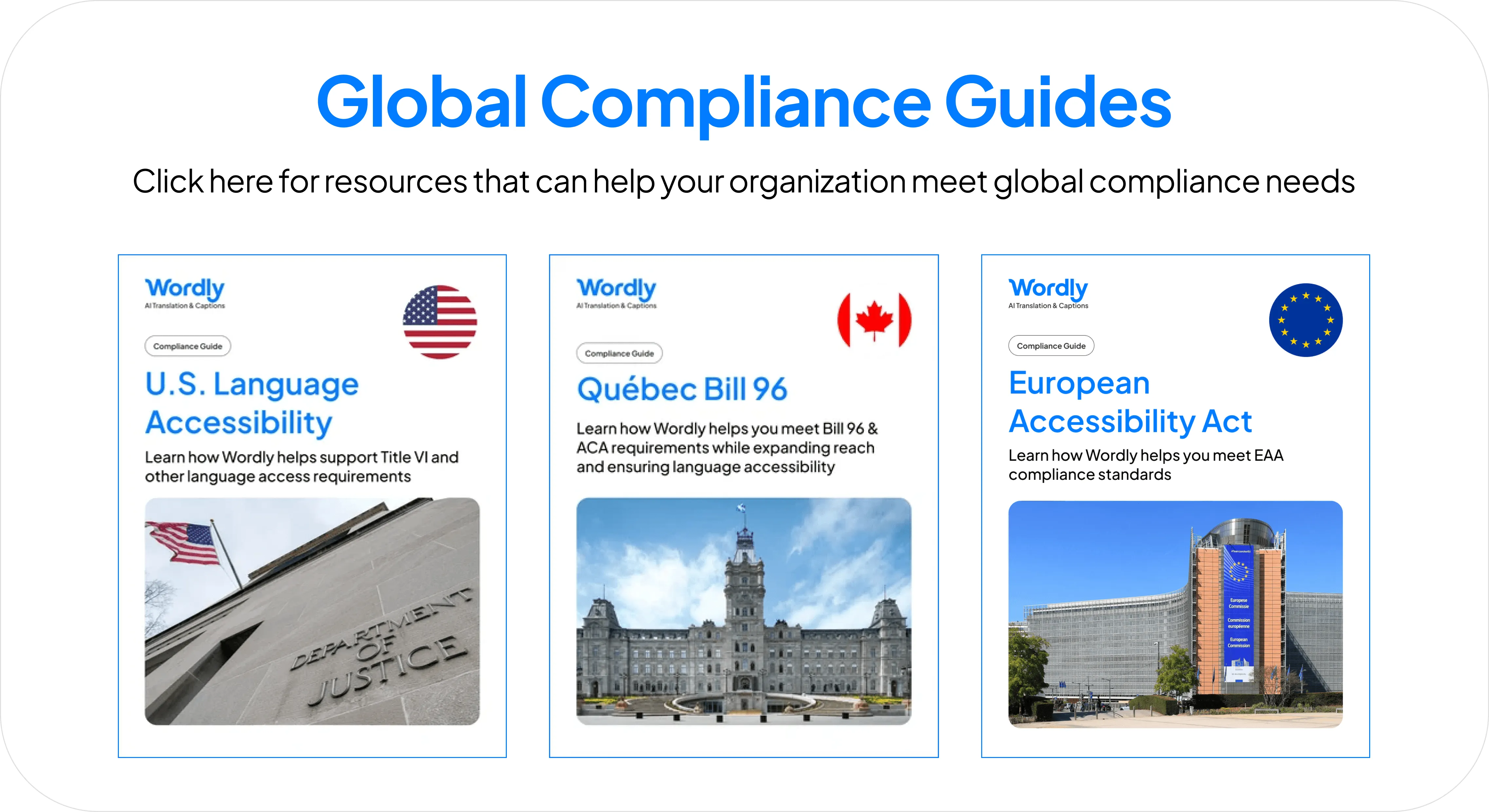
Related Compliance Guides
If your organization isn't primarily focused on conferences and events, Wordly publishes language access compliance resources for other common contexts:
Enterprise Language Access Compliance
Covers ADA, Section 508, and WCAG requirements for large organizations, including multilingual workplace communications, customer-facing content, and digital accessibility across enterprise systems. Read more on enterprise compliance.
Nonprofit and Association Compliance
Covers ADA, Title VI, and accessibility requirements for nonprofits, associations, and NGOs that receive federal funding or serve diverse communities, including event programming and member communications. Read more on nonprofit and association compliance.
SMB Language Access Compliance
Covers ADA, Section 508, and Title VI standards as they apply to small and mid-sized businesses, with practical guidance for organizations that don't have dedicated compliance staff. Read more on SMB compliance.
Government Compliance in Language Access
Covers federal, state, and local government requirements for language access, including Title VI, executive orders, and state-level mandates like California SB 707 and Quebec Bill 96. Read more on government compliance.


.png)
