Translation Services for Government: How Cities Are Expanding Access and Cutting Costs with AI
.avif)
.avif)
Table of Contents:
- The Growing Demand for Language Access in Government
- Why Do Translation Services Matter for Government?
- Case Study 1: Small City
- Case Study 2: Mid-Sized City
- Case Study 3: Large City
- Why Is AI Translation the Future of Government Language Access?
- The Results Government Can Expect
- Frequently Asked Questions About Translation Services for Government
- Conclusion: A Smarter Way Forward for Government
Translation services for government use live AI translation and captions to make city council meetings, public hearings, town halls, community forums, and government communications accessible to multilingual residents in dozens of languages. Real-world examples like Sunnyvale (55% cost reduction), a mid-sized Southwestern city (14 councils and committees adopting AI translation), and a large U.S. metro (300% increase in Spanish participation, two-thirds cost reduction) show how AI translation removes the cost and logistical barriers of traditional interpretation while dramatically expanding civic participation. Wordly delivers real-time translation directly to residents' phones, tablets, or laptops via QR code, with no scheduling, no interpreter booths, and no specialized equipment required, making professional-grade language access practical for governments of any size.
The Growing Demand for Language Access in Government
Government agencies at every level face a common challenge: how to serve increasingly multilingual populations in ways that are both inclusive and cost-effective. From city council meetings to public hearings and community forums, language access is essential for ensuring all residents can participate fully in civic life.
This is where translation services for government become critical. They allow municipalities to comply with federal regulations, eliminate barriers for non-English speakers, and build stronger trust with the communities they serve. Yet many governments still rely on traditional interpretation models that are costly, inefficient, and limited in scope.
Across the country, forward-thinking cities are showing that AI-powered translation services can meet this challenge head-on. Case studies from small, mid-sized, and large cities illustrate how real-time solutions transform civic engagement while reducing costs.
Why Do Translation Services Matter for Government?
Governments are held to high standards of accessibility and equity. Language barriers can limit participation in public decision-making, exclude residents from vital services, and even expose agencies to compliance risks.
Modern translation services help address these priorities by:
- Ensuring compliance with language access and public participation requirements.
- Improving inclusivity so residents feel welcome and represented in government processes.
- Expanding engagement by enabling diverse communities to take part in discussions that impact their neighborhoods.
- Reducing costs compared to hiring interpreters for multiple languages.
As the following examples show, cities of all sizes are finding that live AI translation is a smarter, more sustainable approach to language access.
Case Study 1: Sunnyvale – A Small City Creates Equal Access
In Sunnyvale, California, nearly 60% of residents speak a language other than English at home. Traditional interpreter services were expensive, inconsistent, and disruptive to meeting flow. A Spanish-speaking commissioner even faced barriers to fully contributing during live discussions.
Sunnyvale turned to Wordly to deliver real-time translation in dozens of languages, including Spanish, Mandarin, Cantonese, Hindi, and more. With QR-code access on personal devices, residents and officials could engage without delays or interruptions.
Results in Sunnyvale:
- 55% reduction in translation costs compared to hiring interpreters.
- Stronger representation in leadership, allowing multilingual commissioners to participate fully.
- Enhanced compliance with the city’s Language Access and Public Participation Plans.
- More inclusive civic engagement, with residents reporting this was the first time they truly felt they had a voice in city decisions
See the full Sunnyvale case study to learn how AI translation cut costs 55% and expanded civic participation.
Case Study 2: Mid-Sized City Overcomes Doubts with Real-Time Translation
A fast-growing Southwestern city with more than 250,000 residents faced skepticism about adopting AI translation and transcription for public meetings. Concerns included accuracy, usability, and fears that technology might feel impersonal.
After evaluating solutions, city leaders adopted Wordly to provide instant translation in dozens of languages. Attendees could access live translations on their own devices simply by scanning a QR code – no interpreters, headsets, or complicated setup required.
Results for the mid-sized city:
- Increased participation from multilingual residents.
- Greater public trust, as AI translation proved accurate, neutral, and unbiased.
- Cost savings from eliminating dependence on interpreters.
- 14 councils and committees adopted the solution for full-scale implementation
By debunking misconceptions, the city demonstrated how AI translation could create a more transparent and inclusive civic environment.
Read the complete case study to discover how this mid-sized city built trust and boosted engagement with AI translation.
Case Study 3: Large U.S. City Cuts Costs and Triples Participation
In one of the nation’s largest metropolitan areas, where over half of residents spoke a language other than English, traditional translation methods were failing. Spanish-speaking residents were often separated into different rooms, and costs reached hundreds of thousands of dollars each year.
By adopting Wordly, the city gained on-demand access to dozens of languages without scheduling or logistical hurdles. AI translation created a neutral, transparent experience that improved trust while reducing expenses.
Results for the large city:
- Two-thirds reduction in translation costs, saving hundreds of thousands annually.
- 300% increase in Spanish participation through livestreams and digital channels.
- Inclusive engagement, keeping residents together in the same space regardless of language.
- Smarter translations with custom glossaries for local terms and officials
This shift marked a turning point in civic participation, proving that real-time AI translation could strengthen connections between government and community.
Explore the full case study to see how a large U.S. city reduced translation costs by two-thirds while tripling participation.
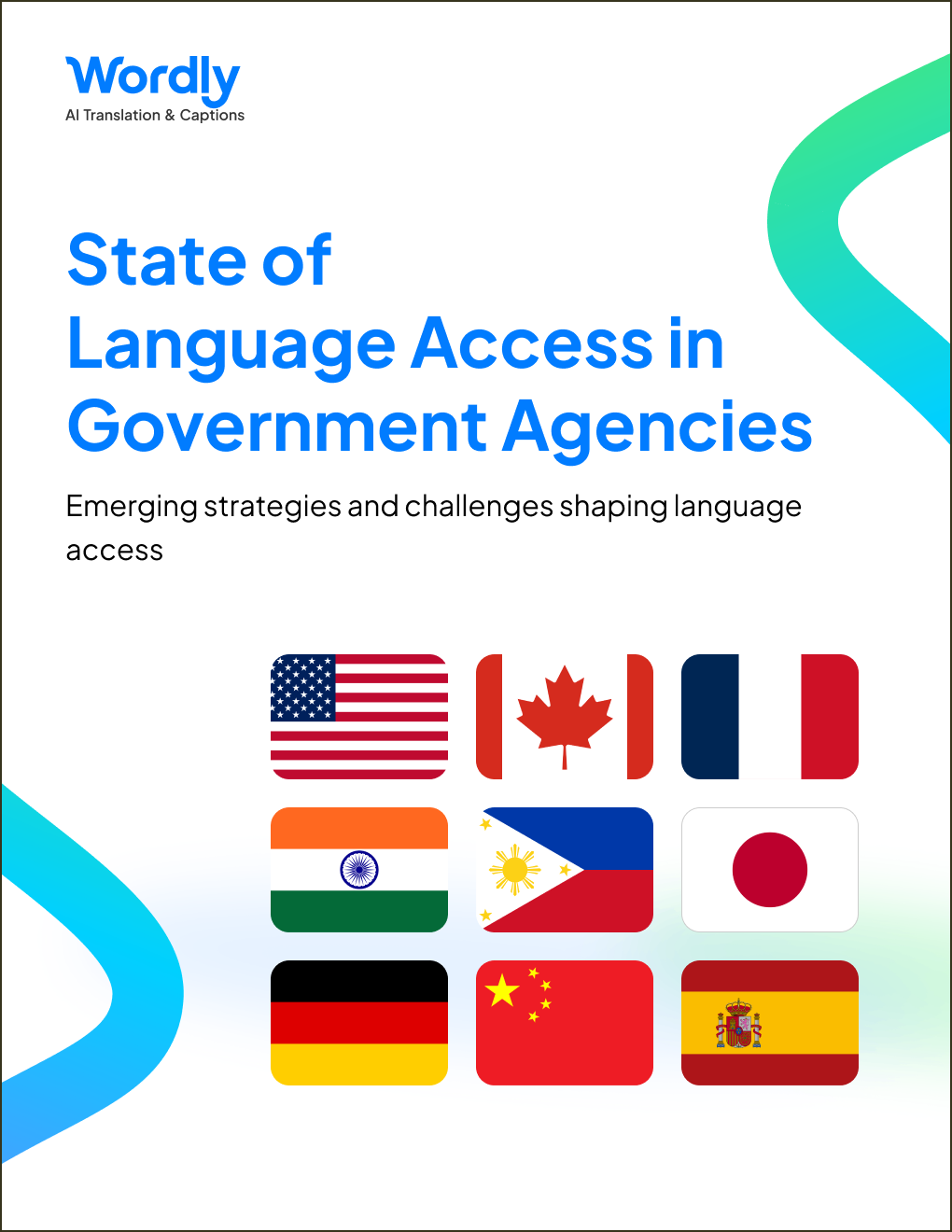
State of Language Access Report
Wordly surveyed 117 U.S. local governments on language access. Download the full 2025 report for the complete data on rising demand, top barriers, AI translation adoption, and the steps agencies are taking next.
Download ReportWhy Is AI Translation the Future of Government Language Access?
Traditional interpretation models can no longer meet the needs of today’s diverse populations. Live AI translation services for government provide a more flexible, scalable, and equitable approach.
Key benefits include:
- On-demand access to dozens of languages without scheduling or extra equipment.
- Neutral and unbiased translations that reflect only what was said.
- Custom glossaries to capture local terminology, acronyms, and cultural context.
- Accessibility across formats, from in-person meetings to hybrid and virtual events.
By embracing these tools, government agencies can foster more inclusive engagement while demonstrating fiscal responsibility.
The Results Governments Can Expect
The experiences of Sunnyvale, the mid-sized city, and the large metropolitan area show consistent outcomes when AI translation is adopted:
- Large cost savings compared to traditional interpreter models.
- Increased participation from multilingual residents in civic life.
- Stronger trust and transparency, as residents feel heard and included.
- Compliance with federal requirements, avoiding risks associated with inadequate language access.
These are results any government agency can achieve – whether serving 100,000 residents or a million.
Frequently Asked Questions About Translation Services for Government
Why do government agencies need translation services?
Translation services help government agencies serve multilingual communities, improve civic participation, and meet federal compliance requirements under Title VI, ADA Title II, and other language access mandates. They ensure every resident, regardless of the language they speak, can engage with public meetings, government services, and community programs.
How do AI translation services compare to human interpreters?
AI translation services are on-demand 24/7, support dozens of languages simultaneously, reduce costs dramatically, and eliminate scheduling challenges. Where a single human interpreter typically costs hundreds to thousands of dollars per day per language pair and can only translate one language at a time, AI translation delivers all supported languages from a single source at a subscription cost that scales predictably.
What languages do government translation services support?
Modern AI translation supports dozens of languages, with new languages added regularly. Wordly supports the most-requested languages across U.S. local governments, including Spanish, Mandarin, Cantonese, Vietnamese, Tagalog, Korean, Haitian Creole, Arabic, Russian, and many more, with custom glossary support for city-specific terms, official titles, place names, and municipal vocabulary.
Which government agencies are using AI translation?
Cities and counties across the U.S. are using AI translation, including Sunnyvale (CA), San Jose (CA), Washoe County (NV), Los Angeles County (CA), Vermont municipalities, and dozens of other local governments of all sizes. Adoption is growing as governments face rising demand for language access alongside budget constraints and newer state laws like California SB 707 requiring more accessible public meetings.
Can translation services help governments comply with accessibility laws?
Yes. Translation services support compliance with Title VI of the Civil Rights Act, ADA Title II, California SB 707, Washington SHB 2475, and other language access requirements by providing equal access for individuals with Limited English Proficiency and those with hearing or communication disabilities.
What types of government meetings can use translation services?
Translation services work for city council meetings, public hearings, town halls, community forums, board meetings, commission meetings, planning meetings, virtual public meetings, hybrid public meetings, and other government gatherings. Wordly integrates with common meeting setups including in-person events, Zoom, Microsoft Teams, Webex, and other virtual platforms.
How do residents access translation at government meetings?
Residents scan a QR code displayed at the meeting or click a shared link, select their preferred language, and follow along on their own phone, tablet, or laptop. No app download is required, no account creation is needed, and residents can switch languages at any time. This eliminates the traditional friction of specialized interpreter equipment or dedicated headsets.
Is AI translation secure for sensitive government meetings?
Enterprise-grade AI translation platforms protect meeting audio with industry-standard encryption and offer clear data privacy controls. Wordly is SOC 2 Type II compliant and ISO 27001 certified, meeting the security standards required for sensitive government meetings including executive sessions, personnel matters, legal proceedings, and regulated content.
Conclusion: A Smarter Way Forward for Government
Language should never be a barrier to civic engagement. By implementing modern translation services for government, agencies at every level can reduce costs, strengthen participation, and build more inclusive communities.
Cities across the U.S. are already proving that live AI translation is more than a technology – it’s a tool for equity, representation, and trust.
Ready to explore how Wordly can support your government agency? Book a personalized demo to learn more about our translation services for government.
Want to learn more? Explore our full library of customer case studies.


.png)
