AI Interpretation Services: A Guide to Modern Translation for Meetings and Events
.avif)
.avif)
Table of Contents:
- What are interpretation services?
- How do AI interpretation services work?
- Human vs. AI Interpretation Solutions
- Where are AI interpretation services used?
- Why Spring CUE and CASBO Matter for Educators
- Powering Spring CUE 2026 with AI Interpretation Services
- Showcasing Interpretation Services at CASBO Con 26
- Why Education Leaders Need Interpretation Services
- Frequently Asked Questions About Interpretation Services
- Next Steps: Let's Connect
AI interpretation services translate spoken language in real time, enabling people who speak different languages to participate together at meetings, conferences, and events. Modern AI interpretation platforms deliver live translation in dozens of languages directly to attendees' phones, tablets, or laptops, with no booths, headsets, or per-language interpreter fees required. Schools, government agencies, conferences, businesses, and faith communities use AI interpretation services to expand accessibility, meet language access compliance requirements, and reach broader audiences at a fraction of the cost of traditional human interpretation.
What are interpretation services?
Interpretation services translate spoken language from one language into another in real time, allowing people who speak different languages to communicate naturally. Unlike translation (which typically handles written content with time for review), interpretation happens live, as the conversation unfolds.
Interpretation services fall into two main categories:
Human Interpretation Services
Professional interpreters listen to a speaker and translate spoken content into a target language in real time, either in-person or remotely. Human interpretation is the traditional approach and remains the standard for high-stakes, culturally sensitive, or legally complex contexts.
AI Interpretation Services
AI-powered platforms use speech recognition and machine translation to convert spoken language into text and audio in target languages, with delays typically under three seconds. AI interpretation scales to dozens of languages from a single source and removes the equipment and per-language cost of traditional human interpretation.
Most modern multilingual meetings and events now use AI interpretation as the practical default, with human interpretation reserved for specialized contexts where the additional cost and complexity are justified by the stakes.
How do AI interpretation services work?
AI interpretation services use a multi-step workflow that processes spoken language and delivers translations to attendees in real time.
The process:
- Audio capture: A speaker's voice is captured through a microphone connected to the meeting platform or event system.
- Speech recognition: AI models trained on millions of hours of audio convert the spoken words into text in the source language.
- Machine translation: The text is translated into one or more target languages selected by attendees.
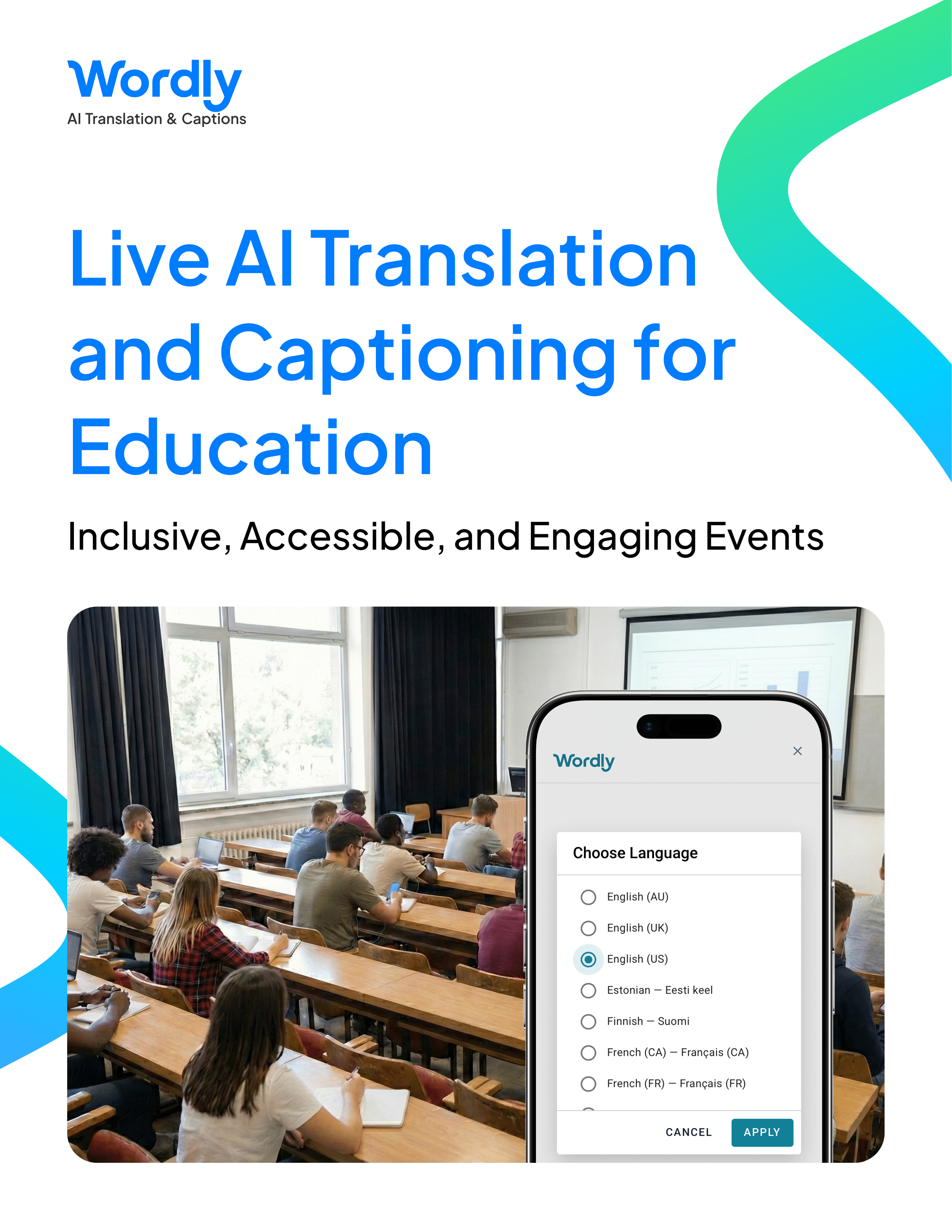
- Delivery: Attendees receive the translation as on-screen captions, translated audio through their device, or both. They join via a session link or QR code and select their preferred language.
- Post-event output: Most AI interpretation services also generate transcripts, summaries, and multilingual content from the same source session, supporting accessibility and content reuse after the event ends.
Unlike human interpretation, which requires one interpreter per language pair (and often expensive in-person equipment like booths and headsets), AI interpretation can support dozens of languages from a single session, with each attendee accessing their preferred language on their own device.
AI vs. Human Interpretation: Which is right for you?
Traditionally, interpretation was handled by trained professionals (human interpreters) who listened and translated on the spot. While valuable for highly sensitive or legally nuanced conversations, hiring professional interpreters is often expensive and difficult to scale across multiple languages.
AI interpretation services like Wordly offer a powerful alternative. By providing live simultaneous interpretation in dozens of languages without headsets or on-site booths, AI tools are perfectly suited for:
- Large-scale school district events and conferences
- Virtual and hybrid school board meetings
- Tight administrative budgets
- Real-time captioning alongside translated audio
Where are AI interpretation services used?
AI interpretation services have applications across nearly every industry and setting where people speak different languages. Here's how organizations are putting them to work:
Education
Education translation supports K-12 districts, colleges, and learning programs for parent-teacher conferences, IEP meetings, student orientation, faculty meetings, and large education conferences like Spring CUE and CASBO Con (covered in detail below).
Government and Public Sector Meetings
City councils, county boards, state agencies, and federal departments use government translation to comply with language access requirements (Title VI, California SB 707, ADA Title II) and provide Limited English Proficiency residents with meaningful access to public meetings and hearings.
Conferences and Events
Conference translation makes multi-day events accessible to global attendees in dozens of languages without renting interpretation booths or coordinating teams of human interpreters across multiple language pairs.
Business Meetings and Corporate Communications
Multinational companies use corporate translation for global all-hands meetings, board meetings, sales kickoffs, and customer or partner meetings, removing language friction from distributed teams.
Training and Learning Programs
Training translation supports corporate training, professional development, and certification programs in every learner's preferred language.
Churches and Faith Communities
Houses of worship use church translation to welcome members of every language background into Sunday services, Bible studies, and community events.
Associations and Nonprofits
Membership organizations use AI interpretation to make committee meetings, chapter programming, and member events accessible to international and multilingual members.
To explore interpretation services use cases across every industry Wordly supports, see the full Wordly translation services and use cases page.
Why Spring CUE and CASBO Matter for Educators
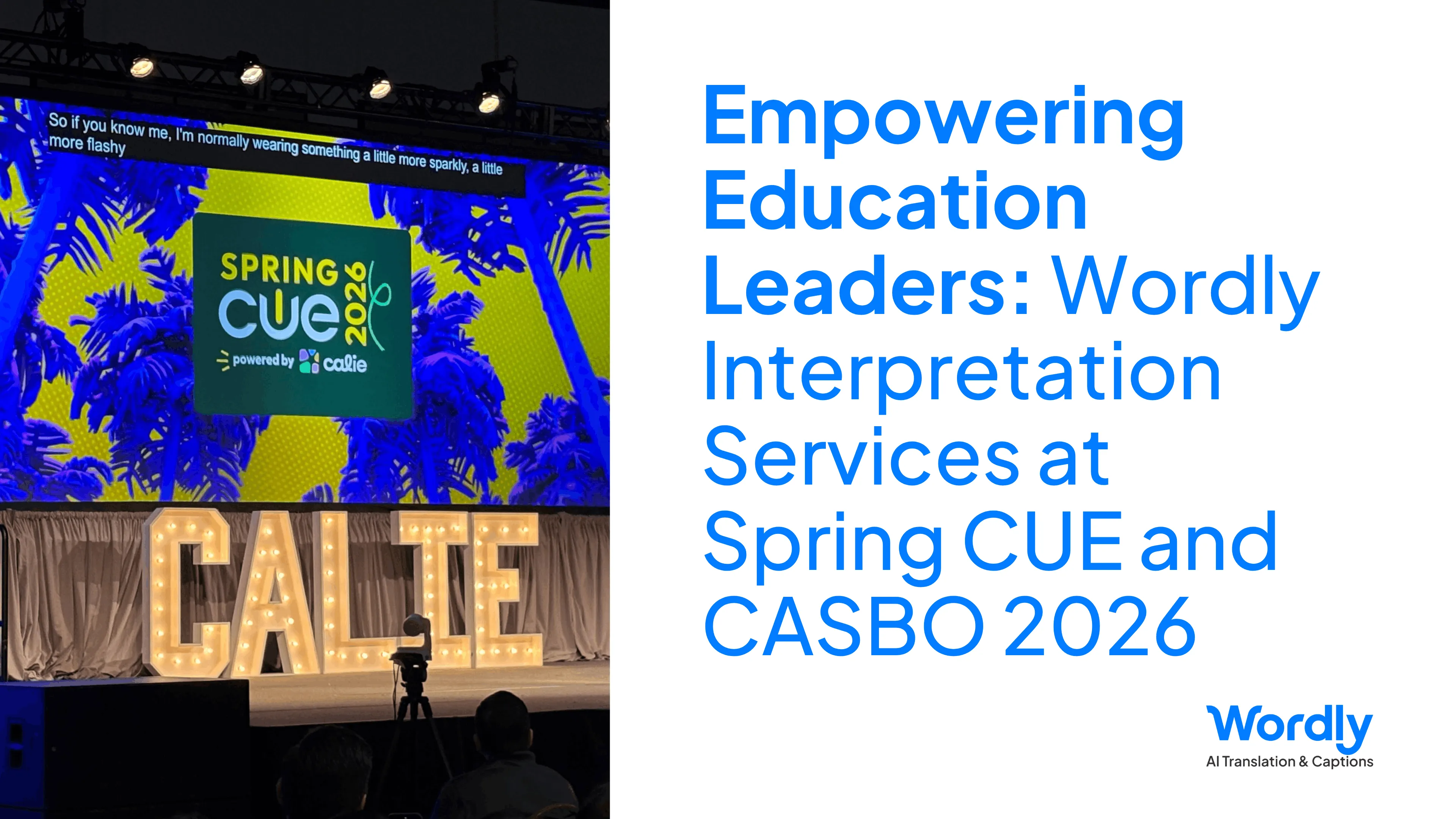
Wordly recently participated in two of California's premier education conferences, showcasing how modern interpretation services can bridge communication gaps in classrooms, school board meetings, and large-scale educational events.
Spring CUE 2026
Powered by CALIE and held in Palm Springs, this flagship event brought together over 3,000 educators, administrators, and IT professionals to connect, learn, and discover cutting-edge educational technology.
CASBO Con 2026
Hosted by the California Association of School Business Officials in San Diego, this three-day expo gathered 2,000+ school business professionals to discuss everything from finance and human resources to inclusive leadership and technology.
Both events reinforced the growing need for scalable, reliable ways to connect with multilingual communities and ensure equitable access to information.
Powering Spring CUE 2026 with AI Interpretation Services
At Spring CUE 2026, Wordly did more than just exhibit, we actively powered the event’s language access. With over 3,000 attendees and hundreds of dynamic sessions, relying on traditional human interpreters would have been logistically complex and prohibitively expensive.
Instead, event organizers leveraged Wordly’s AI interpretation services to provide real-time translation and captioning across multiple keynote sessions. Attendees were able to select their preferred language and follow along seamlessly, ensuring every educator could fully engage with the content, regardless of their native language.
Showcasing Interpretation Services at CASBO Con 26
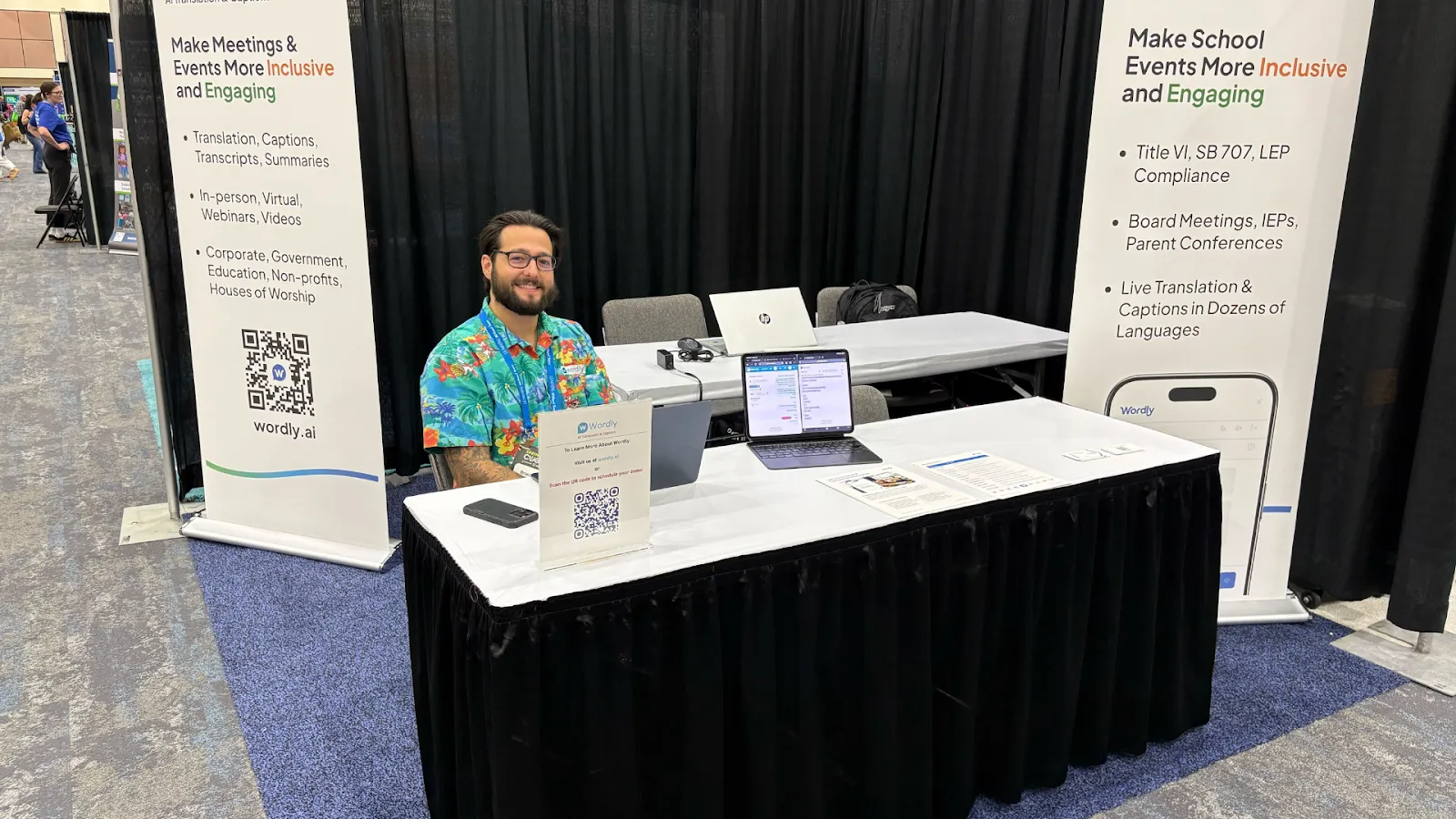
While Wordly strictly exhibited at CASBO Con 26, the event provided the perfect stage to demonstrate how our education translation technology can seamlessly power complex, multi-day educational summits.
If deployed at large-scale administrative events like CASBO, Wordly’s AI interpretation services enable organizers to:
- Support diverse professionals: Deliver instant audio and text interpretation directly to attendees' personal devices
- Streamline operations: Eliminate the need for expensive interpreter booths, AV tech crews, and specialized equipment
- Enhance comprehension: Provide highly accurate, real-time captions for complex sessions on school finance, legal compliance, and human resources
- Scale effortlessly: Support anything from a 50-person roundtable to a massive keynote presentation with thousands of attendees
Why do education leaders need interpretation services?
Whether you are planning a massive educator conference or simply trying to make a district-wide webinar more inclusive, interpretation services are essential. These solutions translate spoken content from one language to another in real-time, bridging the communication gap between speakers and attendees.
In the education sector, relying on comprehensive interpretation services helps districts:
- Boost engagement: Ensure parents and community members understand and can participate in school board meetings
- Break down barriers: Foster inclusive environments for non-English speaking students and families
- Comply with accessibility standards: Meet state and federal DEI (Diversity, Equity, and Inclusion) requirements for public education
- Enhance virtual and hybrid formats: Easily add multilingual support to remote learning sessions or district town halls
Frequently Asked Questions About Interpretation Services
What are interpretation services for events?
Interpretation services are tools or solutions that translate spoken content from one language to another in real time. They allow attendees to listen, read, and engage in their preferred language as the event happens.
What is the difference between simultaneous and consecutive interpretation?
Simultaneous interpretation translates the speaker's words in real time with almost no delay, making it ideal for fast-paced events. Consecutive interpretation requires the speaker to pause every few sentences so the translation can be delivered, which disrupts the natural flow of a presentation.
How do AI interpretation services work in government meetings?
AI interpretation services let government agencies translate city council meetings, public hearings, and constituent meetings into multiple languages in real time, helping agencies meet Title VI, ADA Title II, and state language access requirements like California SB 707. Residents join the meeting via a link or QR code on their phone, select their preferred language, and follow along through translated captions or audio without specialized equipment.
Do attendees need to rent special equipment to use Wordly?
No. While human interpreters often require expensive sound booths and rental headsets, Wordly's AI interpretation services let attendees access live translations directly on their own phones, tablets, or laptops via a browser link or QR code.
What languages do AI interpretation services support?
Modern AI interpretation services support dozens of languages, with new languages added regularly. Wordly supports the most-requested languages across enterprise, education, government, and faith-based contexts, with custom glossary support to handle industry-specific terminology and proper nouns.
How accurate are AI interpretation services compared to human interpreters?
Modern AI interpretation services reach 95-99% accuracy on clear audio with well-supported languages. Human interpreters typically reach 99% or higher in the same conditions, especially for culturally sensitive or industry-specific content. Customizable glossaries significantly narrow the accuracy gap by improving AI performance on industry-specific terms, brand names, and proper nouns.
How quickly can AI interpretation services be deployed for a meeting?
AI interpretation services can be deployed in minutes. Unlike human interpretation, which typically requires booking interpreters weeks or months in advance, AI platforms let organizers set up a session, share a join link or QR code with attendees, and start interpreting immediately. This makes AI especially valuable for short-notice meetings, ad-hoc sessions, and any organization that runs multilingual meetings on a frequent or recurring basis.
How much do interpretation services cost?
Costs vary based on event size, number of languages, and contract structure. Human interpreters typically cost $200 to $1,000+ per day per language pair, plus travel and equipment. AI interpretation services like Wordly are typically dramatically more cost-effective, especially for multilingual events with three or more languages.
Why do school districts need interpretation services?
If a school's community includes multilingual families or international stakeholders, interpretation services ensure everyone can participate fully in meetings, conferences, and educational programs without language acting as a barrier. They also help districts meet federal language access requirements under Title VI of the Civil Rights Act.
Next Steps: Let's Connect Beyond the Events
Whether we saw you on the expo floor at Spring CUE or connected at CASBO Con 26, it's never too late to explore how Wordly can transform your district's communication strategies.
Schedule a personalized demo today to see Wordly in action, and learn how our AI-powered interpretation services can help you reach, include, and engage your entire educational community.


.png)
