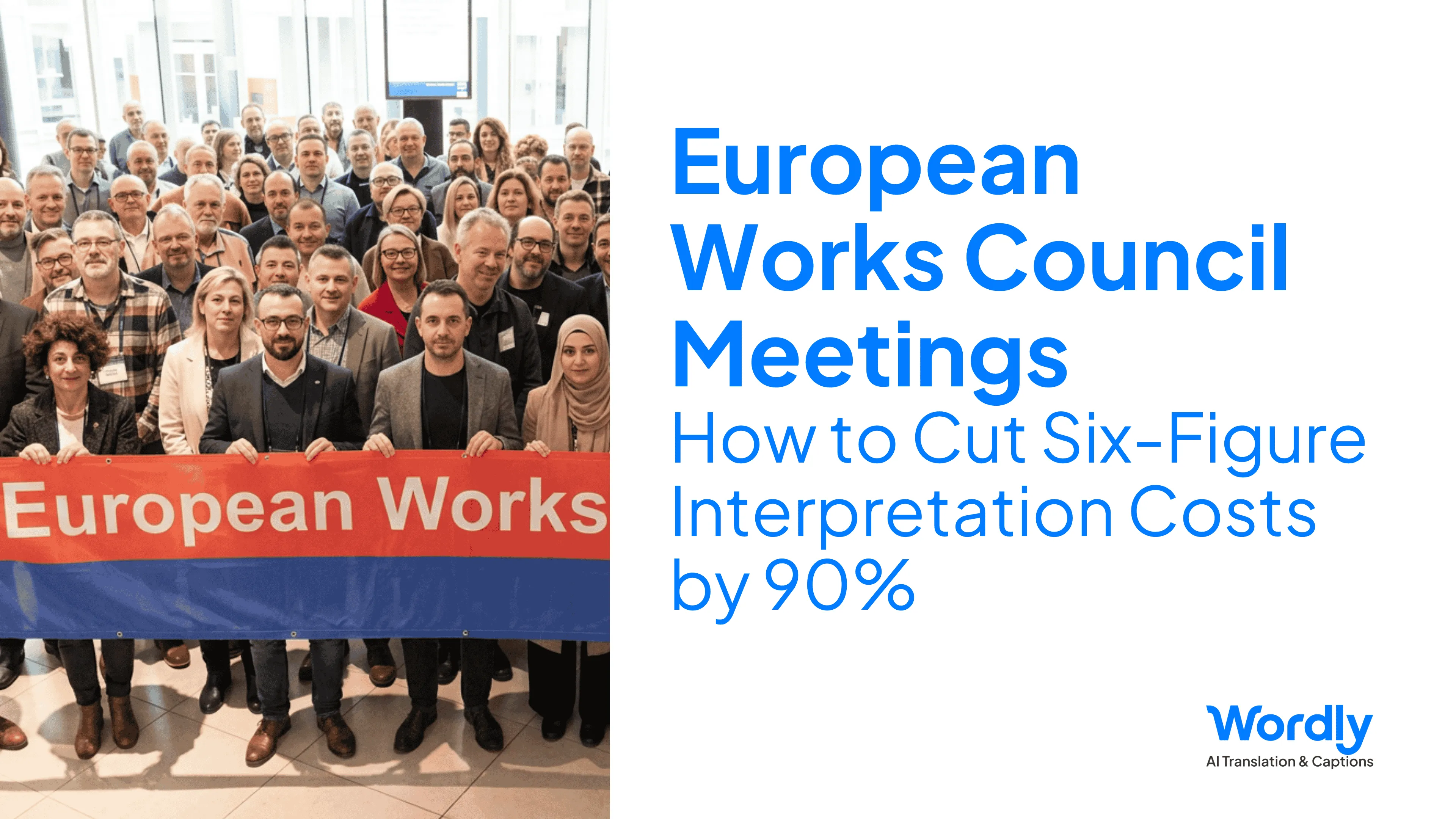
European Works Council Meetings: How to Cut Six-Figure Interpretation Costs by up to 90%
.avif)
.avif)
Table of Contents:
- The Biggest Change to European Employee Representation in 30 Years
- What Is a European Works Council, and Who Needs One?
- What the 2025 Revised EWC Directive Changes
- The Real Cost of a 10-Language EWC Meeting Interpretation
- A Modern Approach to Multilingual EWC Meetings
- Why This Works for EWC Meetings Specifically
- Frequently Asked Questions About European Works Council Interpretation
- Getting Started: Pilot or Go All-In
The Biggest Change to European Employee Representation in 30 Years
The EU just overhauled the rules governing European Works Councils. The revised EWC Directive, adopted in late 2025, eliminates decades-old exemptions and will bring around 350 additional companies under EWC requirements by 2028.
For HR leaders, this creates an immediate challenge: running multilingual meetings where many delegates may need interpretation to understand every word. Traditional simultaneous interpretation routinely costs €50,000 to €150,000 per event. Now there's a better way.
What Is a European Works Council, and Who Needs One?
A European Works Council (EWC) is a legally mandated body that brings together employee representatives from across EU and EEA member states to ensure workers are informed and consulted on transnational decisions like restructuring, mergers, and layoffs.
Any company with 1,000 or more employees in the EU/EEA and at least 150 in each of two member states must establish an EWC if employees request one. There are currently around 1,250 active EWCs across Europe, covering approximately 16.6 million workers, concentrated in manufacturing, chemicals, and services.
What the 2025 Revised EWC Directive Changes
The revised directive, published in the Official Journal on December 11, 2025, introduces several changes that directly affect how companies plan and budget for EWC meetings:
Legacy exemptions are gone. For 30 years, hundreds of companies with pre-1996 employee consultation agreements were exempt from formal EWC rules. That ends on January 1, 2028. Around 350 companies will need to establish compliant EWCs for the first time.
The definition of "transnational" is broader. Decisions that affect workers in one country now trigger EWC consultation obligations if consequences can reasonably be expected to reach workers in another country. This means more issues will require formal EWC involvement.
Consultation must be meaningful. EWCs must be given the opportunity to express an opinion, and management must provide a written response before making final decisions. This makes EWC meetings longer and more substantive.
Companies must fund more resources. Expert support, legal fees, and training costs for EWC representatives now fall on the employer. Physical meetings are mandatory under the default rules.
Member states have until January 2028 to transpose the directive into national law, with full application expected by January 2029. For companies that have never had a formal EWC, the clock is ticking.
The Real Cost of a 10-Language EWC Meeting Interpretation
A typical EWC meeting brings together 10 to 20 delegates (usually two per country) for two to three days of presentations and discussion. The delegates are often employee representatives and trade union officials, many of whom do not speak the language the meeting is conducted in. Meetings commonly involve 5 to 10 languages simultaneously.
To make that work with traditional simultaneous interpretation, here's what's required:
For companies that hold EWC meetings twice a year, that's €100,000 to €300,000 annually, just for language services. And this doesn't account for the weeks of lead time needed to coordinate EWC meeting interpretation, rare language pairings, venue logistics, or equipment shipping.
A Modern Approach to Multilingual EWC Meetings
What if every delegate could participate in their native language, across 10 languages, without any of that infrastructure?
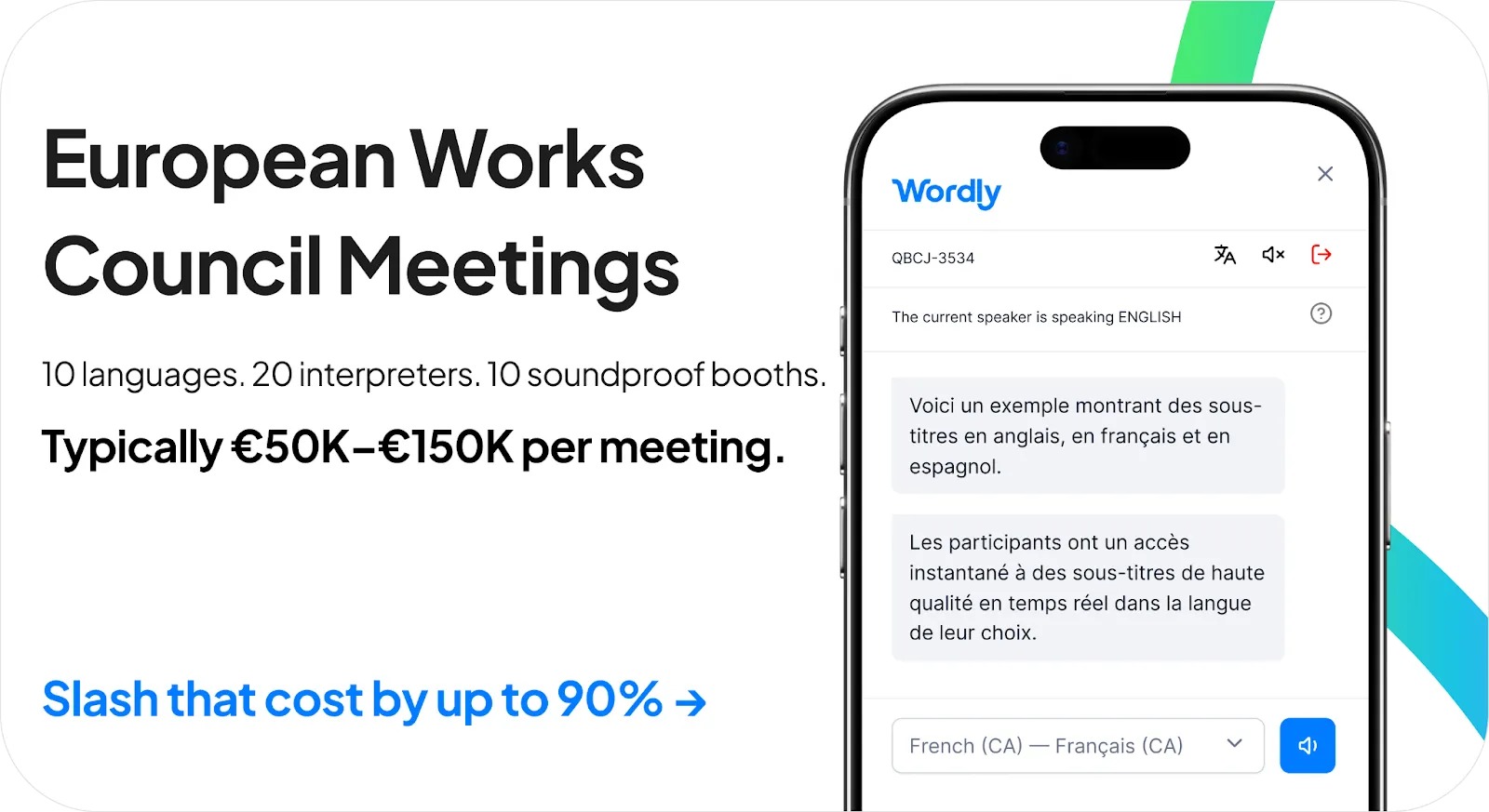
AI-powered EWC Meeting Interpretation replaces the entire traditional setup. Each delegate uses their own phone, tablet, or laptop with headphones. They scan a QR code, select their language, and get real-time translated audio and captions throughout the meeting.
Check out the Wordly ROI Calculator to see just how much you can save on interpretation costs.
Traditional vs. AI Interpretation
Why This Works for EWC Meetings Specifically
Trade union friendly. EWC delegates are often factory workers and trade union representatives, not conference regulars. They don't need training to use a phone and headphones. The interface is simple: scan, select language, listen.
Confidentiality. EWC meetings routinely cover sensitive topics. Plant closures, restructuring plans, workforce reductions. With traditional interpretation, 20 or more external interpreters are privy to every word. AI translation eliminates that exposure entirely.
Rare language combinations. Finding qualified simultaneous interpreters for Hungarian-to-Slovak or Czech-to-Bulgarian is difficult and expensive. AI handles these combinations instantly, at the same cost as common language pairs.
Hybrid-ready by default. As EWCs increasingly adopt hybrid meeting formats, some delegates are in the room, others joining remotely, EWC Meeting interpretation works identically in both settings. No additional platform integration or remote interpreter consoles needed.
Frequently Asked Questions About European Works Council Interpretation
Are EWC meetings required by law?
Yes. EU law mandates them for companies with 1,000+ employees across two or more member states.
How much does traditional interpretation cost?
€50,000 to €150,000 per event for a typical 10-language, 2 to 3 day meeting.
Can AI EWC meeting Interpretation handle rare language combinations?
Yes, Wordly EWC meeting interpretation covers this. Languages like Lithuanian, Latvian, Estonian, Norwegian, and Finnish are covered instantly at the same cost as any other language.
Is AI interpretation secure enough for EWC meetings?
Wordly uses ISO 27001-certified AI processing with no human listeners. Your EWC meeting interpretation is secure.
Getting Started: Pilot or Go All-In
If your company already has an established EWC: Consider running an AI EWC meeting interpretation pilot at your next gathering. Use AI interpretation alongside your traditional interpretation setup for one or two sessions. Let delegates experience it firsthand. In our experience, once people see how simple the setup is and how natural the translated audio sounds, the conversation shifts from "can this work?" to "why are we still paying for booths?"
If your company is setting up an EWC for the first time: You have a rare opportunity to start modern. The ~350 companies entering the EWC framework between now and 2029 don't need to inherit the legacy interpretation model. Starting with AI translation from day one means lower costs, simpler logistics, and a meeting infrastructure that scales as your EWC evolves.
Either way, the math is straightforward. Traditional interpretation for a 10-language EWC meeting costs €50,000 to €150,000. AI-powered translation costs a fraction of that. For a meeting you're legally required to hold, the savings are hard to ignore.
Ready to see how Wordly Interpretation works for European Works Council meetings?


.png)
