Washington State SHB 2475 Compliance: What State Agencies Need to Know
.avif)
.avif)
Washington State has signed SHB 2475 into law, directing the Office of Equity to develop uniform language accessibility guidelines for all state agencies. Effective June 11, 2026, the law requires those guidelines to cover how agencies deliver language access across all modalities, from in-person services to virtual meetings and digital communications. Here's what SHB 2475 means for state agencies and how to start preparing.
Table of Contents:
- What is SHB 2475?
- Who Must Comply with SHB 2475?
- Key SHB 2475 Requirements
- Penalties and Enforcement
- Why SHB 2475 Matters Now
- Preparing for SHB 2475
What is SHB 2475?
SHB 2475, officially titled "An act relating to providing language accessible public programs, activities, and services conducted, operated, or administered by state agencies," was introduced in January 2026 by Rep. Lillian Ortiz-Self and 17 co-sponsors. It passed the House 62-33, the Senate 30-17, and was signed into law on March 23, 2026 by Governor Bob Ferguson. The effective date is June 11, 2026.
The law doesn't create new protected classes or entirely new mandates. Instead, it brings consistency to language access practices that already exist under federal law, specifically Title VI of the Civil Rights Act and Executive Order 13166.
The need is clear: Washington is home to over 700,000 individuals with limited English proficiency (LEP), and Census data shows that 21% of households statewide speak a language other than English at home.
Who Must Comply with SHB 2475?
SHB 2475 applies to all Washington state agencies that conduct, operate, or administer public programs, activities, and services. This is a broad category that includes:
- Major service departments such as the Department of Social and Health Services (DSHS), Department of Licensing, Department of Health, and Employment Security Department
- Regulatory agencies including the Department of Ecology, Utilities and Transportation Commission, and Department of Labor & Industries
- Education-related state agencies such as the Office of Superintendent of Public Instruction and the Student Achievement Council
- State commissions and boards including commissions supporting underrepresented populations in policymaking, such as the Commission on Hispanic Affairs and the Commission on Asian Pacific American Affairs
- Any other state entity administering programs, activities, or services used by the public
Note: The bill targets state-level agencies, not local municipalities. However, local governments often follow state-level language access precedents and may adopt similar standards.
Key SHB 2475 Requirements
The law creates three specific mandates:
1. Uniform Language Access Guidelines (Due December 1, 2027)
The Office of Equity must develop uniform guidelines for all state agencies covering the delivery of language-accessible services. These guidelines must address both spoken and signed languages across all modalities of communication: in-person, telephone, virtual, recorded, paper, and digital.
The guidelines will be developed with input from state agencies, impacted communities, state commissions, and organizations representing language access providers. They must be reviewed and updated every three years.
2. Interpreter and Translator Shortage Proposal (Due December 1, 2027)
The Office of Equity must also develop a proposal addressing Washington's statewide shortage of qualified interpreters and translators, with emphasis on rural communities and "languages of lesser diffusion" (lower-resource languages).
This shortage is serious: credentialed interpreters in Washington dropped from 2,825 to 1,766 in a single year.
3. Agency Implementation Reports (Due June 30, 2028)
Every state agency must report to the Office of Equity and the Office of Financial Management on how it will implement the new guidelines, including a timeline and any additional resources needed.
Penalties and Enforcement
SHB 2475 itself does not establish new penalties. The Office of Equity's representative told the Senate committee that agencies would have "discretion and lead time" in implementing the guidelines.
However, the underlying federal obligations carry real consequences. Agencies that fail to provide meaningful language access remain subject to enforcement under Title VI of the Civil Rights Act, which can result in civil rights complaints, federal investigations, and loss of federal funding. The uniform guidelines created under SHB 2475 will likely become the standard against which adequate language access is measured, making SHB 2475 compliance essential even without bill-specific penalties.
Why SHB 2475 Matters Now
This law arrives at a critical moment. In early 2025, Executive Order 14224 replaced Executive Order 13166, which had guided federal language access policy since 2000. That shift created uncertainty about the scope of agencies' obligations. SHB 2475 reaffirms those obligations at the state level.
The bill also reflects a modern understanding of how public services are delivered. By explicitly requiring guidelines for virtual, recorded, and digital communications, SHB 2475 acknowledges that agencies communicate through webinars, online portals, recorded trainings, and video meetings, not just in-person counters. Agencies that only plan for in-person interpretation will fall short.
Preparing for SHB 2475
The uniform guidelines won't be finalized until December 2027, but agencies shouldn't wait. The law already signals the scope of what's coming.
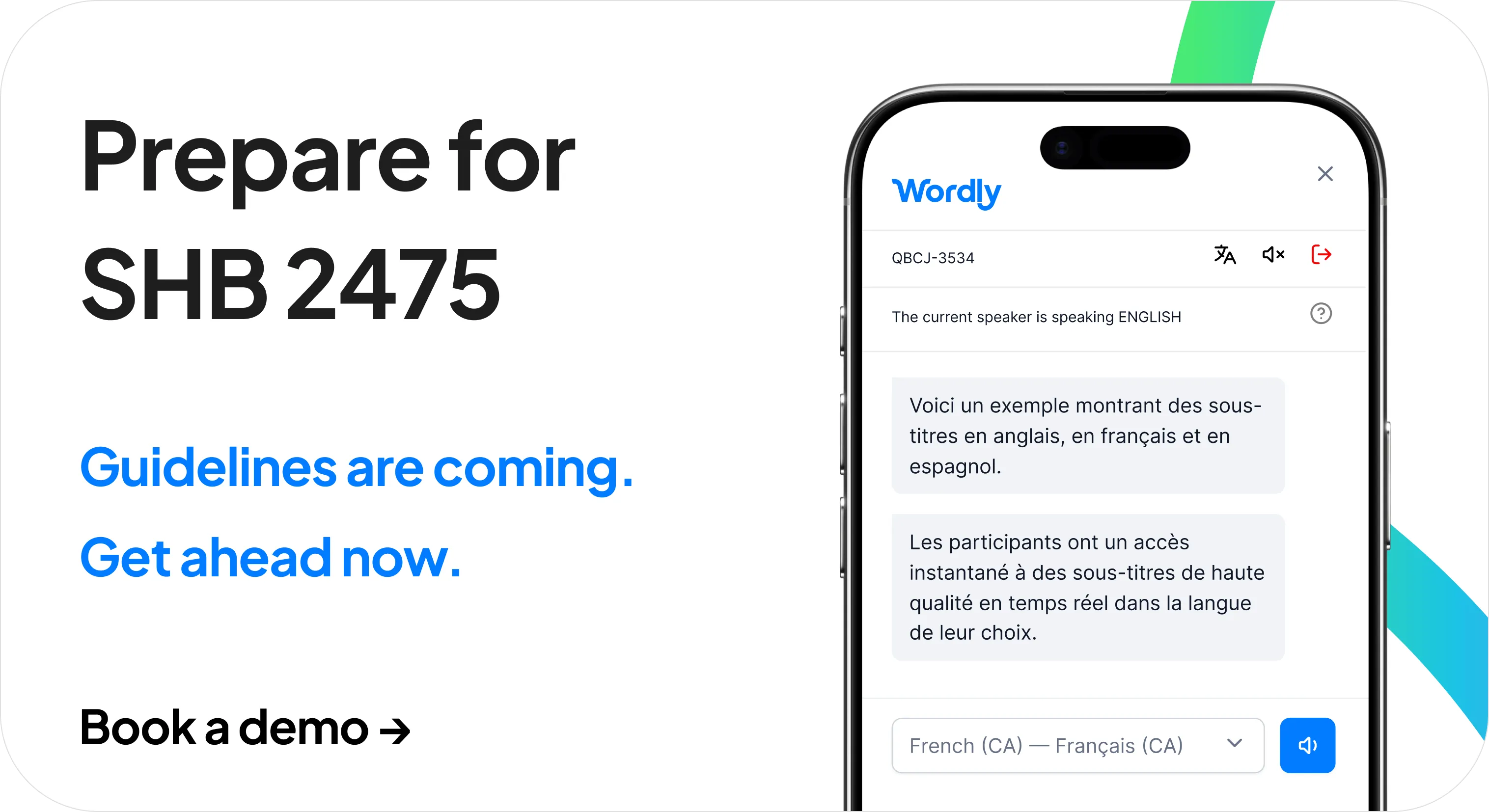
Live translation and captions across formats. Wordly provides real-time AI translation and captions in dozens of languages. Attendees access translation on their own device via QR code or link, no downloads, no equipment, no advance scheduling.
Coverage for every modality. From recorded trainings to live-streamed hearings to virtual town halls, Wordly delivers translated captions and audio across the communication formats SHB 2475 targets. Voice Transcripts can turn recorded content into multilingual materials, such as videos, extending language access beyond live events.
Dozens of languages, including lower-resource ones. Traditional interpreter models struggle with less common languages. Wordly's AI supports dozens of languages simultaneously, helping agencies address the "languages of lesser diffusion" SHB 2475 specifically highlights. You get on-demand access to all languages so you don’t have to plan for each language individually.
Affordable and secure. Wordly reduces the cost and logistical complexity of providing language access at scale. The platform is SOC 2 Type II compliant and ISO 27001 certified, meeting government security standards.
Get Started
SHB 2475 signals where Washington is headed on language access. Agencies that start building a scalable, multi-modality approach now will be better positioned when the guidelines arrive.
Ready to explore how AI translation can support your SHB 2475 compliance efforts?
Book a demo with Wordly to see how it works across the formats and channels SHB 2475 will address.
Disclaimer: Content provided is for informational purposes and does not constitute legal advice. Agencies should consult their legal advisors regarding compliance obligations.


.png)
