Graduation Translation for Every Family, in Any Language
.avif)
.avif)
Table of Contents:
- Why Graduation Is the Hardest Event to Make Multilingual (Until Now)
- Who Needs Graduation Translation
- The Compliance Picture for Schools
- The Real Cost of Traditional Graduation Translation
- A Modern Approach: AI Translation & Captions
- How Wordly Works Before, During, and After Graduation
- Frequently Asked Questions About Graduation Translation
Why Graduation Is the Hardest Event to Make Multilingual (Until Now)
Graduation is the one event many families travel across the world to attend. Parents, grandparents, and siblings fly in for a single afternoon. Many of them don't speak the language of the ceremony..
Higher education institutions hosted nearly 1.2 million international students in the 2024/25 academic year, with the largest cohorts coming from India, China, and a growing list of countries across Asia, Africa, and Latin America.
International schools worldwide face this reality with millions of family members attending graduations in a language they struggle to follow. Most institutions still try to solve this with a single interpreter on a side stage, or skip language access entirely. There's now a better way.
Who Needs Graduation Translation Services
Three audiences face the same problem with very different stakes.
Colleges and universities. International student families travel from 200+ countries for graduation. The top U.S. hosts (NYU, Northeastern, Columbia, USC, UIUC) each enroll between 19,000 and 27,000 international students — and major institutions in the UK, Australia, Canada, and the EU face identical challenges. Even mid-size institutions routinely host families speaking 30 to 50 languages on commencement day.
Community colleges. Community colleges saw the fastest international enrollment growth in 2024/25 (+8%), and serve large LEP populations locally. Bilingual English-Spanish ceremonies are now common, and increasingly so are trilingual ones.
K-12 school districts (primary schools). Roughly 10% of U.S. K-12 students are English Learners, with that figure exceeding 20% in California and Texas. Their parents and guardians attend graduation. Most are LEP, and most districts are federally required to give them meaningful access to the ceremony.
The Compliance Picture for Schools
This part is often overlooked, and it's the biggest reason schools should be paying attention in the U.S. Similar language access obligations exist in Canada, Australia, the UK, and across the EU.
In the States, Title VI of the Civil Rights Act of 1964 requires any school district receiving federal funds to take "reasonable steps" to provide LEP parents with meaningful access to school programs and information.
Graduation is a vital school event. A monolingual English ceremony where 30% of parents can't follow what's happening is not meaningful access, and OCR has investigated districts on exactly these grounds.
For higher education, while Title VI obligations focus more narrowly on student access, ADA and Section 508 require captioning for any livestreamed event. Most institutions livestream graduation. Captions in dozens languages help support compliance obligations globally.
The Real Cost of Traditional Graduation Translation
A typical graduation runs two to three hours, often with multiple speakers and thousands of names read aloud. To make that accessible the traditional way, here's what's required:
That's for one ceremony, in five languages. Universities with multiple ceremonies across schools and departments multiply that number quickly. K-12 districts can't justify the spend, so most don't even try, leaving LEP parents shut out.
And that doesn't include the practical problem: handing receiver headsets to 8,000 guests during a 90-minute pre-ceremony window.
A Modern Approach: AI Translation & Captions
Every family member can now follow the ceremony in their preferred language, on the phone they already brought, with no headset to pick up and no booth in the back of the venue.Guests scan a QR code printed on their program, choose from dozens of languages, and listen to live translated audio through their own earbuds, or read live captions on screen.
How Wordly Works Before, During, and After Graduation
Custom glossary for teacher names. The hardest part of any graduation is reading thousands of names correctly. The Wordly Platform lets you upload the full graduate roster and proper nouns (department titles, honorees, donors, mascot names) before the ceremony, so the AI gets every name right on the day.
Three phases, one platform. Before: build your glossary and run a tech rehearsal. During: live audio translation, captions, and subtitles for in-venue, overflow rooms, and the livestream. After: searchable transcripts, AI summaries, and translated video captions for the replay families share with relatives back home.
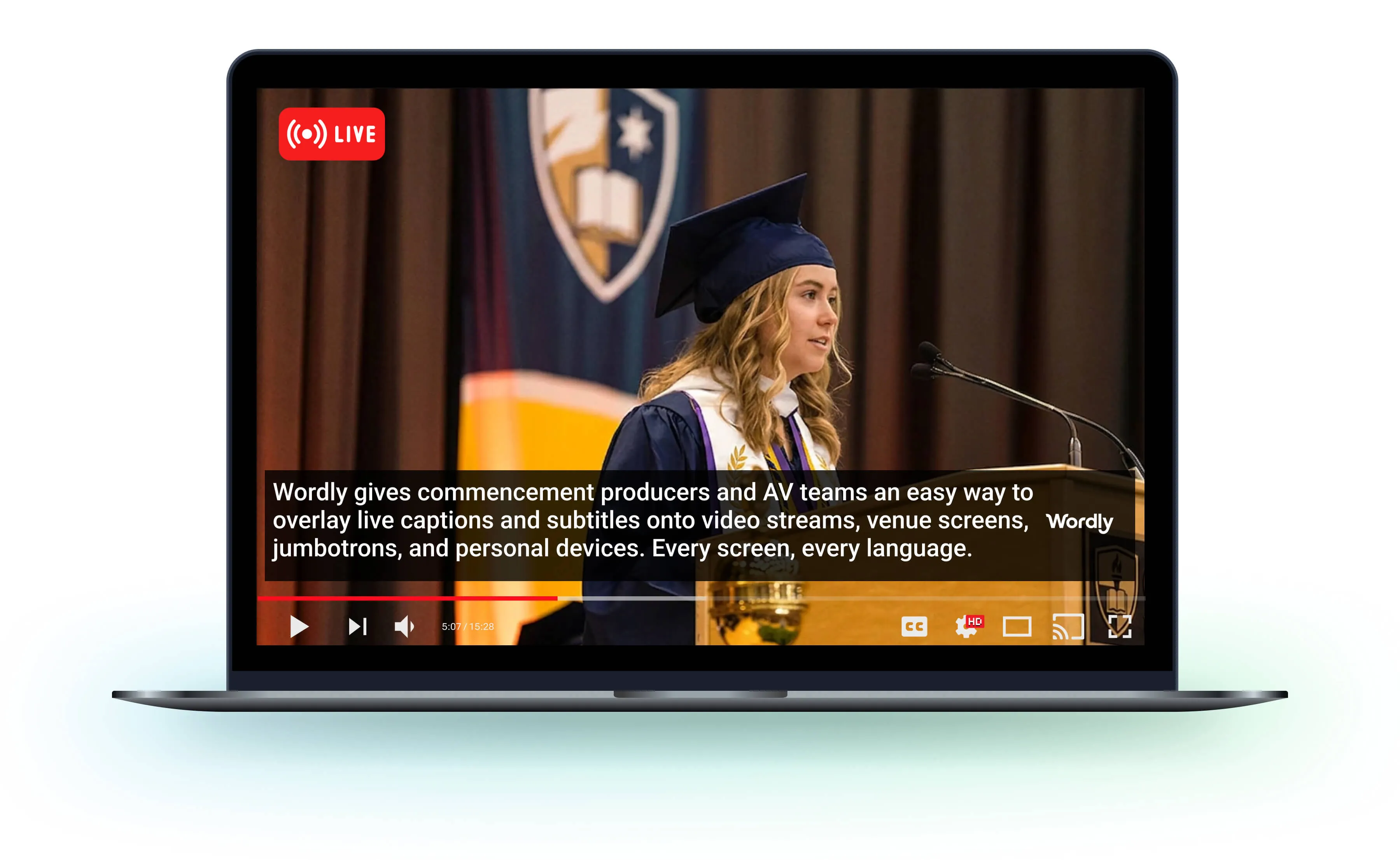
Every screen, every language. AI subtitles and captions can be displayed on personal devices, overlaid on your livestream, projected on overflow room screens, or burned into jumbotron feeds. Whatever the AV team is already running, Wordly fits in.
Works with what you have. Wordly integrates with Zoom, Microsoft Teams, Webex, Google Meet, and any RTMP livestream. No new platform for the production team to learn the week of graduation.
Accessibility. Live captions in the ceremony language help support ADA, Section 508, and equivalent accessibility standards globally. Multilingual captions and audio go further by also satisfying Title VI and similar language access obligations worldwide. For ASL and other signed languages, Wordly complements human interpretation.
Frequently Asked Questions About Graduation Translation
How much do graduation translation services cost?
Traditional simultaneous interpretation runs $20,000 to $35,000+ for a single ceremony in five languages, before headset logistics. AI-powered translation through Wordly delivers dozens of languages at a fraction of that cost, with one annual license covering every ceremony in the academic year.
Can guests use this without downloading an app?
Yes. Guests scan a QR code (printed in the program or projected on screen), pick a language, and the translation runs in their phone's browser. No app store, no account, no downloads. This matters for grandparents who fly in once for the ceremony.
Are K-12 graduations legally required to provide language access for LEP parents?
In the U.S. Title VI of the Civil Rights Act, as affirmed in Lau v. Nichols, requires school districts receiving federal funds to provide LEP parents with meaningful access to school programs and vital communications. OCR has interpreted this to include school events such as graduation. You should consult with your legal team regarding applicability to your organization.
What about the livestream, overflow rooms, and the recording?
Wordly works in all three settings simultaneously. Translated captions overlay on your Zoom/Teams/YouTube livestream, project on screens in overflow rooms, and apply to the post-event recording so families who couldn't attend can watch in their language afterward.
Ready to make your next graduation multilingual?
Whether you're a university hosting families from 50 countries, a community college serving a bilingual community, or a school district trying to support language access obligations on a tight budget, Wordly fits in with the AV setup you already have.
Explore all of our education translation solutions for your school. In addition to graduation and commencement ceremonies, schools use Wordly for Orientation Translation as well as school board meetings, staff training, parent teacher conferences, classroom translation, and many more use cases.


.png)
