AI and the Future of Events: Wordly Featured in the New Skift Meetings Report
.avif)
.avif)
Almost every event tech tool claims to be AI-powered now. The more useful question, and the one at the heart of a new report from Skift Meetings, is whether a tool does something that simply would not be possible without AI.
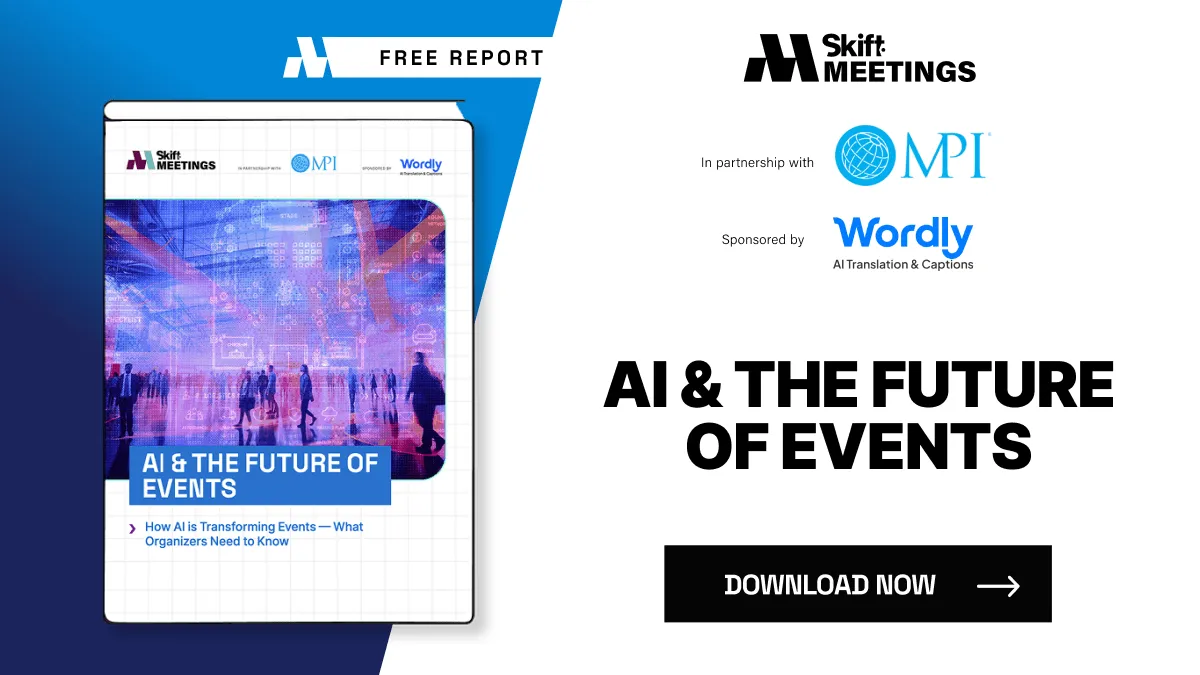
Skift Meetings, in partnership with MPI and sponsored by Wordly, has published AI and the Future of Events, a practical guide to how AI is reshaping the industry, built on an analysis of almost 700 event tech tools. We are proud to sponsor the report and to share our perspective on where AI-powered language access fits into the future of events.
You can read and download the full report on Skift Meetings.
What's inside the report?
The report cuts through the noise around AI in events and gives organizers a clear framework for making smarter decisions in a fast-moving market. Inside, you will find:
- Profiles of more than 130 AI event technology tools, mapped across six event phases, from pre-launch strategy to post-event follow-up.
- Three vivid scenarios imagining the ideal AI-powered experience for an attendee, a sponsor, and an organizer.
- A plain-language explainer on large language models, agentic AI, and the Model Context Protocol (MCP), written for event professionals rather than engineers.
- The key questions to ask, and the red flags to watch for, when buying AI event technology
Why is live translation an AI-native capability?
One of the report's central points is that adding an "AI-powered" label to a feature does not always change what a tool can do. There are, however, clear cases where AI enables something that was impossible before. The report names live translation and captions as one.
That is exactly where Wordly lives. In the report's map of AI-native tools across the event lifecycle, Wordly appears in the on-site phase among the platforms delivering live translation and captions, the moment when operational stakes are highest and attendees are focused on the content in front of them.
Wordly’s View: A Conversation With CMO Dave Deasy
As part of the report, Skift Meetings sat down with Wordly CMO Dave Deasy to talk about how live AI translation is changing the event experience. Here are the highlights:
Live translation that adapts to your audience
Traditionally, event attendees have had to adapt to the language of the room. AI changes that.
"Rather than requiring an audience to adapt to an event, AI-powered translation adapts to the audience, creating an experience that lets attendees engage in the language of their choice on their own device." – Dave Deasy, CMO, Wordly
This matters more every year. Wordly's 2026 research shows that 79% of planners report a rise in non-native English speakers at their events. When language is no longer a barrier, attendees can fully engage with speakers and peers from different regions, which deepens the pool of knowledge and perspectives an event can offer.
Fast to set up, and easy for attendees
Adopting AI translation does not require becoming a technical expert. Deasy describes onboarding as fast and easy for both event planners and attendees, and teams can often get started the same day with a simple configuration.
Instead of coordinating interpreters and managing headsets, event planners can offer live translation across dozens of languages with a plug-and-play process. Connecting to a sound system usually takes less than five minutes, and setting up a new session takes under a minute. Attendees simply scan a QR code, choose their language, and follow along on their own device.
Where language support delivers the most value
Deasy's advice is to think about AI translation at the program level rather than as a per-session decision. The greatest value comes where understanding drives outcomes, such as keynotes, general sessions, training, and interactive formats like Q&A and workshops.
The results add up. In the past two years alone, Wordly has helped clients save more than $200 million compared to traditional interpretation, while making their programs more accessible to global audiences.
"When more attendees fully understand the material, participation and overall event value can increase, especially in global or multilingual audiences where language has historically been a barrier." – Dave Deasy, CMO, Wordly
Enterprise scale, security, and privacy
Wordly launched in 2019, and over the past seven years the platform has evolved through continuous learning in live environments. Customer feedback has driven new languages, better accuracy, and features like custom glossaries for industry-specific terminology. Adoption has grown beyond keynotes and conferences into everyday collaboration through Wordly Workspaces, and today more than 5 million users rely on Wordly.
Security and privacy are core requirements, not afterthoughts. Wordly is SOC 2 Type II and ISO 27001 compliant, supports enterprise controls like SSO, and aligns with GDPR. Just as important, Wordly never uses customer meeting data to train AI models.
What AI means for the event planner's role
Looking ahead, Deasy sees AI freeing event planners from operational complexity so they can focus on designing more intentional, experience-driven programs. His guidance for anyone still getting comfortable with the technology is refreshingly simple.
"Focus on the problem you're trying to solve, not the technology itself. Think of AI as a powerful tool to help you make a program more accessible for your entire audience." – Dave Deasy, CMO, Wordly
Skift Meetings’ Review of Wordly
This is not the first time Skift Meetings has taken a close look at Wordly. Wordly is also the official translation partner for the Skift Global Forum and Skift Meetings Forum, so its team has first-hand experience with the platform.
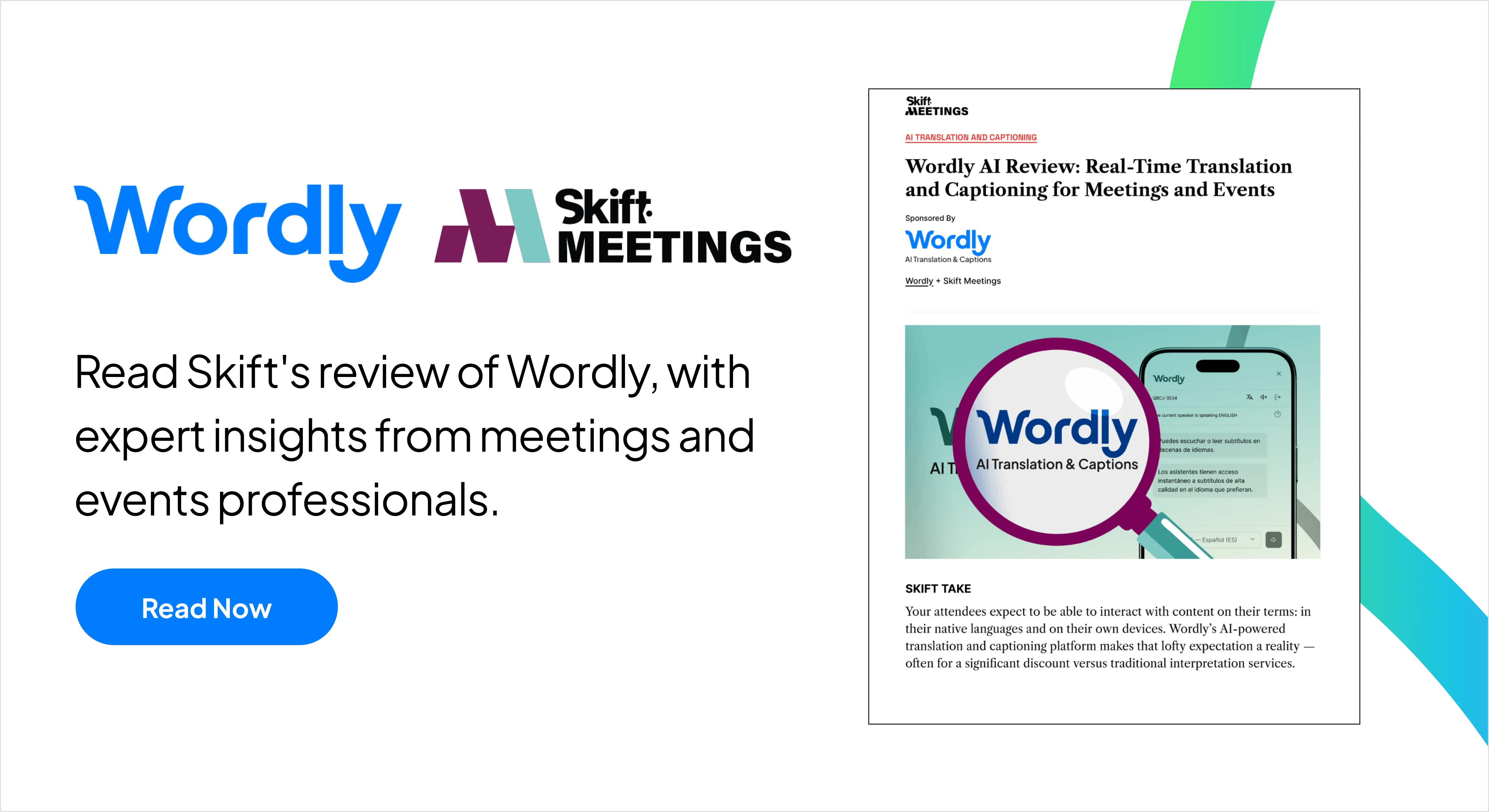
In its product review, Skift called Wordly the industry's leading AI-powered translation and captioning service, and highlighted the fast setup, attendee-friendly access, enterprise scale, and cost savings compared to traditional interpretation.
You can read the highlights from Skift's review of Wordly here, including the numbers Skift validated and a side-by-side look at the cost of AI translation vs hiring interpreters.
Frequently Asked Questions
What is the AI and the Future of Events report?
It is a research-led report from Skift Meetings, produced in partnership with MPI and sponsored by Wordly. It analyzes almost 700 event tech tools, profiles more than 130 AI-native tools across six event phases, and gives event organizers a framework for buying and using AI-powered event tech.
What is Wordly's role in the report?
Wordly is a sponsor of the report and contributed a Skift Studio interview with CMO Dave Deasy on how AI-powered translation is making events more personalized and inclusive. Wordly is also featured among the AI-native tools delivering real-time captioning and translation on-site.
How does AI translation improve the attendee experience at events?
AI translation lets attendees follow a session in their preferred language on their own device, through live audio or real-time captions. This removes language barriers so more people can fully engage with speakers and peers, which is increasingly important as the number of non-native English speakers at events continues to rise.
How quickly can Wordly be set up for an event?
Teams can often get started the same day. Connecting Wordly to a sound system usually takes less than five minutes, and setting up a new session takes under a minute. Attendees join by scanning a QR code, with no downloads or accounts required.
Bring Live AI Translation to Your Next Event
Language should never be the reason someone misses out on your event. With Wordly, every attendee can follow along in the language they think in, on the device already in their hand, with no headsets, no interpreter scheduling, and no downloads.
Book a live demo to see how it works for your organization.


.png)
