OSHA Training Translation: How Multilingual Safety Training Keeps You Compliant & Lowers Insurance Costs
.avif)
.avif)
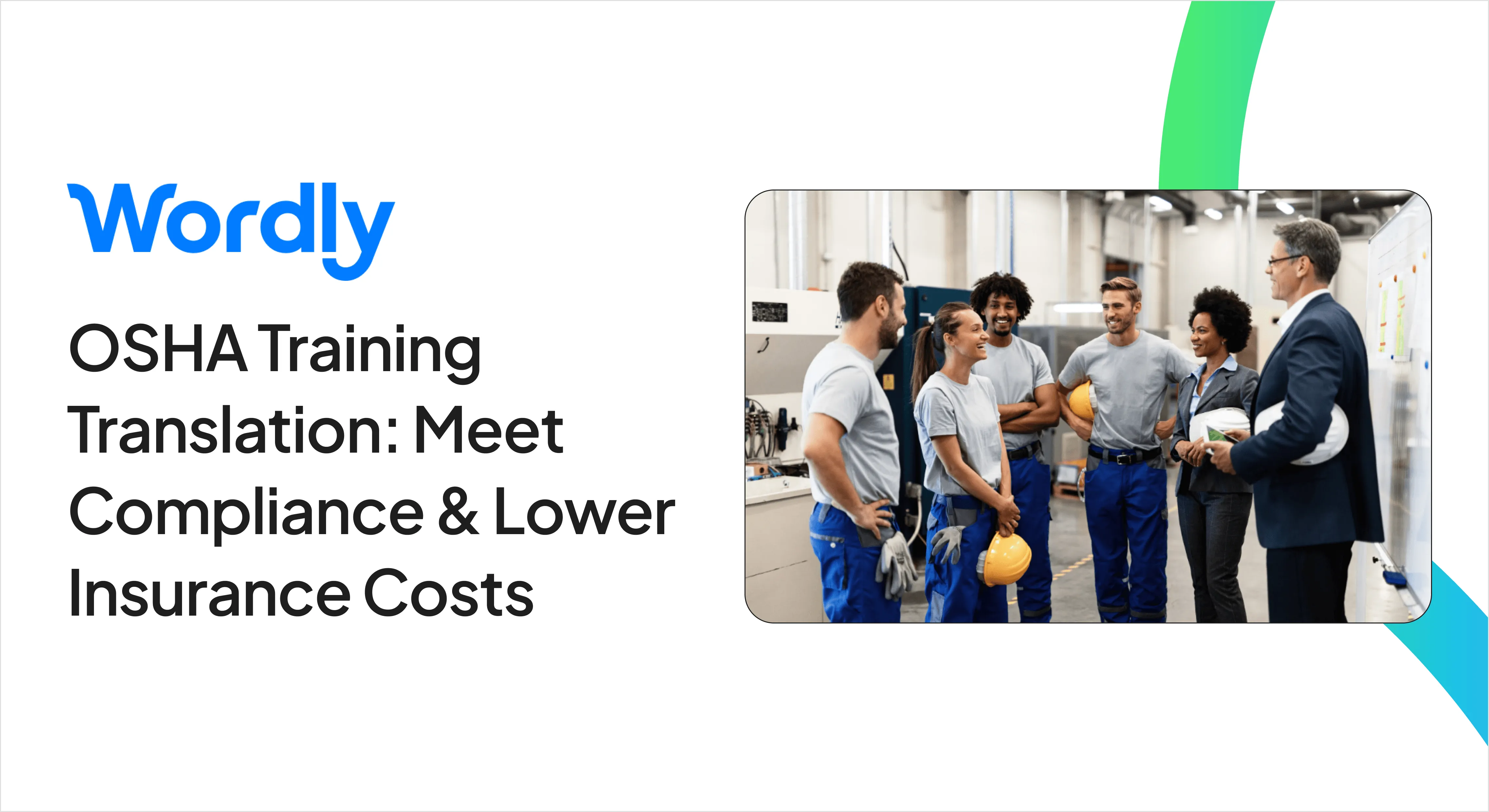
Walk on to almost any construction site or manufacturing floor today and you'll hear more than one language. In the U.S., roughly one in three construction workers identifies as Hispanic or Latino, and a significant share of the trade workforce speaks a first language other than English.
That reality conflicts with a legal obligation many employers misunderstand: under OSHA, safety training only counts if the worker can actually understand it.
If your crew takes daily instructions in Spanish but sits through safety training in English, you are not compliant, no matter how thorough the training or how complete your sign-in sheets.
This Wordly best practices post breaks down the OSHA translation requirements, what non-compliance costs, and why multilingual safety training does more than check a box: it reduces accidents and can lower your insurance cost.
Table of Contents:
- What OSHA Actually Requires for Training Translation
- The Comprehension Standard: Why Translated Handouts Aren't Enough
- The Cost of Getting It Wrong: Fines, Enforcement, and Injuries
- The Overlooked Payoff: Lower Insurance Premiums
- A Modern Approach to Multilingual Safety Training
- Traditional vs. AI-Powered OSHA Training Translation & Interpretation
- Frequently Asked Questions About OSHA Training Translation & Interpretation
- Getting Started
Note - This information is not meant to be legal advice. You should consult with your legal team to understand the specific compliance requirements for your organization.
What OSHA Actually Requires for Training Translation
Here's the part that surprises most safety managers: there is no OSHA standard that says, in so many words, "you must translate your training." Instead, OSHA's requirement is built around a single idea: comprehension.
OSHA's position, formalized in its 2010 Training Standards Policy Statement, is that any employee training required by an OSHA standard must be delivered in a language and vocabulary the worker can understand. The agency has reinforced this through a long line of interpretation letters dating back to the late 1980s, particularly around the Hazard Communication Standard (29 CFR 1910.1200).
The practical trigger is clear and worth committing to memory: if you routinely communicate work instructions or other job information to employees in a language other than English, you are expected to provide their safety and health training the same way.
An employer that runs its jobsite in Spanish but conducts safety training only in English is in conflict with standards like Hazard Communication (1910.1200) and Fall Protection (1926.503) — two of the most frequently cited standards in the country.
In other words, the OSHA translation requirements aren't a separate rule you can look up and file away. They're baked into every training obligation you already have. If a worker can't understand the training, in OSHA's eyes the training didn't happen.

The Comprehension Standard: Why Translated Handouts Aren't Enough
Many employers try to satisfy the requirement the cheap way: running English training and handing out a translated PDF, or dropping a Spanish subtitle track onto an English video. That approach rarely holds up.
OSHA's standard is comprehension, not translation. Some of its training provisions go further and require the employer to verify that workers actually understood the material, not simply that they attended. If an OSHA compliance officer decides your training was deficient, the burden falls on you to show that workers were able to understand it and apply it to their specific jobsite.
A static translated document can't answer a question, can't confirm understanding, and can't adapt when a worker looks confused. Real comprehension means a worker can follow the training live, ask questions in their own language, and demonstrate they got it. That's a high bar for a translated slide deck, and exactly the gap that live, multilingual safety training is designed to close.
The Cost of Getting It Wrong: Fines, Enforcement, and Injuries
OSHA has directed its inspectors to check, during site visits, whether workers were trained in a language they understand. This is an active enforcement priority, not a theoretical one.
The financial exposure is significant and rises every January with inflation. As of the 2026 adjustment:
- Serious and other-than-serious violations: up to $16,550 per violation
- Willful or repeat violations: up to $165,514 per violation
- Failure to abate: up to $16,550 per day past the deadline
Because penalties are assessed per violation rather than per inspection, a single site visit that uncovers multiple deficiencies can climb into six or seven figures fast.
And fines are only the visible cost. The real damage from a worker who didn't understand a lockout/tagout procedure or a fall-protection briefing is the injury itself: the medical claim, the lost time, the investigation, the reputational hit, and the human toll. Language-related misunderstanding is one of the most frequently cited challenges in keeping immigrant and limited-English-proficient workers safe. Compliance and safety are the same problem viewed from two angles.
The Overlooked Payoff: Lower Insurance Premiums
Most employers treat multilingual safety training as a compliance cost. The forward thinking companies treat it as a way to reduce their insurance bill.
The mechanism is straightforward. Better training reduces incidents. Fewer incidents mean fewer workers' compensation claims. Fewer claims improve your experience modification rate (e-mod) — the multiplier insurers apply to your premium based on your claims history. A lower e-mod means a lower premium, year after year. OSHA itself estimates that employers see an average return of $4 to $6 for every dollar invested in workplace safety programs, and lists lower insurance premiums among the direct benefits.
The most compelling proof that language-specific training moves this needle comes out of Colorado. Pinnacol Assurance, the state's largest workers' compensation insurer, pushed its construction clients to train Spanish-speaking workers in Spanish. Over two years, claims by Hispanic or Latino construction workers fell 20 percent — a drop of 378 claims, down to 1,504 — even as overall construction claims edged up with a growing workforce. Pinnacol credited the decline directly to the increase in training Spanish speakers.
One caveat worth mentioning: there's usually no discount labeled specifically for translating your training. But the premium benefit reaches you through two channels:
- The first is indirect: fewer claims improve your experience modification rate and lower your premium over time.
- The second is more direct: more than a dozen states offer workers' compensation premium credits, often ranging from single digits up to 20%, to employers that maintain a certified, documented safety program. Comprehensible, multilingual training is a core part of an OSHA-compliant program, so it helps you qualify for and defend those credits. The specifics vary by state and change periodically, so it's worth confirming what's available with your state's workers' compensation authority or your carrier.
A Modern Approach to Multilingual Safety Training
For years, employers had three imperfect options: hire a bilingual trainer for every language on the crew, book a human interpreter for each session, or fall back on translated handouts that don't meet the comprehension bar. The first two are expensive and hard to schedule; the third doesn't hold up under inspection.
Live AI translation and captions remove that trade-off. With Wordly, a single trainer can present in English (or any language) while every worker follows along in their own language in real time.
Here's how it works: each worker scans a QR code on their own phone, selects their language, and receives live translated audio and captions as the trainer speaks. No booths, no headsets to sanitize and hand out, no interpreter to schedule. Wordly supports dozens of languages, so a crew that speaks English, Spanish, Portuguese, and Vietnamese is handled in the same session, at the same cost. Because workers can read captions and hear audio simultaneously, comprehension improves, which is the exact standard OSHA is measuring against.
For safety leaders, that means one training session covers the whole crew, documentation is cleaner, and the "language a worker can understand" requirement is met by design rather than by patchwork.
You can explore the Wordly Training Translation solution and Language Access Compliance resources to see how it maps to your needs.
You can also estimate the potential savings of using AI vs human interpretation with the Wordly Savings Calculator.
Watch a 3-minute demo to see how Wordly works.
Traditional vs. AI-Powered OSHA Training Translation
Set the three approaches side by side and the trade-offs are clear.
A bilingual trainer or human interpreter can meet the comprehension standard and field questions in a worker's language, but only when one is available to book. You are usually limited to 1-2 languages per session, lead times run days or weeks, and each session leans on specialized equipment or an on-site interpreter. The cost climbs with every language you add and every session you run.
Translated handouts require no equipment and cost very little, but those savings are misleading. A static document is stuck with whatever you translated in advance, can't answer a question in real time, and can't verify that anyone understood it. That's exactly why it falls short of OSHA's comprehension standard, which turns the low price tag into a false economy.
Live AI translation with Wordly clears the bar the other two struggle with, and it removes their constraints along the way. Real-time audio and captions meet the comprehension standard, a single session handles dozens of languages at once, and setup only takes a few minutes. Questions get answered live in each worker's language, one session covers the whole crew, and the only equipment anyone needs is the phone in their pocket and a pair of headphones.
For any employer training a workforce that speaks more than one language, Wordly is the clear choice.
Frequently Asked Questions About OSHA Training Translation
Does translated safety training help with OSHA compliance?
Yes. OSHA requires training to be delivered in a language and vocabulary the worker can understand. In practice, if you communicate work instructions in a language other than English, you must provide safety training the same way.
Is a translated handout or subtitled video enough to be compliant?
Probably not. OSHA's standard is comprehension, and some provisions require you to verify workers actually understood the material. A static document can't confirm understanding or answer questions, so it often falls short under inspection.
What are the penalties for non-compliant training?
As of 2026, serious violations carry penalties up to $16,550 each, and willful or repeat violations up to $165,514 each. Penalties are assessed per violation, so exposure adds up quickly.
Can multilingual safety training really lower our insurance costs?
Yes. Better comprehension leads to fewer injuries and claims, which improves your experience modification rate and lowers premiums over time.
How many languages can Wordly handle in one training session?
67 languages simultaneously. Every worker chooses their own language on their own device, so a multilingual crew is covered in a single session.
Is Wordly secure enough for internal training content?
Yes. Wordly is ISO 27001 certified and SOC 2 Type II compliant.
Getting Started
The compliance case for multilingual safety training is already settled — OSHA expects your crew to understand what they're taught, and inspectors are checking. The business case is just as strong: fewer injuries, fewer claims, and lower insurance premiums over time.
The only real question is how you deliver it. Bilingual trainers and human interpreters are expensive and hard to schedule. Translated handouts don't meet the bar. Live AI translation lets one trainer reach an entire multilingual crew in real time, in every language on the jobsite, using the phones already in workers' pockets.
Ready to see how Wordly makes your safety training compliant in every language your crew speaks? Schedule a demo today.


.png)
