How Cities Are Using AI Translation to Manage Rising Costs and Staff Cuts
.avif)
.avif)
Local governments are being squeezed from all sides. Budgets are shrinking, hiring is harder, and demand for services keeps growing. On top of that, cities are serving increasingly diverse communities where dozens of languages may be spoken across households, schools, and businesses. Around 68 million people in the U.S. speak a language other than English at home, and more than 25 million have limited English proficiency. When residents can't understand emergency alerts, public health information, or what's being said in a city council meeting, they're not just left behind, they're shut out.
Real-time AI translation is changing what's possible. Cities like Washoe County, Los Angeles County, and San Jose are using AI-powered live translation to expand language access across public meetings, emergency communications, staff training, and constituent services, delivering dozens of languages simultaneously at a fraction of the cost of traditional human interpretation. This post covers the budget realities driving adoption, real government use cases, and why AI translation is now a practical option for cities of any size.
How AI Translation Solves the Budget Problem for Cities
In the Wordly 2025 State of Language Access in Local Government report, nearly 50% of municipalities cited budget constraints as the biggest barrier to providing language support. And it’s no surprise that traditional interpretation services are costly and nearly impossible to scale across every department or public touchpoint.
This is where AI is really starting to make a difference. AI translation gives cities and counties real-time language support without the high cost of traditional interpreters. Places like Washoe County, Los Angeles County, and San Jose are already seeing significant results, all while reaching more people in more languages. And because the technology runs on everyday laptops and phones, there’s no need for pricey AV equipment or complicated tech upgrades. It’s simple, scalable, and budget-friendly.
How Cities Are Using AI Translation Today: Real-World Examples
And this isn’t theoretical. It’s happening right now, with measurable results:
- In Washoe County, Nevada, AI is being used for everything from food safety training to marriage ceremonies. Their public health department delivers training to restaurant staff in multiple languages in real time using AI translation.
- Los Angeles County tapped AI translation during the wildfires to get emergency updates out fast, in multiple languages. A solution that would’ve been far more expensive and slower to coordinate using interpreters.
- San Jose, California, uses AI to caption and translate public meetings in real time, giving residents immediate access in their preferred languages and improving civic engagement without adding overhead.
Cities are also using AI for employee onboarding, permitting desks, one-to-one customer service, and even field work like animal services, where staff need quick, clear communication with residents who speak different languages.
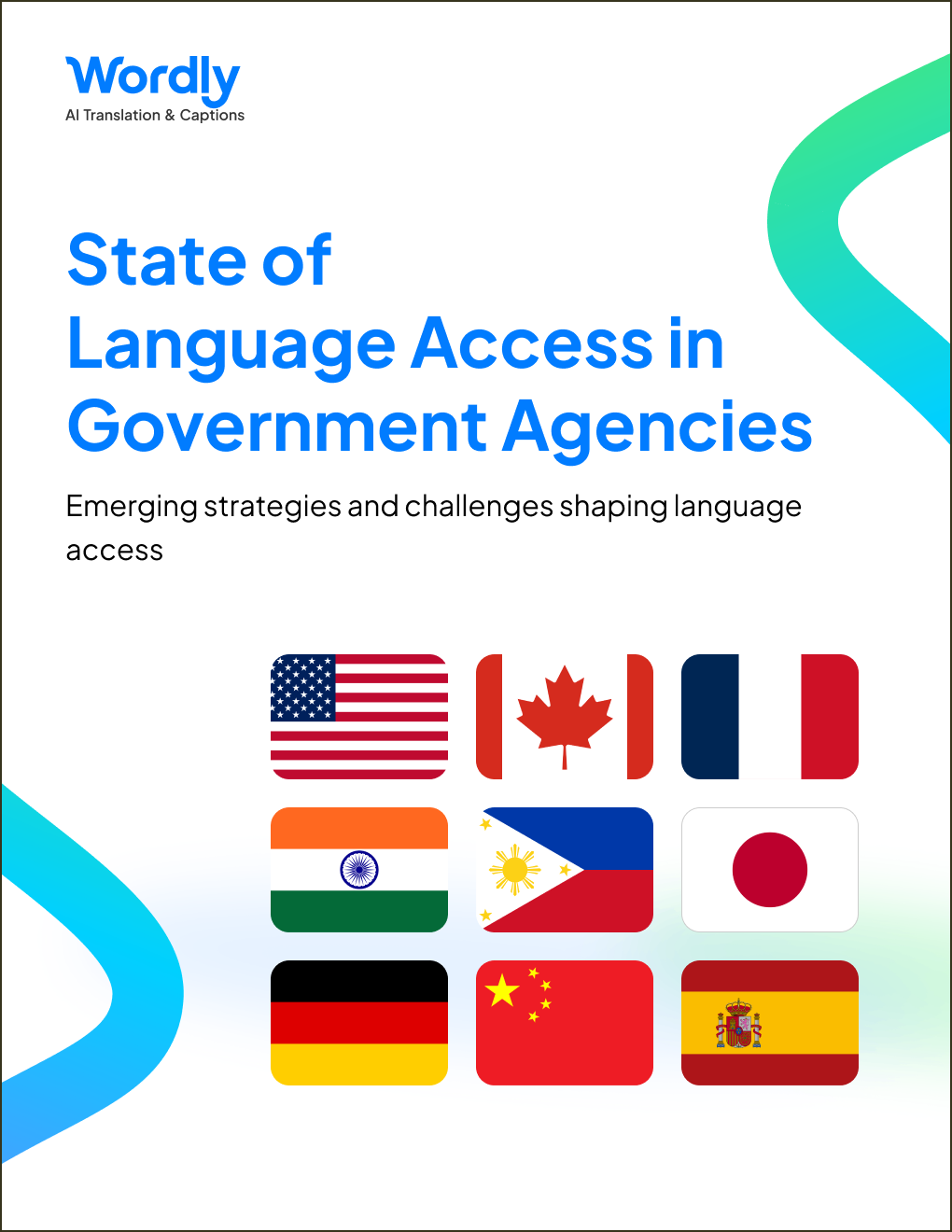
State of Language Access Report
Wordly surveyed 117 U.S. local governments on language access. Download the full 2025 report for the complete data on rising demand, top barriers, AI translation adoption, and the steps agencies are taking next.
Download ReportFrequently Asked Questions About AI Translation for Cities
How can AI translation reduce local government costs?
AI translation dramatically reduces the cost of language access compared to traditional interpretation. Where a single human interpreter typically costs hundreds to thousands of dollars per day per language pair, AI tools like Wordly deliver dozens of languages simultaneously from a single source at a subscription cost that scales predictably. Cities using AI translation report significant savings on interpreter fees, equipment rentals, and coordination overhead across public meetings, staff training, and constituent services.
What government services benefit from AI translation?
Cities and counties use AI translation across nearly every public-facing service: public meetings and city council sessions, emergency communications and public safety alerts, staff training and onboarding, permitting and licensing services, constituent-facing customer service, community outreach events, and field work like animal services or code enforcement. Any government touchpoint where residents need to understand what's being communicated is a candidate for AI translation.
Can AI translation help understaffed government agencies?
Yes. AI translation removes the need to hire bilingual staff for every language a community speaks, letting a small government workforce serve residents in dozens of languages. This is particularly valuable for agencies facing hiring freezes, budget cuts, or shortages of qualified bilingual candidates for specific languages, where AI translation can extend the reach of existing staff without requiring new hires.
Does AI translation work for emergency communications?
Yes. AI translation is well-suited to emergency communications where speed matters. Los Angeles County used AI translation during recent wildfires to distribute evacuation alerts and safety updates in multiple languages faster than traditional interpretation methods could coordinate. AI translation lets emergency managers reach every community with critical information immediately, without waiting for human interpreters to become available.
Which cities are using AI translation?
Many cities and counties across the U.S. use AI translation, including Washoe County (Nevada), Los Angeles County, San Jose (California), Vermont municipalities, and dozens of other local governments. Adoption is growing quickly as cities face rising demand for language access alongside budget constraints, and as newer state laws like California SB 707 require more accessible public meetings.
Can small cities and rural counties afford AI translation?
Yes. Because AI translation scales at a fixed cost regardless of how many languages are supported, professional-grade language access is now affordable for small cities and rural counties, not just major metros. A rural county serving a growing multilingual community can offer the same quality of translation as a large city, without the interpreter budget that only large cities have historically been able to afford.
Does AI translation meet government compliance requirements?
AI translation can help government agencies comply with Title VI of the Civil Rights Act, ADA Title II, California SB 707, and other language access requirements by providing meaningful access for individuals with Limited English Proficiency and those with hearing or communication disabilities. Enterprise-grade platforms with SOC 2 Type II and ISO 27001 certification meet the security standards required for government data.
Equity Without Tradeoffs: AI Translation at Scale
What makes AI translation so powerful is that it scales. Whether you’re supporting two languages or twenty, the cost is the same. That puts professional-grade language access within reach for small cities and rural counties, not just big metros.
In tough economic times, cities need tools that work while saving time and money. AI translation checks all three boxes. It improves access, reduces staff burden, and makes it possible to serve every resident, not just the ones who speak English fluently.
The bottom line is that AI translation isn’t just a tech trend. It’s a smart, budget-friendly strategy for governments trying to do more with less, without sacrificing service or equity.
Request a personalized demo to see how Wordly can help your city expand language access affordably.
About the Author
Dave Deasy is the CMO of Wordly, the leader in live AI translation, captions, and summaries. Used by over 6 million people in dozens of languages, Wordly helps government organizations create more inclusive meetings and events.


.png)
