
Silent Disco Guide: How It Works, What It Costs, and How to Run One Without Equipment Rentals
.avif)
.avif)
A silent disco is an event format where audio is sent directly to each listener instead of being played through room speakers, so attendees hear the presenter through headphones while the room itself stays quiet. At some events or conferences, the same format is called silent theater, silent conference, silent seminar, silent conference, or floor audio, and it lets planners run multiple stages and breakout sessions in one open space without sound bleed. This includes education sessions and booth presentations.
Traditional silent disco rental is priced per headphone per day, so the cost climbs with every attendee, before shipping, staffing, and sanitizing are added. You also need to rent one transmitter for each stage. Wordly Silent Theater delivers the same outcome without rental equipment: attendees scan a QR code and listen with their own device and headphones, with live translation and captions available in dozens of languages.
Table of Contents:
- What is Silent Disco?
- What Else Is a Silent Disco Called?
- How Does a Silent Disco Work?
- Why Is It Important to Offer a Silent Disco at Your Event?
- What Equipment Does a Silent Disco Need?
- How Much Does a Silent Disco Cost?
- Does Wordly Offer Silent Disco?
- How Do You Set Up Silent Theater Sessions at Your Event?
- Silent Disco vs. Silent Theater vs. Floor Audio
- Frequently Asked Questions
- Bring Silent Theater to Your Next Event
What is a Silent Disco?
A silent disco is an event setup where the audio goes directly to each listener rather than through a loudspeaker system. Everyone hears the same content at the same moment, but anyone standing outside the group hears nothing.
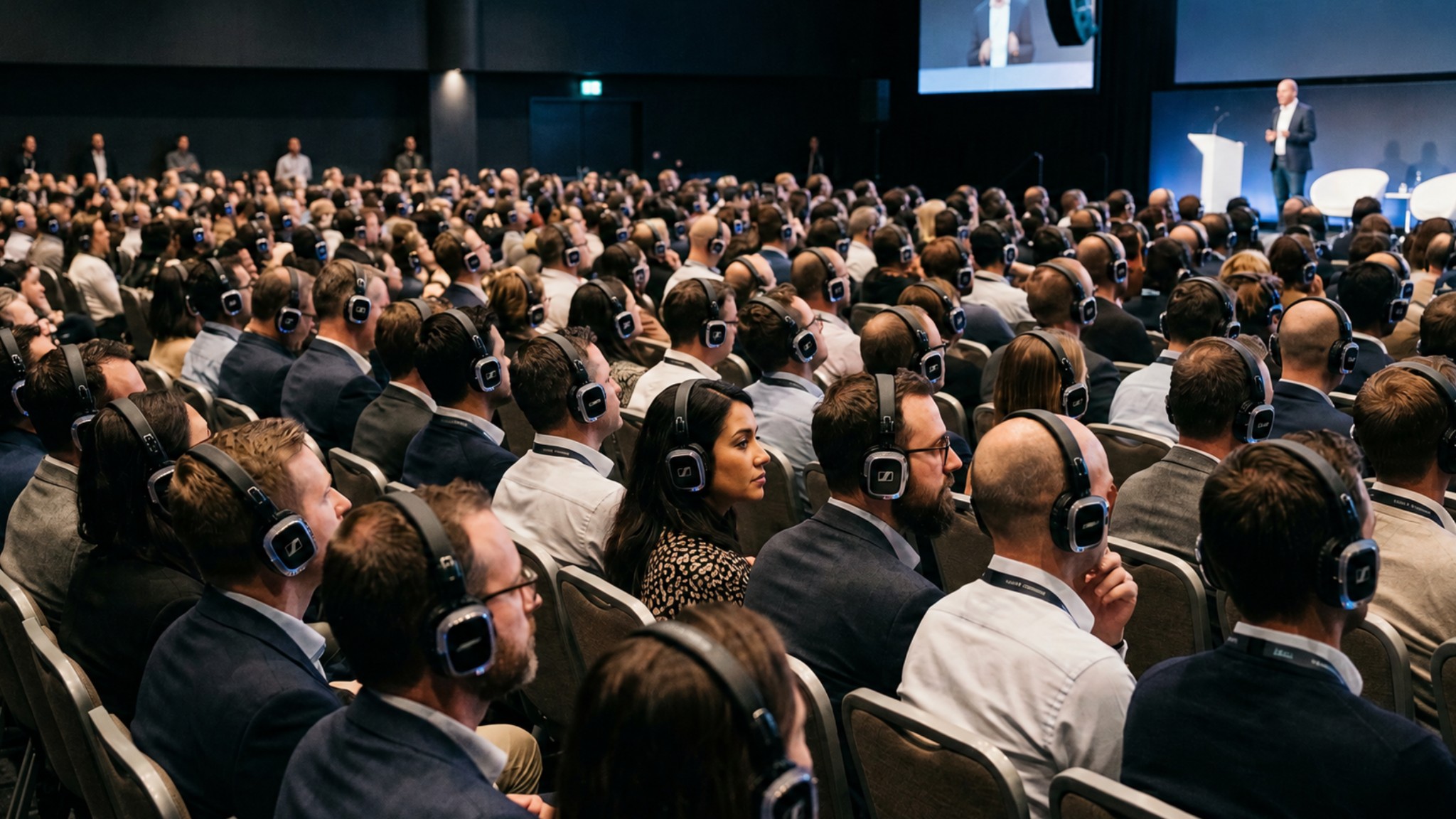
At a music event, that means attendees dance to a DJ while the room is quiet. At a business event, the same silent conference technology means an audience listens to a speaker while a second presentation runs twenty feet away and neither one interferes with the other.
The three things that make the format work are consistent no matter what you call it:
- Direct-to-listener audio: Sound reaches the ear without crossing the room, so it cannot bleed into a neighboring session.
- Individual volume control: Every listener sets their own level. Nobody is stuck too loud or straining at the back.
- Channel switching: When multiple sessions run at once, listeners choose which one they are tuned into and can move between them without leaving the room.
What Else is a Silent Disco Called?
This is one of the more confusing categories in events, because planners, AV vendors, and attendees all use different words for the same thing. If you are looking for a solution, here is what you will run into.
How Does a Silent Disco Work?
There are two ways to deliver a silent disco, and they work very differently.
The Traditional Setup: RF Transmitters and Rental Equipment
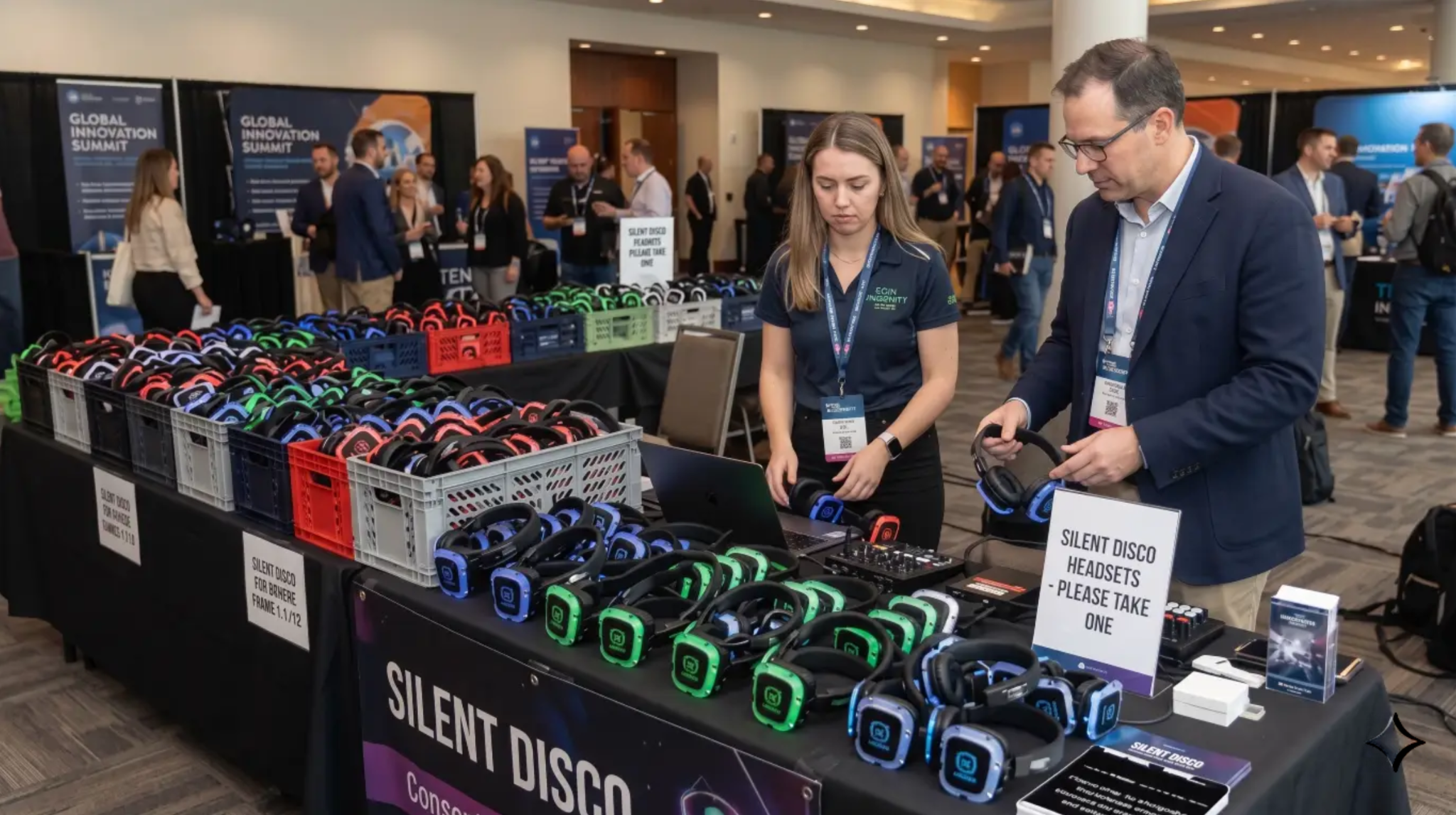
The legacy approach uses radio frequency broadcasting. A transmitter connects to your audio source, usually a presenter's microphone or a mixer, and broadcasts the signal on a dedicated frequency in a license-free UHF band. Every rental headset contains an RF receiver tuned to those frequencies. Press the channel button on the headset and you switch to a different transmitter, which is why the headsets glow a different color for each channel.
RF is used instead of Bluetooth for a practical reason: Bluetooth pairs one device to one source, while an RF transmitter broadcasts to unlimited receivers at once with no pairing step. Range typically runs a few hundred meters in the open and less through walls, and battery life on a good headset covers a full event day.
Standard consumer kits carry three channels. Multi-channel systems built for silent seminars go higher, into the 10 to 30 channel range, at a meaningfully higher price per unit.
The Modern Setup: Attendee Phones and a QR Code
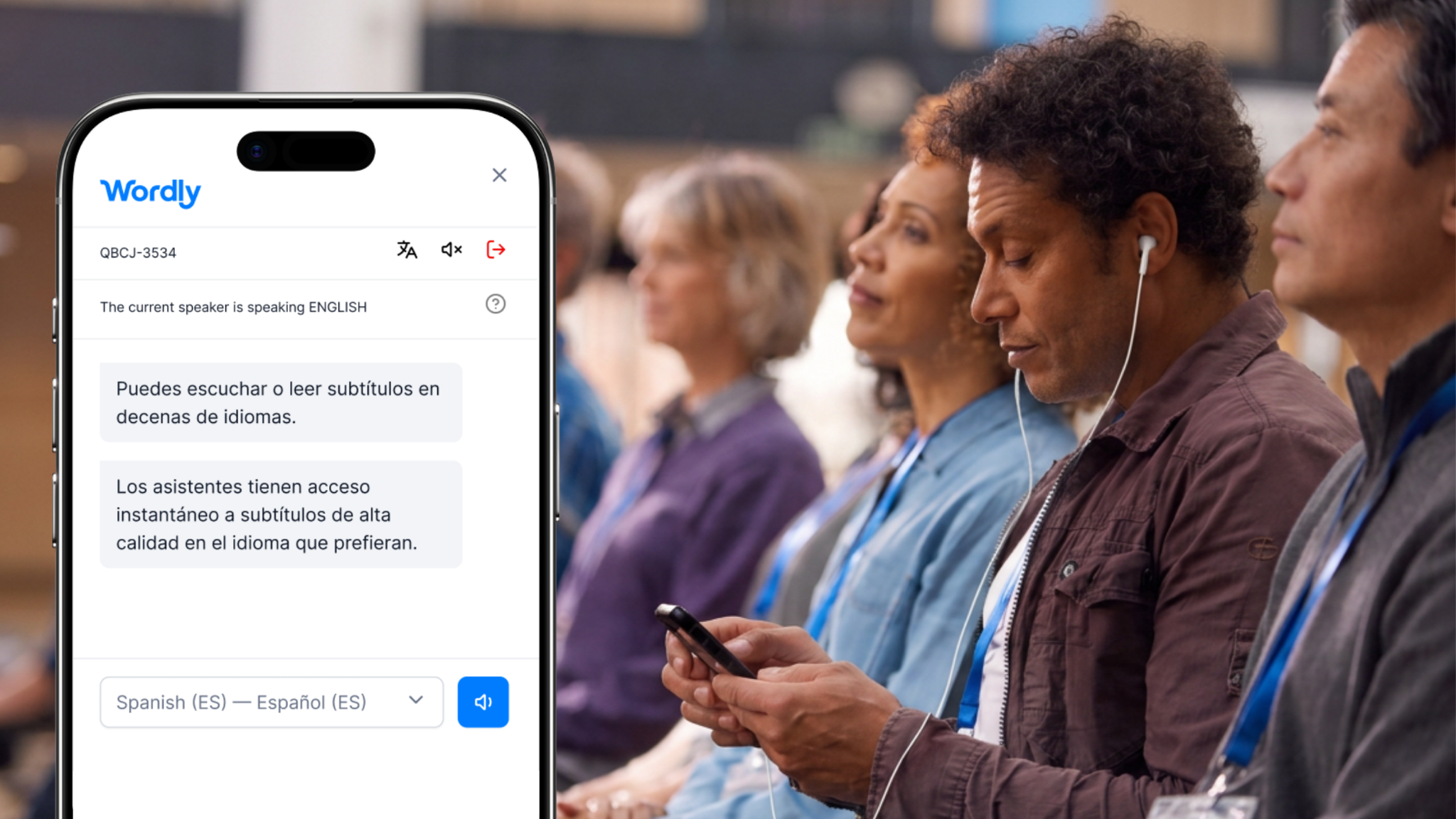
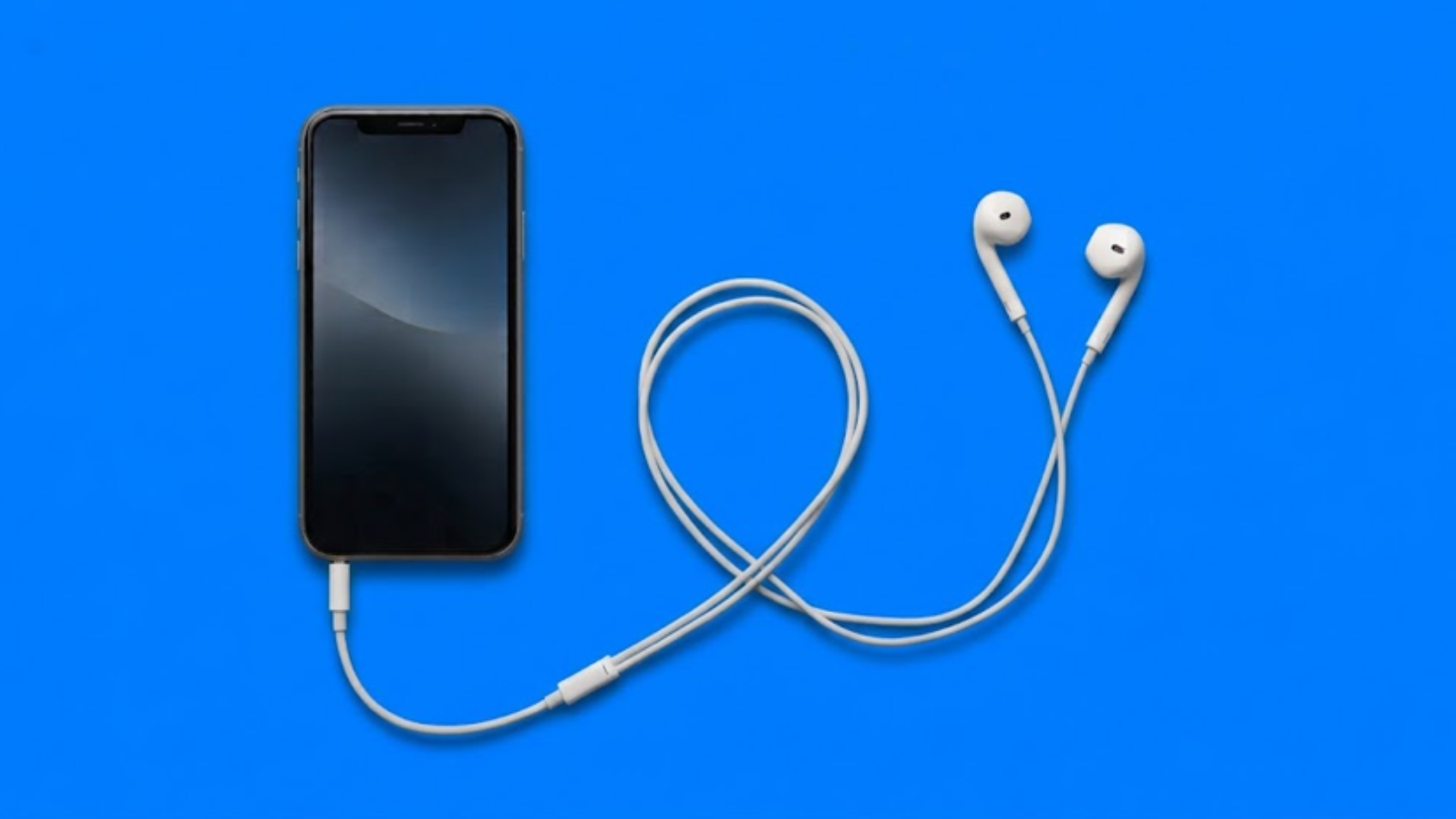
The second approach skips the hardware entirely. The presenter's microphone feeds into event software instead of an RF transmitter, and the audio streams to each attendee's own smartphone. Attendees scan a QR code, use their own earbuds, and listen instantly.
The attendee's phone becomes the silent audio receiver. There is nothing to ship, nothing to charge, nothing to hand out, and nothing to sanitize between sessions. Rooms can be added to the program on short notice, without a hardware order or a call to your AV vendor.
Why Is It Important to Offer a Silent Disco at Your Event?
The reason event planners adopt this format is usually one of the following five problems.
Run Simultaneous Breakout Sessions Without Walls
Convention venues have a fixed number of breakout rooms, and they book out fast. Silent sessions let you put multiple concurrent presentations in one ballroom, with no walls, no soundproofing, and no additional room rental. Your program grows without your floor plan expanding.
Stop Audio Bleed Between Breakout Sessions
Audio bleed is the single most common complaint about open floor plans, and there is no volume setting that fixes it. If you raise one stage you drown out the next. Direct-to-ear audio removes the problem at the source, because the sound never crosses the room in the first place. That is also why the format works in venues with strict decibel limits, in shared lobbies and lounges, and at outdoor or late-night sessions.
Handle Multi-Stage Audio Management From One Floor Plan
Once you are running more than two concurrent stages, multi-stage audio management becomes its own production workstream: frequency coordination, channel assignment, signal checks, and a technician watching all of it. Assigning a separate channel per stage keeps the mapping clean. Attendees see the agenda, pick their channel, and switch when they want.
Give Trade Show Booths Their Own Floor Audio
Expo halls are loud by design, and a booth presentation competing with hall noise loses. A floor audio system for events lets exhibitors run demos and presentations inside their booth footprint without shouting, without annoying neighboring exhibitors, and without a decibel complaint from show management.
Make Sessions Easier To Hear and Easier To Join
Direct audio with individual volume control is simply easier to follow than a room PA, especially for anyone at the back, anyone with hearing loss, and anyone attending in a second language. Attendees who arrive mid-session can join quietly without disrupting the room.
What Equipment Does a Silent Disco Need?
Traditional Silent Seminar Equipment
A conventional rental package includes:
- Wireless RF headsets, typically one per concurrent listener
- One transmitter per channel, connected to each presenter's audio feed
- Charging cases and overnight charging
- Shipping cases in and out
- A distribution desk with staff to hand out, collect, and sanitize headsets
- An on-site technician for frequency coordination on larger multi-channel events
What a Hardware-Free Floor Audio System Needs
The hardware-free approach needs three things:
- A presenter with a microphone
- A solid wireless connection in the venue
- Silent theater event software and an account to run it
Attendees supply the rest, which is the phone and earbuds they already brought to your event.
How Much Does a Silent Disco Cost?
Silent disco rental is priced per headphone per day. That is the key structural fact, because it means your cost grows with every additional person in the room, regardless of how good the content is or how many people actually show up to any given session.
What a Silent Conference Actually Costs
To make the math concrete, take a common mid-size setup: a two-day event, three concurrent stages, eight hours of programming per day, and 50 people listening at each stage. That is 150 headsets, three transmitters, and 48 total session hours.
Priced against published rate cards from four major silent disco rental providers, that event lands here:
- Equipment alone: roughly $1,100 to $1,600, or about $23 to $34 per hour
- Equipment plus shipping and on-site staffing: roughly $3,400 to $3,900, or about $71 to $82 per hour
The second number is the real one. Shipping in both directions plus on-site support, including travel and accommodation for the technician who manages distribution and frequency coordination, adds roughly $2,300 to a two-day event. That cost is largely fixed, so it lands just as hard on a small program as a large one.
Buying instead of renting does not solve it either. Purchase packages from the same providers put 100 headphones and five transmitters near $4,700 before shipping, staffing, storage, or the charging and sanitizing workflow you now own permanently.
Why the Quoted Rate Is Not the Number You Pay
Four variables drive every quote:
- Headphone count: Charged per unit per day, based on concurrent listeners rather than total registrations.
- Channel count: Standard kits carry three channels. Multi-channel systems built for silent seminars run 10 to 45 channels and sit in a higher pricing tier.
- Transmitters: One per channel, quoted separately from the headsets.
- Event length: Many providers discount the per headphone rate after day one, though day one always carries the highest rate.
Then come the line items that are not on the rate card:
- Shipping both directions
- A refundable deposit held against your card
- Staff hours to run the distribution desk across every session
- Sanitizing headsets between sessions
- Replacement charges for lost or damaged units
- Overnight charging and secure storage
- Attendee time spent queuing at the headset desk before each session starts
The 150 headset figure above is concurrent listeners, not registrations. Grow the audience and the headset line grows with it, every day of the event.
The Alternative to Paying per Head
Wordly Silent Theater is not priced against how many people are in the room, because there is no hardware to rent, ship, staff, or sanitize. A session that draws twice the expected audience costs the same as one that draws half, and the shipping, deposit, distribution desk, and replacement charges come off the budget completely. Silent Theater is available standalone or as an option added to your other Wordly purchases.
Does Wordly Offer Silent Disco?
Yes. Wordly Silent Theater delivers silent disco sessions at your event without renting headsets, transmitters, or chargers.
Silent Theater is event software rather than a hardware rental, which changes the economics completely. The hardware is the phone and headphones your attendees have already brought with them. Attendees scan a QR code, and they are listening to the presenter's live floor audio in seconds.
What You Get With Wordly Silent Theater:
- Attendees listen to the original presenter audio on their own smartphone and earbuds
- Live captions are included in every session, so attendees can read the transcript on their device at the same time
- Live translation is available in dozens of languages, and attendees can change output language at any moment
- A separate channel for every room, stage, or booth and setup only takes 2 to 3 minutes
- Requirements are a presenter with a microphone, a solid wireless connection, and a Wordly account
Wordly is SOC 2 Type II compliant, ISO 27001 certified, and supports GDPR, HIPAA, and CCPA requirements, with a VPAT available for accessibility procurement reviews.
Silent Theater is available standalone or as an option added to your other Wordly purchases. Contact your Wordly representative to learn more.
See how Wordly works for in-person meetings and events in this video.
How Do You Set Up Silent Theater Sessions at Your Event
- Map your stages: Decide how many concurrent sessions you are running and where each one sits on the floor plan. Leave enough physical distance that sightlines do not compete, since the audio no longer will.
- Confirm each presenter has a microphone: Silent Theater takes the presenter's audio feed. A lavalier, handheld, or podium mic all work.
- Check connectivity: Confirm reliable wireless coverage in every area where attendees will be listening, and flag any dead zones to the venue before doors.
- Create a session per stage: Each room, stage, or booth gets its own channel and its own QR code.
- Put the QR codes where people will be: Session signage, table tents, booth graphics, badge backs, and the event app all work. Print the agenda with the matching stage name next to each code.
- Tell attendees to bring headphones: Add one line to your pre-event email and your onsite signage. Most people carry them already, and it is worth having a small backup supply at registration.
- Run a sound check per stage: It only takes two to three minutes per room.
Silent Disco vs. Silent Theater vs. Floor Audio: Which Should You Choose?
The names overlap, so the honest question is not which term to use. It is whether you rent hardware or use your attendees' devices.
Rental headsets still make sense when the headphones are part of the spectacle itself. At a music-driven silent disco, the glowing LED channel colors are half the fun, and a crowd of dancers watching which color is winning is the whole point. Rental hardware also holds up in venues where you genuinely cannot count on wireless or cellular coverage.
A hardware-free approach wins when the content is the point. Conference sessions, seminars, breakouts, product demos, booth presentations, and training all fall here. You are not paying per attendee, your cost does not spike when attendance beats forecast, and you can add a stage on short notice. You also get translation and captions from the same stream, which no headset rental delivers.
For most conferences and events, the second option is the best call. The audio quality is what your attendees expect from the headphones they already own, the distribution desk disappears, and the accessibility and language benefits arrive at no extra logistical cost.
Frequently Asked Questions
Is a silent disco only for music and parties?
No. The format is now used more often for business content than for music. Conferences, trade shows, training programs, and association events use it to run simultaneous breakout sessions without walls, which is why you will see it called silent theater in those settings.
How many channels can a silent disco support?
Standard rental headsets typically support three channels, while premium RF systems extend into the 10 to 30 range at a higher price per unit. With Wordly Silent Theater, every room, stage, or booth simply gets its own channel, so the count is not capped by the hardware you rented.
Do attendees need their own headphones for Wordly Silent Theater?
Attendees listen through their own earbuds or headphones, which most people already carry. Remind them in your pre-event communications and keep a small backup supply at registration for anyone who forgot.
Can a silent disco work outdoors or on a trade show floor?
Yes. These are two of the strongest use cases. Outdoor sessions avoid decibel restrictions and noise complaints, and expo floor presentations stay clear without competing against hall noise or bothering neighboring exhibitors.
Does Silent Theater work for multilingual audiences?
Yes. Wordly delivers translation in dozens of languages within the same stream attendees are already using for floor audio, so an attendee can switch output language mid-session without a second device or a separate interpretation setup.
How far in advance do you need to plan silent sessions?
Rental hardware needs lead time for shipping, deposits, and staffing. A software-based setup needs far less, which means you can add a stage or an extra session close to the event date without a hardware order.
How much does Wordly Silent Theater cost?
Silent Theater is quote-based, and the savings come from what it is not priced against. For comparison, a two-day event with three stages and 150 concurrent listeners costs roughly $3,400 to $3,900 on rented hardware once shipping and on-site staffing are included, because rental is quoted per headphone per day. Silent Theater removes that per attendee line item entirely, along with transmitters, shipping in both directions, the refundable deposit, distribution desk staffing, sanitizing between sessions, and replacement charges for lost or damaged units.
Bring Silent Theater to Your Next Event
Wordly Silent Theater gives you silent disco sessions, floor audio, live captions, and translation in dozens of languages, all from one QR code on the device your attendees already carry.
Book a demo to see Silent Theater running on a live session, and talk through how it fits your floor plan.


.png)
